
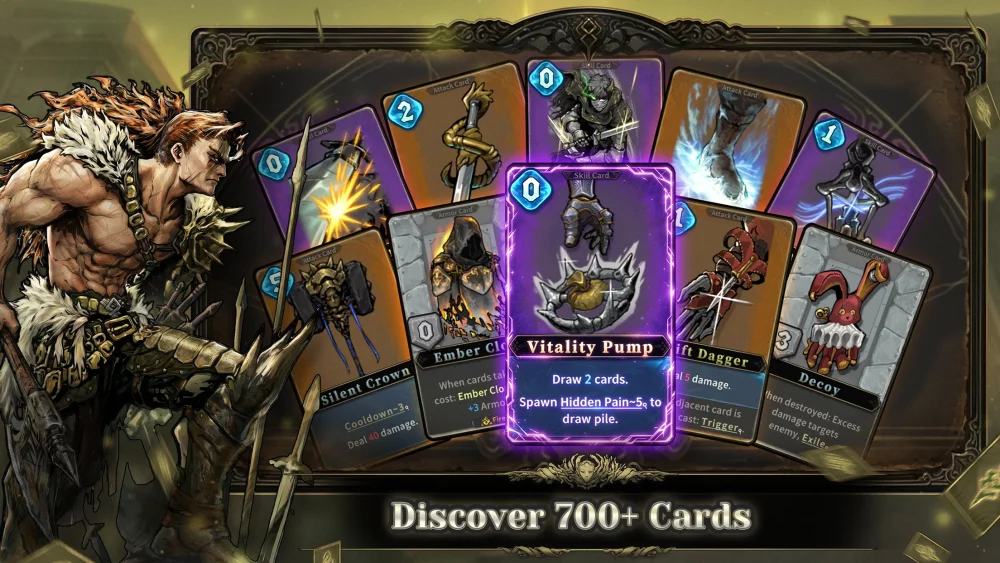
In the dark, punishing world of Abyssal Soul, raw power is a trap. Players who succeed are those who treat their deck as a living, breathing engine rather than a collection of high-damage cards. Because Abyssal Soul is a sequential roguelike card battle RPG, your ability to evaluate potential synergies on the fly is the single most important skill you will develop. This guide will walk you through the advanced tactics required to optimize your deck, manage combat flow, and navigate the treacherous map nodes of this medieval fantasy nightmare.
Understanding Core Roguelike Mechanics
The foundation of any successful run in Abyssal Soul is the acceptance of volatility. Unlike static RPGs, you cannot force a "perfect" deck every time. Instead, you must master the art of the pivot.
- Prioritize Versatility Early: During the first few nodes, avoid committing to a niche archetype. Focus on cards that offer baseline utility—shielding, card draw, or energy generation. These cards provide a safety net, allowing you to survive while the game reveals your potential build path.
- Map Navigation as Resource Management: Every node is a decision. If your health is low, a "Combat" node is not just an encounter; it is a liability. Prioritize "Rest" or "Event" nodes when your deck’s efficiency is flagging. A common beginner mistake is taking every combat encounter to farm experience; in Abyssal Soul, preserving HP is often more valuable than gaining a minor card reward that may clog your deck.
Developing Effective Card Synergies
A "solid" deck in Abyssal Soul is measured by its output-to-energy ratio. You aren't looking for the strongest card; you are looking for the card that makes your existing cards better.
- The Power of Scaling: Look for cards that interact with your play count. A card that deals 5 damage is mediocre, but a card that deals 5 damage and draws a card is a cornerstone of a high-tier deck. When you draft, look for "engine" pieces—cards that replace themselves or generate additional energy—before grabbing heavy hitters.
- Maintaining Cycle Speed: If your hand feels sluggish, you have too many "dead" cards. A lean deck of 15-20 high-synergy cards will almost always outperform a bloated deck of 40 cards. During every shop or event opportunity, prioritize removing your weakest starting cards. Pruning is just as vital to your success as drafting new, powerful cards.
Managing Combat Rhythm and Attack Patterns
Combat in Abyssal Soul is a dance. Every enemy possesses specific telegraphs that indicate their next move. If you are playing cards without checking the enemy’s intended action, you are playing the game on "hard mode" by choice.
- The Defensive Shift: If an enemy is telegraphing a massive strike, your entire turn should shift from aggression to mitigation. If you don't have the cards to fully negate the damage, look for ways to weaken the enemy or apply debuffs that reduce their output.
- Pacing Your Output: Some enemies are "pressure" bosses—they become exponentially more dangerous the longer the fight lasts. Against these, you must be aggressive, taking risks to burn them down. Others are reactive; they punish you for overextending. Identify the type of enemy early in the fight and adjust your tempo accordingly.
Identifying Trade-offs in Deckbuilding
Every choice in Abyssal Soul carries a hidden cost. When you add a powerful, high-energy card to your deck, you are effectively decreasing the frequency at which you can play your other cards.
- The Energy Tax: High-cost cards are tempting, but they create a bottleneck. If your deck relies on playing three or four cards per turn to trigger an effect, a 3-cost card might effectively "brick" your hand for an entire turn. Always calculate if the payoff of a card justifies its impact on your average turn efficiency.
- The Pruning Philosophy: As you progress into the mid-game, your starter cards—the ones that deal 3 or 4 damage—become dead weight. They occupy space in your hand that could be used by cards that synergize with your relics. Use every opportunity to remove these starter cards. A deck that draws only its best cards every single turn is an unstoppable force.
Utilizing Relics for Strategic Scaling
Relics are the force multipliers of Abyssal Soul. While cards provide the "how," relics provide the "why." A relic that grants bonus damage for every card played is useless if you don't have a high-draw, low-cost deck to support it.
- Build-Around Relics: Treat Tier-2 and Tier-3 relics as the "blueprint" for your late-game strategy. If you find a relic that rewards you for discarding cards, your draft priority should shift entirely toward cards that benefit from being discarded or cards that draw more than they cost.
- The Trap of Passive Bonuses: Not all relics are created equal. Some provide flat, boring bonuses that don't scale. If a relic doesn't fundamentally change how you approach combat or provide a significant mathematical advantage, it might not be worth the inventory slot. Be critical of your relics; they should be active partners in your strategy, not just ornaments.
Expert Strategies for High-Level Bosses
Boss encounters in Abyssal Soul test your ability to execute your deck’s win condition under pressure. By the time you reach a boss, you should have a clear understanding of your "kill turn."
- Preparation: Before the fight, look at the boss's primary mechanics. Does it heal? Does it stack armor? Does it have a turn limit?
- Resource Hoarding: Don't be afraid to hold onto a powerful combo piece for two or three turns if it means setting up a massive, fight-ending sequence.
- The "Kill Turn": Most bosses have a phase where they become increasingly dangerous. Your goal is to reach your peak synergy during that window. If you find yourself unable to reach this threshold, your deck is likely too unfocused.
By focusing on these principles—pruning the weak, prioritizing engine efficiency, respecting combat telegraphs, and building around your strongest relics—you will find that Abyssal Soul becomes a game of calculated precision rather than random chance. Master the rhythm, control your deck size, and the abyss will begin to yield to your strategy.

Free Abyssal Soul Codes
Current active codes and how to redeem them.

Michael Smith
Michael covers live-service games, events, reward systems, and efficient daily routines, turning frequent updates into clear actions for players.
COMMUNITY
Player Comments
121 players commented on this guide.
This guide answered the exact question I had.
The explanation is clear, especially for beginners.
I wish I had read this before upgrading the wrong thing.
This helped me understand base building much better.