
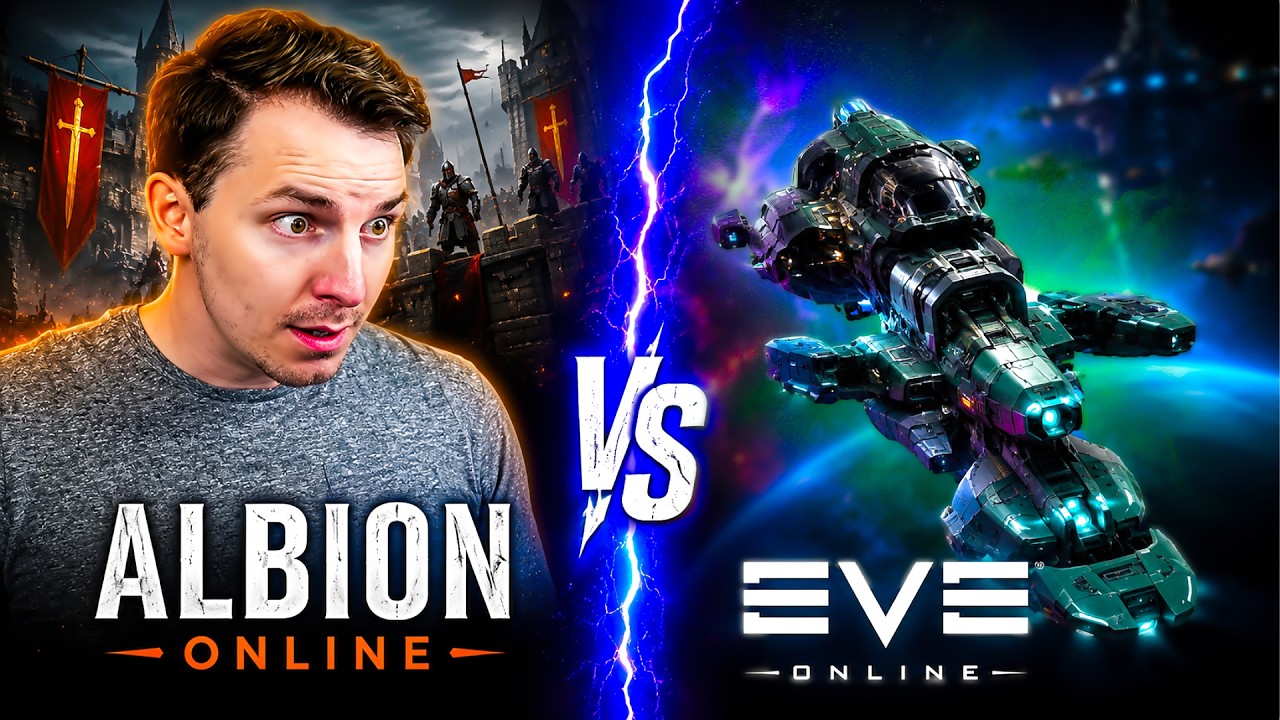
When comparing the landscape of modern sandbox MMORPGs, Albion Online and EVE Online frequently sit at the top of the conversation. Both titles are defined by "full-loot" mechanics, truly player-driven economies, and the potential for massive, player-led warfare. However, they provide these experiences through completely different lenses. If you are trying to decide where to invest your time, the choice comes down to whether you prefer the visceral, immediate thrill of fantasy skill-shots or the cold, calculated depth of interstellar logistics.
The Core Combat Experience: Twitch vs. Tactics
The most immediate difference you will encounter is how combat feels under your fingertips.
Albion Online utilizes a top-down, MOBA-inspired combat system. In this environment, your survival depends on your mechanical skill: positioning, timing your ability cooldowns, and landing skill-shots. Whether you are participating in a small-scale gank in the Black Zones or a massive 100v100 ZvZ (Zerg vs. Zerg) fight, your individual reflexes matter. You are the pilot of your character, and your ability to dodge an incoming area-of-effect spell or interrupt an enemy’s channeled ability is often the deciding factor in a fight.
EVE Online, conversely, treats combat as a strategic simulation. The combat interface is less about "twitch" reflexes and more about managing modules, tracking ranges, and aligning with fleet doctrines. You don't "aim" your guns in the traditional sense; you lock targets and manage your ship’s signature radius and angular velocity. Success here is determined by your knowledge of tactical math and your ability to follow the orders of a Fleet Commander (FC) who is orchestrating the movement of hundreds of ships across a massive grid.
Economic Agency and the Player-Driven Market
Both games feature economies where nearly every item—from the cheapest tier of armor to the most powerful ship or weapon—is crafted by players.
In Albion Online, the economy is highly localized and high-turnover. Because gear is destroyed upon death, there is a constant, massive demand for new equipment. This creates a "cycle of consumption" that keeps crafters busy and markets fluid. Your personal contribution to the economy is tangible; you can gather resources in a dangerous zone, refine them, and craft gear that will likely be destroyed by another player within a few days. The feedback loop is fast, allowing you to see the direct impact of your labor on the market in real-time.
EVE Online’s economy is a macro-scale industrial simulation. While the principle of player-driven production remains, the scale is vastly larger. A single ship can take weeks to build, involving thousands of sub-components and complex supply chains that span entire star systems. In EVE, economic warfare is a primary tool. Corporations can win wars without firing a single shot by choking off the supply of raw materials or bankrupting an enemy alliance through market manipulation. If you enjoy the idea of being a "space tycoon" or a master of logistics, EVE offers a level of complexity that is unrivaled in the genre.
Social Structure and Political Commitment
The social requirements of these games represent the most significant hurdle for new players.
Albion Online respects your time by allowing for a high degree of autonomy. While joining a guild provides access to territory and safer group content, the game’s design enables solo players and small groups (groups of 2–5) to have a meaningful impact. You can log on for an hour, go "roaming," find a fight, and log off without needing to check in with a massive political hierarchy.
EVE Online is built on the foundation of the "Corporation." Because of the game’s sheer scale and the time investment required to train skills (which happens passively over time), the game is explicitly designed to incentivize joining large-scale organizations. Engaging with the "true" end-game of EVE—sovereignty warfare, capital ship fleets, and massive political alliances—requires a long-term commitment. You are a cog in a massive machine; for many, this is the primary draw, but for players who value independence, it can feel restrictive.
Risk Management and the Psychology of Loss
Full-loot is the heartbeat of both titles, but the emotional weight of loss differs significantly.
In Albion Online, loss is a frequent, normalized event. Because combat is fast and gear is relatively easy to replace, you are encouraged to take risks. Losing a "set" (your armor and weapons) is often viewed as the "cost of doing business." This keeps the game’s pace brisk and prevents players from becoming too risk-averse, as the barrier to entry for a new set of gear is low.
EVE Online treats loss with the severity of a long-term investment. Losing a capital ship can be the result of months of saving and planning. Because the loss is so significant, the tension in EVE is often much higher. Every time you undock, there is a genuine risk of losing assets that represent weeks of your life. This creates a high-pressure environment that rewards those who are patient and cautious, but it can be devastating for players who are not prepared for the consequences of a failed operation.
Summary Comparison Table
| Feature | Albion Online | EVE Online |
|---|---|---|
| Combat Style | Mechanical, skill-based, fast | Tactical, strategic, methodical |
| Primary Risk | Gear loss, frequent skirmishes | Asset loss, long-term consequences |
| Social Depth | Flexible, small-group autonomy | Mandatory, deep, long-term alliances |
| Economy | Localized, high-turnover, direct | Macro, industrial, supply-chain heavy |
| Play Session | Short-to-medium duration | Long-term project management |
Making Your Decision
Ultimately, the decision between Albion Online and EVE Online depends on what you want from your gaming experience.
Choose Albion Online if you want a game that respects your time but offers the adrenaline of high-stakes, skill-based combat. It is the perfect choice for players who want to be able to jump in, find a fight, craft their own gear, and feel the immediate impact of their actions without needing to dedicate their lives to a massive corporate hierarchy.
Choose EVE Online if you are looking for a deep, challenging, and long-term sociological and economic simulation. If you find joy in spreadsheets, long-term strategic planning, and the thrill of being a small part of a massive, player-led space empire, there is no other game that can replicate the experience of EVE.
Both games are masterpieces of the sandbox genre, but they offer different types of freedom: Albion offers the freedom of the blade, while EVE offers the freedom of the boardroom and the shipyard.
Free Albion Online Codes
Current active codes and how to redeem them.

Sarah Williams
Sarah specializes in RPG and collection games, explaining team building, character growth, and beginner-friendly ways to avoid expensive early mistakes.
COMMUNITY
Player Comments
89 players commented on this guide.
The explanation is clear, especially for beginners.
This saved me time in the early game.
The tips are practical and easy to follow.
I wish I had read this before upgrading the wrong thing.