
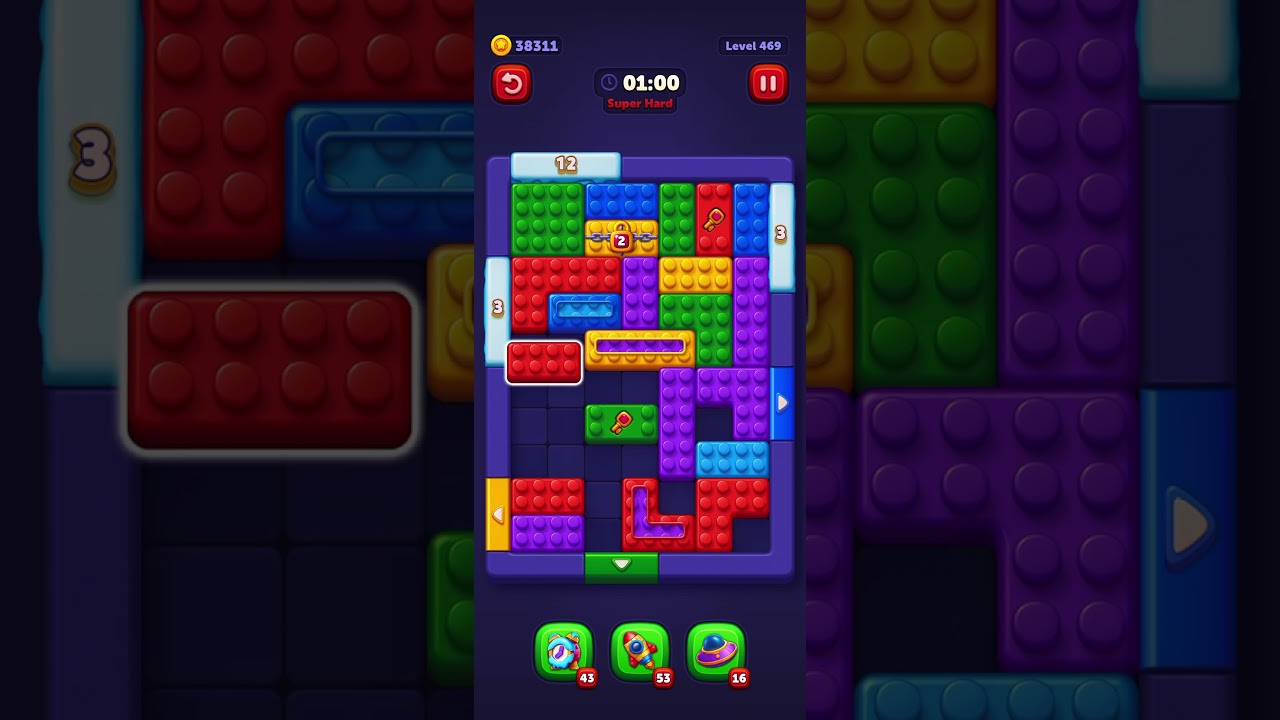
To solve Level 469 in Block Out, your immediate priority is clearing a single column entirely to serve as an open transfer lane. Do not spread single blocks into open spaces without an exit plan. Once you create a free lane, use it strictly as a temporary holding zone to extract buried colors and merge them into matching stacks until the board is clear.
Level 469 Layout and Obstacles
Level 469 restricts early movement with multi-colored columns and buried base pieces. Several colors are fragmented across separate lanes, often trapped beneath contrasting colors. Blindly shifting blocks to make partial matches on top will clog your upper slots, quickly leading to a deadlock.
| Board Factor | Tactical Problem | Required Action |
|---|---|---|
| Buried base blocks | Target colors are locked beneath unrelated layers | Avoid piling neutral blocks onto columns hiding needed colors |
| Tight starting headroom | Zero or minimal empty lanes limit transfer options | Focus early transfers on emptying the shallowest lane |
| Fragmented colors | Matching segments are split across multiple columns | Consolidate top pieces first to expose bottom layers |
Step 1: Open Your First Empty Column
Before touching any piece, survey the top layer across every lane to find the shallowest mixed column. A column containing only two distinct color segments can be emptied much faster than one split into three or four alternating layers.
- Locate two columns that already share an exposed matching color.
- Transfer matching surface blocks together to condense their footprint.
- Move the remaining top piece of your shallowest column onto its matching color elsewhere on the board to vacate the lane completely.
If the stage provides an open buffer slot at the start, do not fill it with an arbitrary piece. Use it strictly as a pass-through: drop a blocking segment into the buffer, move the newly exposed piece underneath to its matching stack, and immediately move the buffer block back out.
Step 2: Extract Buried Blocks and Consolidate Colors
Once you have one completely empty lane, shift your focus to consolidating colors from the bottom up.
- Commit to one color at a time: When assembling a color, aim to gather at least three connected units before switching focus. Leaving half-sorted columns with mixed pairs cuts down maneuvering space.
- Keep base foundations clear: If a column has the bottom base piece of a color you are building, do not place unrelated colors on top of it.
- Execute pass-through transfers: Use your empty column to temporarily hold blocking top blocks one at a time. Move the newly exposed base piece to its target stack, then retrieve the block from the empty lane.
Step 3: Prevent Buffer Deadlocks
Most failed attempts on Level 469 happen when open utility lanes are converted into dead storage. Maintain board mobility by following three placement rules:
- No parking without an exit: Never deposit a block into an empty lane unless you can clear it out on the very next move or complete the full stack immediately.
- Preserve max-stack capacity: Ensure at least one lane retains enough empty headroom to receive the largest continuous block segment currently on the board.
- Avoid unnecessary shifts: Do not transfer a block purely because a legal move exists. If the move does not uncover a buried piece or consolidate a target color, leave it in place.
Step 4: Final Clearance Sequence
Once two full color stacks are permanently completed, the board opens up significantly. You can now clear the remaining mixed columns through rotational swaps:
- Transfer the top segment of a mixed column into an open lane.
- Move the exposed bottom piece directly to its matching column.
- Return the transferred segment back into place or onto its own completed stack.
- Repeat this rotation one column at a time until the final two colors consolidate into their completed tubes.

Free Block Out Codes
Current active codes and how to redeem them.

Sarah Williams
Sarah specializes in RPG and collection games, explaining team building, character growth, and beginner-friendly ways to avoid expensive early mistakes.
COMMUNITY
Player Comments
134 players commented on this guide.
Can you add more details about strategy in a future update?
This helped me understand strategy much better.
I tried this today and it worked better than my old setup.
This saved me time in the early game.