
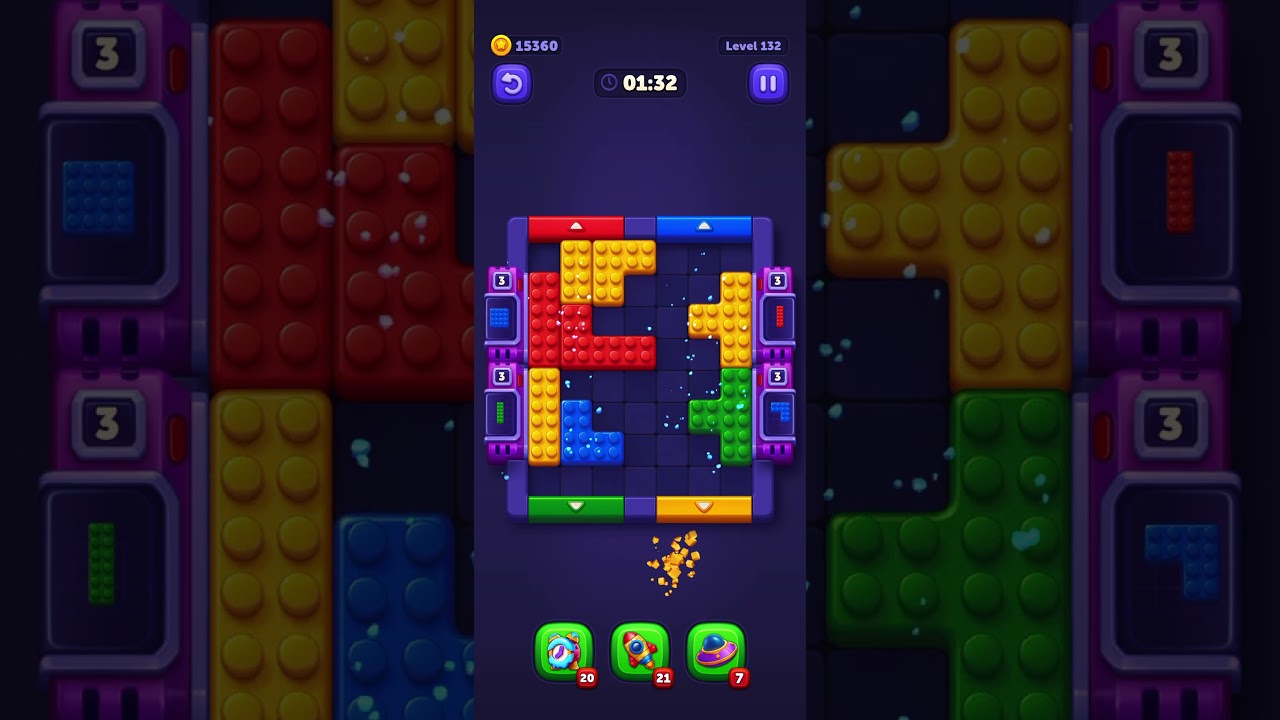
To beat Level 132 in Block Out, dismantle the outer perimeter blocks before attempting to touch the interior grid. Colored blocks move strictly along straight slide lines toward matching collection trays. Tapping blocked interior pieces will only divert mismatched tiles into your bottom holding dock, rapidly causing a game-ending deadlock. By clearing direct perimeter matches first and maintaining open dock capacity, you create the escape lanes needed to resolve the dense center.
Understanding the Level 132 Grid Bottleneck
Level 132 arranges colored blocks in a tight layout where outer border tiles block all movement vectors from the center. Horizontal and vertical paths cross in dense intersections, meaning that moving a block from an edge can leave adjacent perpendicular tiles trapped.
The central cluster contains high-density color groupings that cannot slide until external corridors open up. Tapping these trapped tiles early accomplishes nothing if their direct paths are obstructed or if the matching tray is not active. Treat the board as concentric layers: peel away the exterior boundary tiles first so interior pieces have unobstructed slide paths when their turn comes.
Clearing Outer Lanes in Order
Work from the outside inward to systematically open the board without filling your dock with loose tiles:
- Tap Direct Perimeter Matches: Scan the exposed outer edges for tiles that immediately match active collection trays. Clearing these removes them from the board instantly without using dock space.
- Remove Corner Anchors: Corner blocks lock the outer ring together. Once direct edge matches are cleared, tap corner anchor tiles that open secondary paths, even if they must temporarily occupy a dock slot.
- Open a Single Flank Corridor: Focus your clearing efforts on one side of the board rather than stripping all four edges equally. Opening one entire flank creates a clear exit route, allowing interior pieces from that half of the grid to reach trays easily.
Targeting an entire flank first gives you complete visibility into inner layers and prevents fragmented, unpredictable block movement.
Managing Dock Space to Prevent Deadlocks
The bottom dock serves as a temporary buffer when a tapped block has an open slide path but no active tray ready to accept it. Because dock capacity is limited, loading slots with mismatched colors will freeze your board. Maintain at least two empty slots to preserve maneuvering room.
| Dock Status | Open Slots | Required Action |
|---|---|---|
| Safe Buffer | 3 to 5 Slots | Clear anchor blocks to reveal buried paths and expose matching sets. |
| Restricted Buffer | 1 to 2 Slots | Stop moving off-colors; tap only tiles that match active trays or dock pieces. |
| Deadlock Risk | 0 Slots | Immediate failure risk; move only blocks that immediately complete a set. |
When your buffer drops to two or fewer empty slots, halt all exploratory moves. Focus strictly on blocks that match colors already sitting in the dock to free up space.
Resolving the Central Clusters
Once outer exit lanes are clear, clear the central clusters one color at a time:
- Target Single-Color Sweeps: Identify which color has the highest number of accessible pieces and focus solely on clearing that set. Completing one full color clears that tray, empties any matching pieces parked in the dock, and restores your buffer headroom.
- Check Path Dependencies: Before tapping an interior piece, look at the block directly behind it. Aim for moves that trigger chain reactions, where sending one tile forward allows the piece behind it to slide straight into an active tray.
- Maintain Board Balance: Level 132 features symmetrical obstacles on opposite sides. Avoid completely ignoring one half while clearing the other, as leaving an entire flank tightly packed can force difficult extractions near the end of the puzzle.
Free Block Out Codes
Current active codes and how to redeem them.

James Brown
James focuses on Android gaming on PC, emulator setup, controls, performance tuning, and practical troubleshooting for longer play sessions.
COMMUNITY
Player Comments
113 players commented on this guide.
I tried this today and it worked better than my old setup.
Good guide for Block Out players. The updates part was useful.
I wish I had read this before upgrading the wrong thing.
This helped me understand updates much better.