
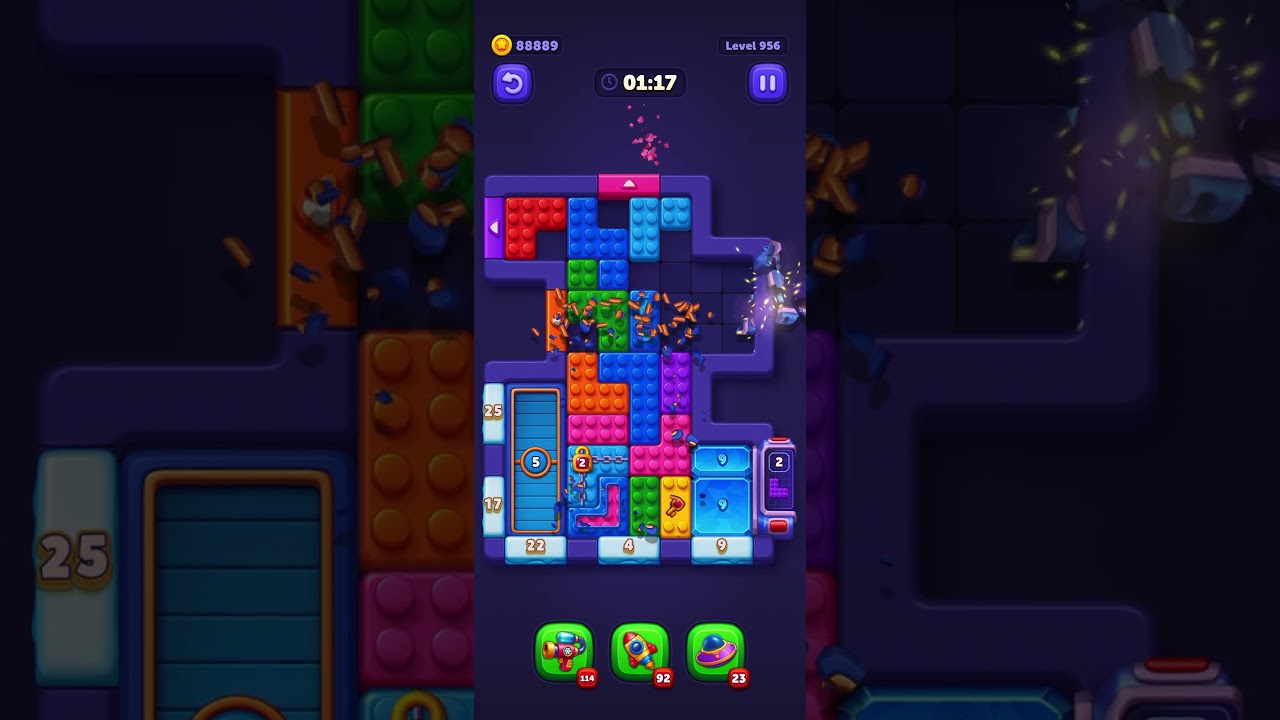
To beat Level 956 in Block Out, immediately identify and empty the shallowest multi-color column on the board to create an open transit tube. Level 956 constrains your opening options with split color layers trapped beneath opposing blocks. Clearing one column early gives you the buffer space needed to shuffle top obstructions, expose buried base colors, and assemble uniform stacks without freezing the board.
Opening Priorities: Creating Your First Buffer Column
Your opening four to six moves decide whether the board remains workable. Before moving any blocks, scan every column to locate tubes containing only two distinct color layers where the top segment can immediately merge into an existing match. Transferring these exposed blocks onto matching stacks removes them from the source column without taking up empty buffer slots.
Follow this move hierarchy during the opening setup:
| Move Priority | Target Action | Purpose |
|---|---|---|
| Priority 1 | Match exposed top blocks onto existing stacks | Consolidates colors without consuming empty slots |
| Priority 2 | Empty the shallowest two-tone column | Creates a free transit column for shuffling |
| Priority 3 | Reveal covered secondary colors | Uncovers buried blocks required for base matches |
| Priority 4 | Consolidate split pairs across columns | Minimizes the total number of mixed-color tubes |
Once you empty your first tube, treat it strictly as a temporary transit lane. Never park an isolated block in that space unless your immediate next moves will clear it back out.
Mid-Stage Strategy: Uncovering Buried Colors
After establishing an open column, shift your focus to excavating deeply buried blocks. Level 956 features several columns where target base colors sit beneath two or three mismatched layers.
Work through buried layers with the following steps:
- Move the top obstructing block into your empty transit column.
- Transfer the second obstruction onto an identical color stack elsewhere on the board.
- Move the exposed target block directly to its matching base cluster.
- Move the temporary block out of the transit column to reset your buffer space.
Focus on completing one color family at a time rather than shifting multiple colors simultaneously. Gathering all accessible units of a single color, such as green or red, prevents half-filled columns from clogging the upper row. Do not drop non-matching blocks onto secondary columns if the underlying blocks in those receiving columns are needed for near-term moves.
Sealing Stacks and Avoiding Deadlocks
A tube is permanently completed when it holds four units of a single color. While finishing a stack frees up mental overhead, sealing a tube too early can remove a valid landing space. Only drop the final piece into a four-block stack when all remaining units of that color are accounted for, or when closing the tube does not trap other colors across the board.
Watch out for these common failure points on Level 956:
- Filling the lone open tube: Storing an uncommitted block in your only empty slot eliminates your ability to cycle pieces, resulting in a game-ending stall.
- Building checkerboard columns: Alternating two colors repeatedly in the same column makes sorting impossible without multiple empty tubes. Always consolidate matching pieces onto matching pieces.
- Making idle moves: Moving a block simply because a slot is available wastes positioning. Every transfer must expose a covered block, consolidate an existing stack, or work toward emptying a column.
Once the board is reduced to three or four active colors, use your open transit lanes to swap remaining split pairs until every active column contains only one uniform color.
Free Block Out Codes
Current active codes and how to redeem them.

Michael Smith
Michael covers live-service games, events, reward systems, and efficient daily routines, turning frequent updates into clear actions for players.
COMMUNITY
Player Comments
55 players commented on this guide.
The tips are practical and easy to follow.
I wish I had read this before upgrading the wrong thing.
This saved me time in the early game.
I tried this today and it worked better than my old setup.