
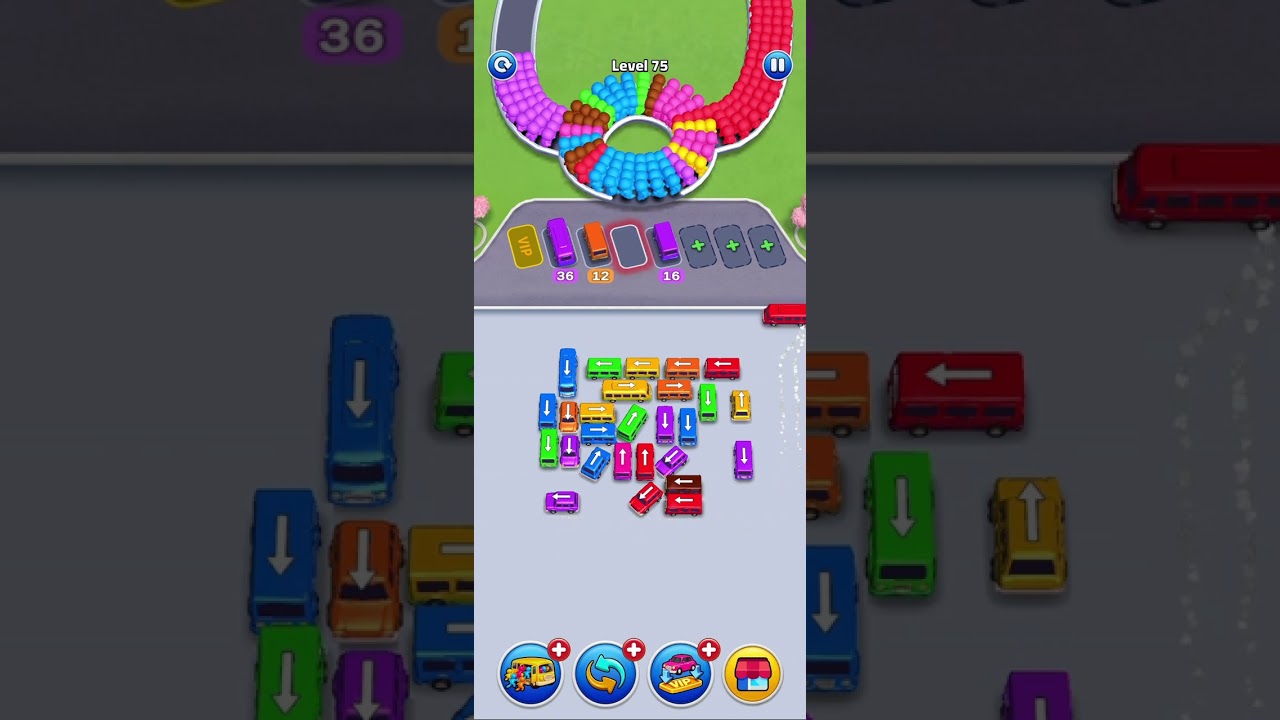
Level 75 in Bus Traffic Fever! is widely considered one of the game's most notorious "skill check" stages. It forces players to navigate high-density parking congestion without the luxury of boosters, shuffles, or power-ups. To beat this level, you cannot rely on luck; you must adopt a disciplined, analytical approach to board management. The key to victory lies in prioritizing central lane clearance, maintaining strict color segregation, and anticipating the incoming bus flow before the grid reaches a critical state.
Understanding the Level 75 Mechanic
Level 75 introduces a complex grid where the primary challenge isn't just the number of colors, but the physical arrangement of the buses. You are presented with a board that quickly becomes "choked" if you make reactionary moves rather than strategic ones. Without boosters to clear rows or shuffle the deck, every single tap must contribute to creating an opening.
The level’s difficulty stems from its "overcrowding" threshold. If you fail to keep lanes moving, the board fills up, and the game ends prematurely. To win, you must shift your mindset from "finding any match" to "finding the match that opens the most potential for future movement."
Prioritize Clearing Central Obstructions First
The most common mistake players make on Level 75 is clearing buses from the edges too early. The central lanes in this level act as the "arteries" of the board. If these are clogged, you lose the ability to move buses between different sections of the grid, effectively sealing your fate.
- Target the Center: Focus your first 3–5 moves entirely on the buses blocking the middle lanes.
- Create Corridors: By clearing the center, you create a "pathway" that allows you to move buses across the board, providing you with more options to group colors that were previously unreachable.
- Avoid Peripheral Traps: While it is tempting to clear a simple match on the far left or right, doing so often leaves the center congested, which makes it impossible to resolve the complex color clusters waiting in the middle.
Sequencing Moves for Maximum Color Efficiency
In Bus Traffic Fever!, efficiency is measured by how much board space you reclaim per move. Level 75 requires you to prioritize matches that unlock the most space.
When you have multiple match options, use this decision-making hierarchy:
- The "Unlocker" Match: Choose the match that clears a bus currently blocking a lane with multiple buses of another single color.
- The "Lane-Clearer" Match: Choose the match that completely empties a lane, giving you a "blank slate" to hold a new color.
- The "Reactive" Match: Only choose a match that simply removes buses from the board if it doesn't improve your board state or unlock a new lane.
By consistently choosing matches that create space rather than just removing colors, you keep the "overcrowding" mechanic at bay, even when the incoming buses are unfavorable.
Managing Board Density and Capacity
Level 75 punishes "cluttered" play. If your lanes are filled with mixed colors, you are essentially one bad draw away from a game over. You must practice active color segregation.
- Dedicate Lanes: Attempt to keep specific lanes reserved for specific colors. If a lane starts with a Blue bus, try to clear all other colors from that lane so that it becomes a "Blue-only" zone.
- Anticipate the Queue: The sidebar in Bus Traffic Fever! is your most important tool. It shows you the next three buses entering the grid. If you see a Red bus coming, ensure you have a lane with space for it. If you don't, prioritize clearing a Red match immediately to open a slot.
- The "One-In, One-Out" Rule: Never move a bus into an empty lane unless it is part of a sequence that will eventually clear that lane. Keeping lanes empty is a resource; use it to store buses you can't match yet, but don't waste it on buses that don't belong there.
Recognizing Patterns in Bus Flow
Level 75 is not procedurally generated in a way that is completely random; it follows a rhythm. The buses enter in waves, often grouped by color. If you watch the flow for a few attempts, you will notice that the game provides "bursts" of specific colors.
Tactical Tips for Success:
- Don't Rush: Level 75 is a puzzle, not a speed-run. Take five seconds to look at the entire board before every tap.
- Identify the "Dead" Bus: Look for the bus at the front of a lane that is blocking everything else. That is your primary target. If you can't move it, you must move other buses to create a space where that "dead" bus can be shifted.
- Save the Edges: Use the far-left and far-right lanes as "staging areas." If you have a bus that doesn't have a match, place it in a corner where it won't block the central flow.
Common Mistakes to Avoid
Even with a good strategy, players often lose Level 75 due to small, preventable errors:
- Ignoring the Sidebar: Players often focus only on the board and get surprised by a wave of buses they weren't prepared for. Always check the queue before making a move.
- The "Quick-Match" Temptation: Taking a match just because it's available. If that match creates a worse board state (e.g., leaving a lone, unmatchable bus deep in a lane), it is a bad move.
- Over-filling: If you have four or five lanes that are all half-full with different colors, you are in a "soft-lock" state. You must focus on clearing one lane completely before moving on to the next, even if it means ignoring other matches for a turn or two.
Conclusion: Patience is the Ultimate Booster
Beating Level 75 in Bus Traffic Fever! without boosters is entirely possible if you treat the board like a logistical puzzle. By focusing on central clearance, maintaining color-specific lanes, and utilizing the preview queue to plan your moves, you eliminate the randomness that usually causes a failure. Remember: every tap should serve a long-term goal of freeing up capacity. If you keep the board clean and the lanes segregated, you will clear Level 75 with ease.

Free Bus Traffic Fever! Codes
Current active codes and how to redeem them.

Sarah Williams
Sarah specializes in RPG and collection games, explaining team building, character growth, and beginner-friendly ways to avoid expensive early mistakes.
COMMUNITY
Player Comments
136 players commented on this guide.
The explanation is clear, especially for beginners.
Good guide for Bus Traffic Fever! players. The strategy part was useful.
Can you add more details about strategy in a future update?
Nice guide. I am checking the other Bus Traffic Fever! articles next.