
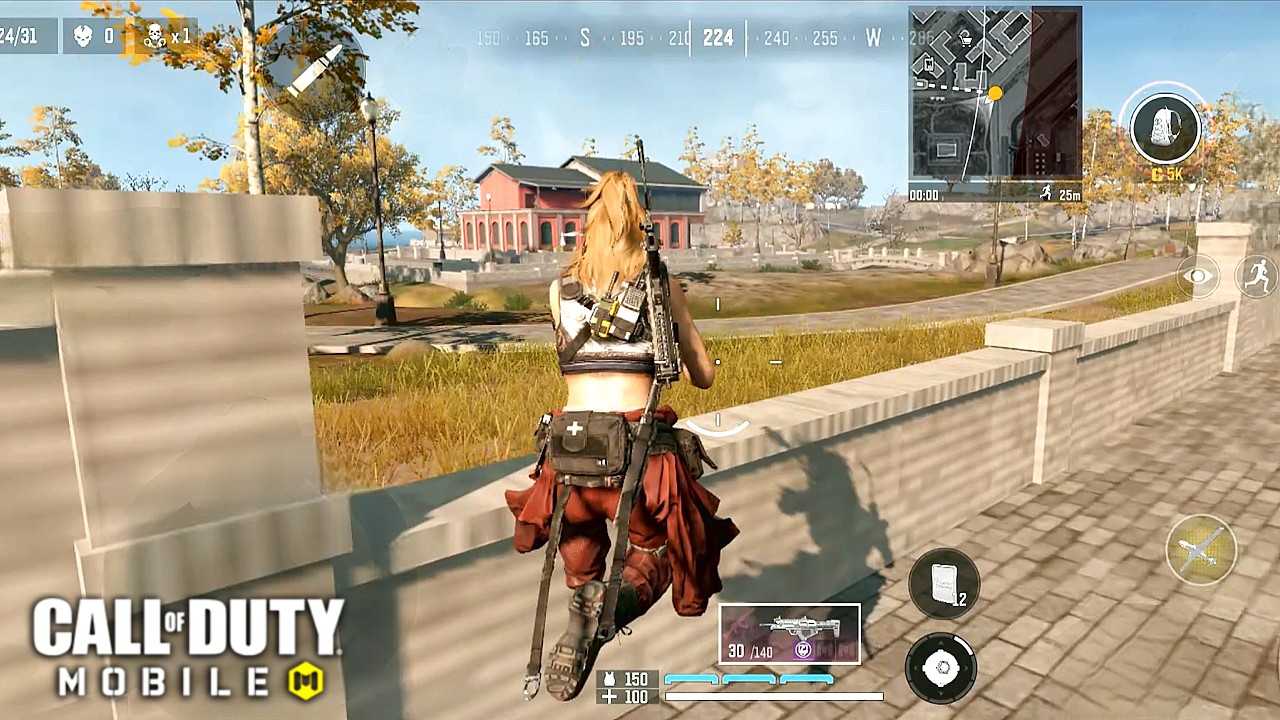
To master third-person perspective (TPP) movement across Verdansk in Call of Duty®: Mobile, combine camera peeking behind cover with chained slide-cancels and disciplined rotations along low-exposure terrain. Verdansk features wide-open sightlines and extreme verticality. Controlling your camera offset and travel velocity before engaging enemies determines whether you survive open-field crossings and dense urban ambushes.
Scouting Angles with the Third-Person Camera
The TPP camera rests offset behind your operator's shoulder, granting visual coverage around corners and over waist-high obstacles without exposing your hitbox.
- Hug interior walls: When clearing rooms or alleyways, stay flat against the inner barrier and angle the free-look camera outward. This reveals enemy paths and positions while keeping your character completely concealed.
- Pre-aim before stepping out: While hidden behind a doorframe or wall, center the third-person reticle directly over the enemy's expected position. When you step out and aim down sights (ADS), your weapon aligns instantly with the target, eliminating mid-fight aim corrections.
- Avoid holding static angles: Opponents have the exact same camera advantages. Holding a fixed angle behind obvious cover invites pre-fired swings, so shift your position slightly between peeks to disrupt enemy crosshair placement.
Chaining Slide-Cancels and Directional Mantles
Continuous slide-canceling resets your tactical sprint velocity and constantly shifts your head level, which disrupts enemy sniper tracking and crosshair alignment.
To execute a slide-cancel:
- Sprint forward to reach maximum speed.
- Tap the crouch button to initiate a slide.
- Immediately tap jump or sprint to break the slide animation before the deceleration curve begins.
- Repeat the cycle in rhythm, pacing inputs deliberately to avoid movement fatigue, which shortens your slide and momentarily locks your operator in a slow crouch.
When approaching obstacles like low fences, vehicle hoods, or concrete barriers, approach at a slight angle rather than head-on. Triggering a mantle while maintaining forward velocity vaults your operator cleanly over the barrier. This keeps your weapon ready and prevents the slow, holstered climbing animation caused by jumping straight into tall structures.
| Movement Technique | Optimal Context | Primary Tactical Advantage | Mechanical Risk / Trade-Off |
|---|---|---|---|
| Slide-Canceling | Open streets and clearings | Resets sprint speed and lowers hitbox profile | Mistimed inputs trigger slide fatigue |
| Jump-Peeking | Low perimeter walls and crates | Grants aerial line of sight while moving | Creates a predictable airborne trajectory |
| Directional Mantle | Fences and vehicle hoods | Rapid obstacle clearance without halting | Straight-on jumps trigger holstered climbs |
| Zig-Zag Sprinting | Open fields lacking hard cover | Throws off long-range sniper lead time | Slightly increases overall travel time |
Navigating Urban Chokepoints in Downtown and Stadium
Downtown and Stadium feature heavy verticality, where entrenched rooftop squads hold firing angles over ground streets.
When navigating Downtown, avoid central avenues. Route your movement through interior shopping corridors, covered colonnades, and narrow alleys. Running close to building facades forces elevated snipers into steep, awkward angles where rooftop ledges partially obscure their view. When ascending stairwells or exterior zip lines, tilt the third-person camera upward before stepping onto each landing to spot trip mines or shotgun users holding pre-aim angles.
In Stadium, avoid cutting across the central playing field, which acts as a lethal crossfire trap. Instead, rotate through outer concourses and lower loading bays to retain physical cover while repositioning.
Traversing Open Areas and Endgame Zones
Crossing barren sectors like Farmland or Airport runways requires micro-terrain navigation rather than straight-line sprinting.
- Use natural terrain dips: Hug bomb craters, shallow drainage ditches, ridgelines, and scattered hay bales to break enemy sightlines across open expanses.
- Manage vehicle signatures: Trucks and off-road vehicles provide rapid early-game transit from distant drops. However, their engine audio alerts nearby squads to your exact approach. Abandon vehicles several hundred meters before reaching contested points of interest or final zone borders, and cover the remaining distance on foot using smoke canisters.
- Practice zone-edge pacing: During late-game circle collapses, avoid cutting straight into the center where multiple teams can pin you down. Move along the narrow side of the circle near the gas boundary, where the safe zone contracts at its slowest rate.
- Hold perimeter high ground: Push for elevated rocky bluffs and hillsides along the northern sectors of the map. Using the third-person camera from elevated perches allows you to spot targets pinned behind low ground cover without exposing your operator, letting you gatekeep incoming rotations effectively.

Free Call of Duty®: Mobile Codes
Current active codes and how to redeem them.

Emily Johnson
Emily writes practical mobile strategy guides with a focus on resource planning, base progression, and the early decisions that shape a long-term account.
COMMUNITY
Player Comments
32 players commented on this guide.
The tips are practical and easy to follow.
This guide answered the exact question I had.
I wish I had read this before upgrading the wrong thing.
I tried this today and it worked better than my old setup.