
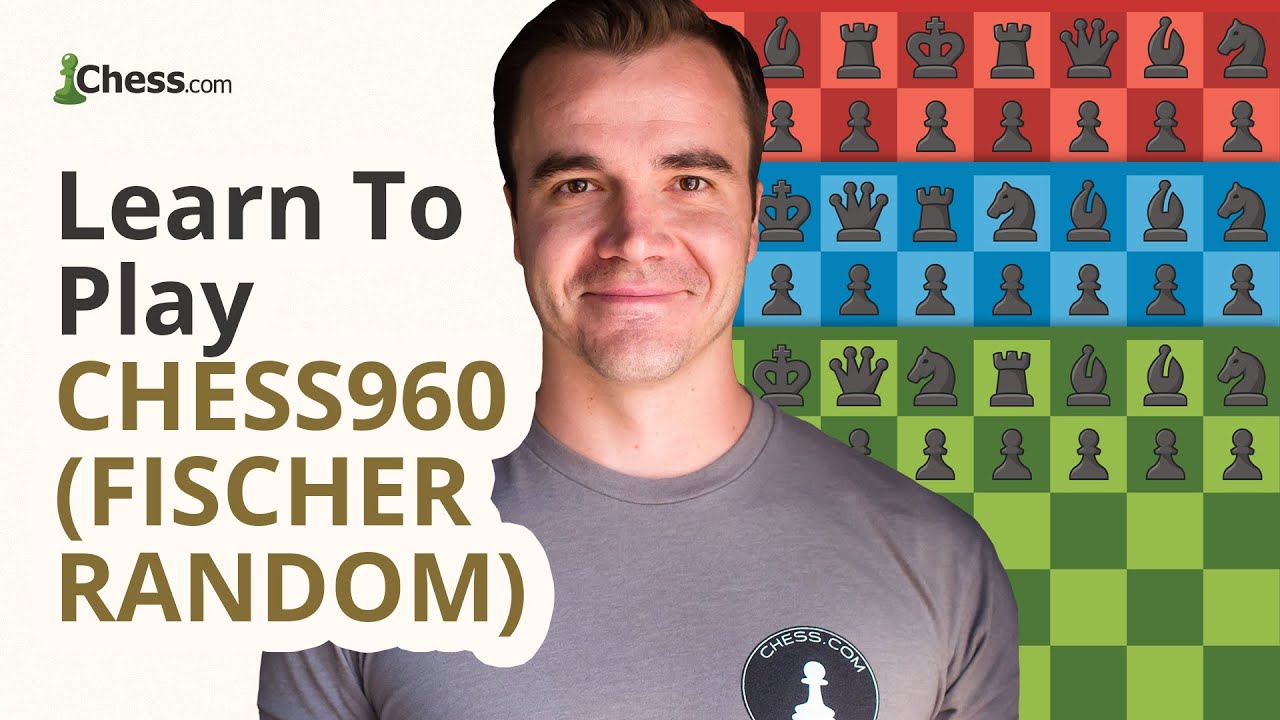
In Chess.com - Play and Learn, Chess960 (also known as Fischer Random Chess) randomizes the back-rank pieces while retaining traditional pawn structures, opposite-colored bishops, and a king positioned between two rooks. Regardless of starting squares, castling always moves the king and rook to the exact same destination squares used in standard chess: g1 and f1 for White kingside, c1 and d1 for White queenside, g8 and f8 for Black kingside, and c8 and d8 for Black queenside.
Chess960 Board Setup Constraints
Chess960 generates one of 960 starting positions by shuffling pieces across the first and eighth ranks. Every legal setup follows four fixed conditions:
- Opposite-Colored Bishops: Each player receives one light-squared bishop and one dark-squared bishop.
- King Between Rooks: The king always begins on a file between the two rooks, preserving the ability to castle to both sides.
- Symmetrical Layout: Black's pieces mirror White's pieces on the same files along the eighth rank.
- Standard Pawn Placement: All sixteen pawns start on the second and seventh ranks, matching traditional chess.
Universal Castling Squares
Because the king starts between both rooks, castling is classified by the rook used: kingside castling uses the rightmost rook (from White's perspective), while queenside castling uses the leftmost rook.
| Castle Type | Side | King Start | Rook Start | King Destination | Rook Destination |
|---|---|---|---|---|---|
| Kingside (O-O) | White | Between rooks | Rightmost rook | g1 | f1 |
| Queenside (O-O-O) | White | Between rooks | Leftmost rook | c1 | d1 |
| Kingside (O-O) | Black | Between rooks | Rightmost rook | g8 | f8 |
| Queenside (O-O-O) | Black | Between rooks | Leftmost rook | c8 | d8 |
Depending on starting positions, pieces may move across several files or remain in place:
- If White's king starts on g1 and the kingside rook starts on h1, castling shifts the rook to f1 while the king stays on g1.
- If White's rook starts on f1 and the king starts on e1, castling shifts the king to g1 while the rook remains on f1.
- Even if one piece does not physically change squares, the action counts as a castling move and permanently uses that castling right.
Legal Castling Requirements and Transit Clearance
To legally castle in Chess960, the corridor between the starting squares and ending squares must be completely open:
- Clearance of All Transit Squares: Every square between the king's start and destination squares must be vacant. Every square between the rook's start and destination squares must also be vacant.
- Unmoved Pieces: Neither the king nor the participating rook may have moved previously in the match.
- No Check on King's Path: The king cannot be in check, cannot pass through any square attacked by an enemy piece, and cannot land on an attacked square.
Squares crossed exclusively by the rook can be attacked by enemy pieces without preventing castling. The king and the participating rook do not obstruct each other during the execution of the move.
How to Execute Castling on Chess.com
On the Chess.com - Play and Learn platform, players can input castling in two ways:
- Drag King to Rook: Click and drag the king directly onto the participating rook. This is the most reliable input method across all starting configurations, especially in fast time controls.
- Drop on Destination Square: Move the king directly to its legal destination square (g1/c1 for White, g8/c8 for Black).
Verify that all intervening minor and major pieces have vacated the target destination files (c, d, f, and g) before attempting the input to prevent accidental standard king moves.
Opening Tactical Priorities
Randomized starting positions alter natural piece protections on move one:
- Inspect Corner and Central Pawns: Check the a-, b-, g-, and h-pawns immediately. Unlike classical chess, where only f2 and f7 lack starting defenders, Chess960 setups frequently leave edge pawns completely unprotected.
- Identify Long Diagonal Threats: Look for bishops starting on corner squares (a1, h1, a8, h8). Unobstructed bishops can target undefended pawns on the first move.
- Clear Destination Files: Prioritize developing the minor pieces occupying the c-, d-, f-, and g-files to secure castling lanes early and protect your king.

Free Chess.com - Play and Learn Codes
Current active codes and how to redeem them.

Emily Johnson
Emily writes practical mobile strategy guides with a focus on resource planning, base progression, and the early decisions that shape a long-term account.
COMMUNITY
Player Comments
97 players commented on this guide.
The explanation is clear, especially for beginners.
I wish I had read this before upgrading the wrong thing.
Good guide for Chess.com - Play and Learn players. The strategy part was useful.
This saved me time in the early game.