
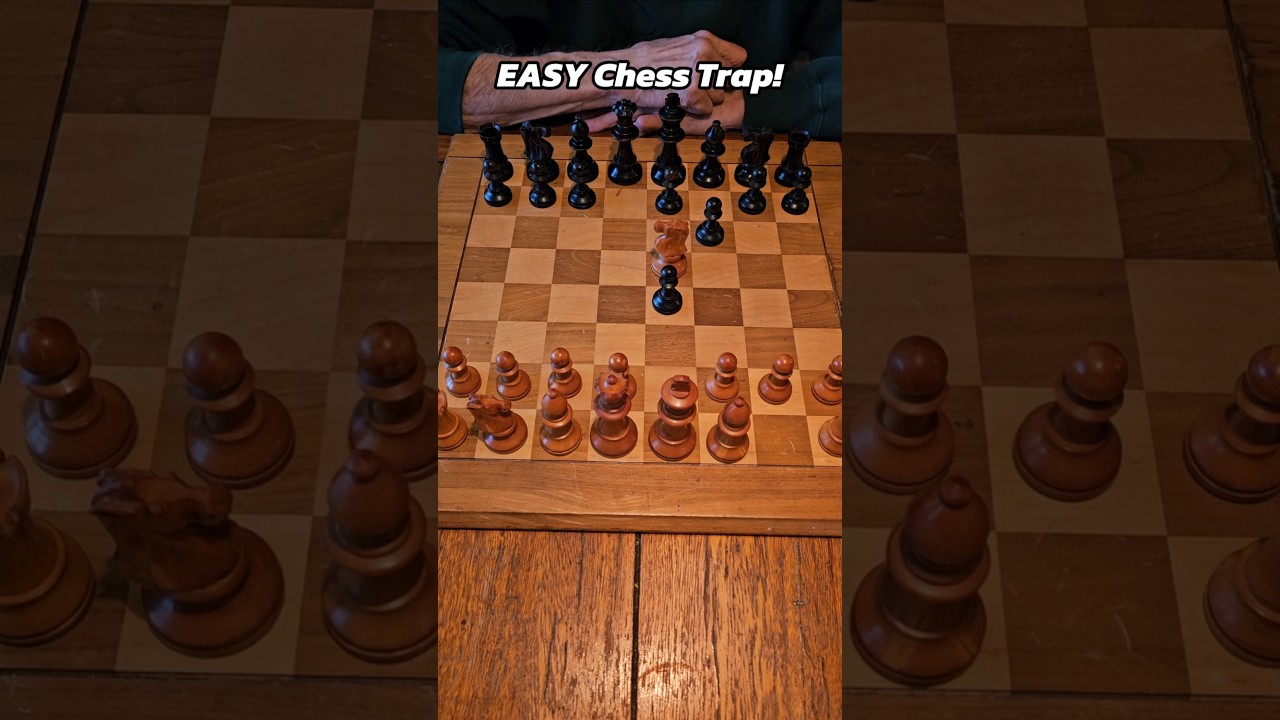
To play the Blackburne Shilling Trap as Black in Chess.com - Play and Learn, bait White's knight away from the center during the Italian Game by offering an unprotected pawn on e5 with 3... Nd4. When White takes the bait with 4. Nxe5, immediately counterattack with 4... Qg5. If White continues aggressively by playing 5. Nxf7, respond with 5... Qxg2 to force a smothered checkmate or win decisive material by move seven.
The Opening Setup and Bait
The trap begins from the standard Open Game when White develops toward the Italian Game. Black breaks traditional opening principles by moving the queen's knight twice:
- 1. e4 e5
- 2. Nf3 Nc6
- 3. Bc4 Nd4
Moving the knight to d4 leaves the pawn on e5 completely undefended. In live online matchmaking, opponents frequently assume Black made an amateur blunder and take the central pawn with 4. Nxe5.
The Main Checkmate Line
Once White takes on e5, Black seizes the initiative by targeting both the knight on e5 and the pawn on g2.
4. Nxe5 Qg5!
5. Nxf7 Qxg2
6. Rf1 Qxe4+
7. Be2 Nf3#| Move | Black Move | White Response | Board State |
|---|---|---|---|
| Move 4 | 4... Qg5 | 4. Nxe5 | Black double-attacks the knight on e5 and the g2 pawn. |
| Move 5 | 5... Qxg2 | 5. Nxf7 | White forks the queen and rook; Black attacks White's h1 rook. |
| Move 6 | 6... Qxe4+ | 6. Rf1 | White saves the rook; Black checks the king on the open e-file. |
| Move 7 | 7... Nf3# | 7. Be2 | Black checkmates because the e2 bishop is pinned to the king. |
Because White's bishop on e2 cannot move without exposing the king to the black queen, the knight delivery on f3 results in a smothered checkmate.
Responding to White's Alternate Defenses
Alert opponents may avoid the checkmate on move 5 or move 7. Black must adapt based on White's specific response.
If White Sacrifices the Queen on Move 7 (7. Qe2)
If White spots the smothered mate threat after 6... Qxe4+, they may play 7. Qe2 to block the check and cover f3:
- Play 7... Nxe2 to capture White's queen.
- After White recaptures with 8. Bxe2, play 8... Kxf7 to take the stranded knight.
- Consolidate your material lead (a queen and a pawn) by developing with d6, Be6, and Nf6.
If White Checks First on Move 5 (5. Bxf7+)
Cautious players may decline the knight fork on f7 and instead check with their bishop:
- Play 5... Ke7!. Do not worry about losing castling rights, as White's minor pieces are overextended.
- If White castles with 6. O-O, play 6... Qxe5 to win the hanging knight.
- If White retreats the bishop to safety, play 6... Qxg2, trapping the h1 rook and continuing the attack.
What to Do When White Refutes the Bait (4. Nxd4)
Higher-rated players will often decline the trap entirely on move 4 by trading minor pieces:
- 4. Nxd4 exd4 5. O-O
When White plays 4. Nxd4, the tactical trap is deactivated, leaving Black with a doubled pawn on d4. Transition immediately to standard positional play:
- Develop the dark-squared bishop to Bc5 to contest the center.
- Solidify your pawn structure with d6 and prepare Nf6 for kingside castling.
- Use the d4 pawn as an outpost wedge to deny White's queen's knight its preferred c3 square.

Free Chess.com - Play and Learn Codes
Current active codes and how to redeem them.

Sarah Williams
Sarah specializes in RPG and collection games, explaining team building, character growth, and beginner-friendly ways to avoid expensive early mistakes.
COMMUNITY
Player Comments
86 players commented on this guide.
Good guide for Chess.com - Play and Learn players. The strategy part was useful.
Nice guide. I am checking the other Chess.com - Play and Learn articles next.
I wish I had read this before upgrading the wrong thing.
Can you add more details about strategy in a future update?