
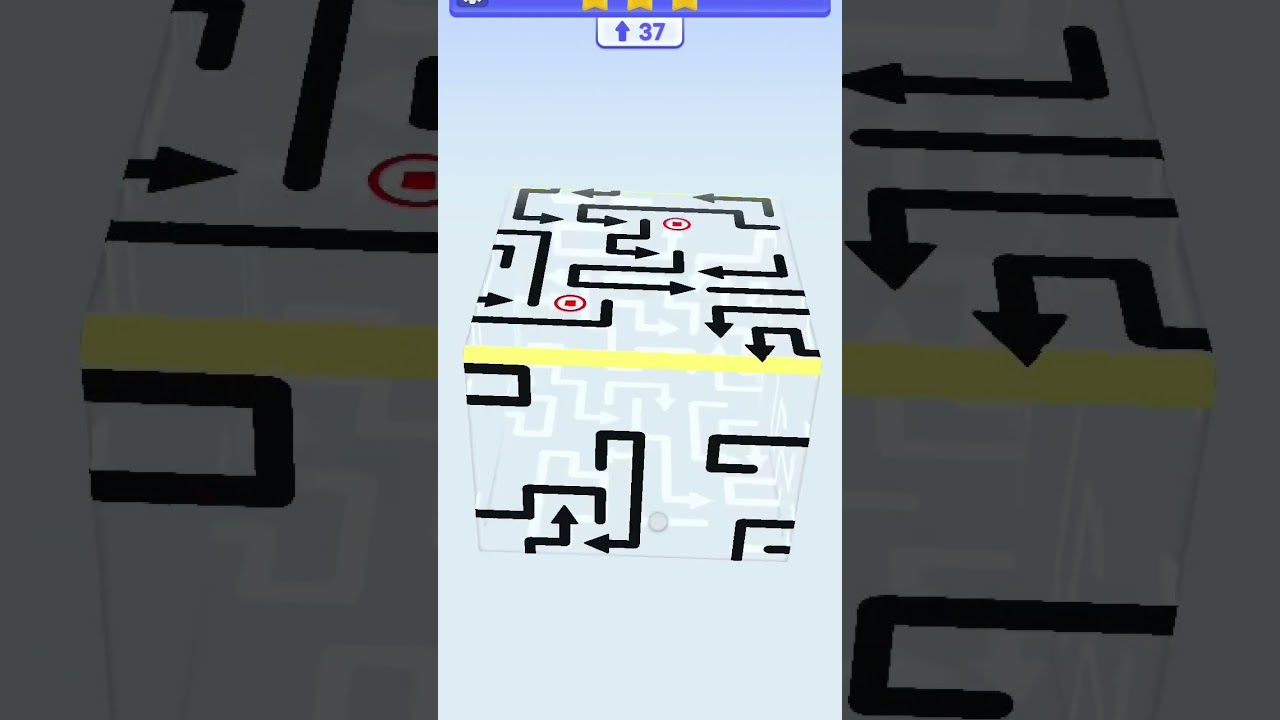
To clear Level 213 in CubeAway, dismantle unobstructed outer arrow blocks before tapping any pieces in the central core. Blocks only exit if their forward path is completely empty; tapping an arrow that points directly into another cube causes it to vibrate in place and stay locked. Stripping away the exterior shell layer by layer opens flight paths for internal cubes and prevents deadlocks.
Outer-to-Inner Clearing Sequence
Level 213 packs cubes tightly across staggered elevations and opposing faces. Tapping visible interior blocks too early wastes moves because their exit lanes are obstructed by outer layers.
Work through the cluster using this sequence:
- Remove outward-facing corners: Outer corners have three exposed faces and the highest probability of an unobstructed exit. Clear all corner blocks that point away from the structure into empty space.
- Peel the perimeter edges: Once the corners are gone, inspect the perimeter ridges. Tap edge blocks that point perpendicular to the face of the cluster.
- Clear open face centers: Check center blocks on each flat surface. Tap them only if their entire trajectory lane is empty.
- Dismantle the core: With the outer shell removed, start resolving the remaining internal blocks.
| Block Position | Clearance Priority | Obstacle and Risk |
|---|---|---|
| Outer Corners | Immediate (Priority 1) | Trajectory clipped by an extended wing piece. |
| Perimeter Edges | High (Priority 2) | Arrow pointing inward across the cluster rather than outward. |
| Face Centers | Moderate (Priority 3) | Arrow pointing directly into internal core cubes. |
| Internal Core | Deferred (Priority 4) | High deadlock risk; blocked on multiple sides until the shell is gone. |
Rotational Checks for Blocked Paths
Perspective distortion in 3D space can make a blocked arrow appear unobstructed. Always inspect trajectories from multiple angles before tapping.
- 360-degree horizontal rotation: Rotate the puzzle slowly in horizontal increments. If an arrow points toward the screen or parallel to your view, rotate the cluster 90 degrees to confirm that a protruding piece does not block its flight path.
- Vertical tilt: Tilt the cluster up and down to check stepped tiers. Recessed blocks often appear clear from a direct side view but remain blocked by overhanging upper layers.
Resolving Core Interlocking Dependencies
After removing the outer layers, the core contains blocks that depend on each other's removal. To unlock these paths without causing failed taps, trace dependencies backward:
- Locate an internal block that has only one obstruction in front of it.
- Identify the specific cube blocking that exit route.
- Check whether the blocking cube has an open path or points into a third block.
- Continue along this line until you find the free "keystone" block.
- Tap the keystone to remove it, which frees the rest of the chain in sequence.
Common Mistakes to Avoid
- Tapping based on cube exposure: An exposed block cannot move if its arrow points inward. Base every tap on arrow direction rather than how much of the cube's face is visible.
- Ignoring structural symmetry: Level 213 features complementary geometry on opposing sides. Clearing an opening on the front-right section usually signals a matching sequence on the rear-left.
- Losing your visual anchor: Spinning the puzzle rapidly makes it easy to lose track of cleared faces. Pick a distinct architectural feature, such as an asymmetrical protrusion or a specific color cluster, to keep your orientation consistent.
Free CubeAway Codes
Current active codes and how to redeem them.

Emily Johnson
Emily writes practical mobile strategy guides with a focus on resource planning, base progression, and the early decisions that shape a long-term account.
COMMUNITY
Player Comments
97 players commented on this guide.
This guide answered the exact question I had.
The explanation is clear, especially for beginners.
Can you add more details about strategy in a future update?
Nice guide. I am checking the other CubeAway articles next.