
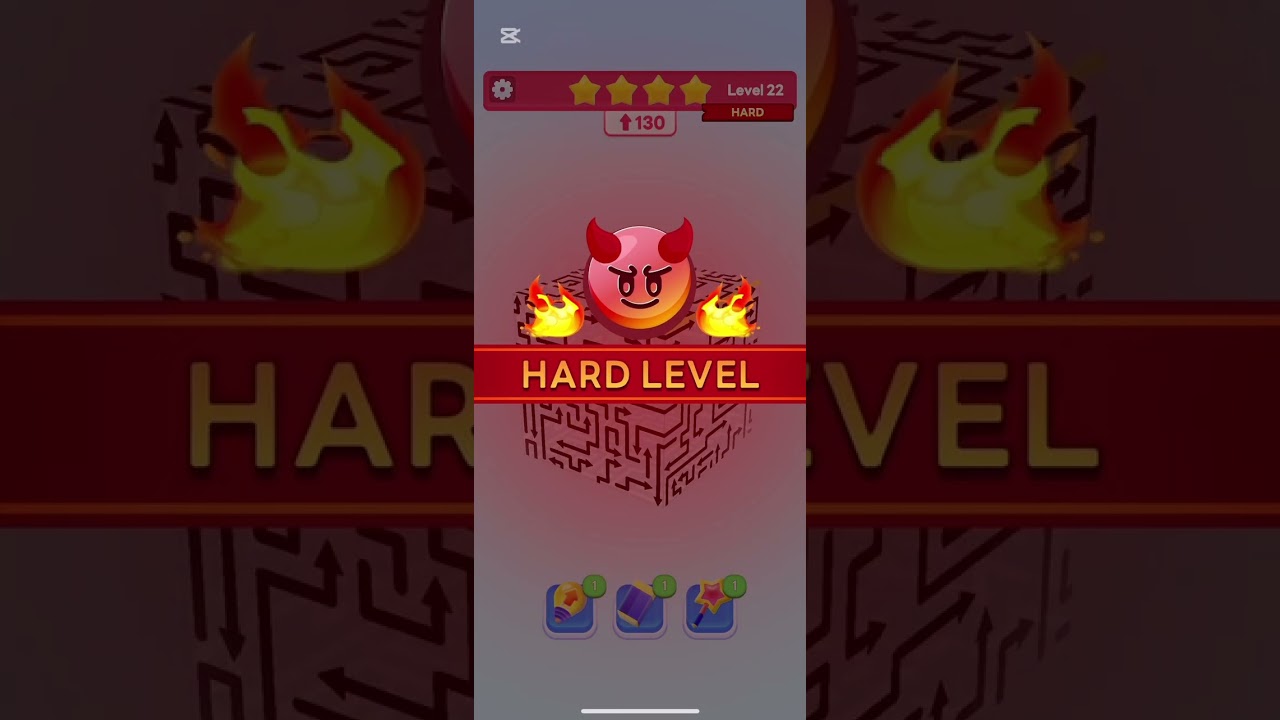
In the increasingly complex world of CubeAway, levels 21 and 22 represent a significant spike in difficulty. These stages serve as a "skill check," forcing players to transition from simple clicking to tactical, long-term spatial planning. Because these levels feature multi-layered structures with restrictive directional arrows, acting without a plan is the fastest way to hit a dead end.
This guide provides the expert strategies needed to dismantle these structures, manage your move queue effectively, and master the spatial logic required to progress through the game.
Understanding Directional Arrow Logic
At its core, CubeAway is a game of vectors. Each block is constrained by the arrow on its face, which dictates the only direction in which it can be removed from the grid. In levels 21 and 22, the game begins to trap these arrows behind or beneath other pieces, creating a dependency chain.
The Golden Rule of Arrows: Always prioritize blocks that have an unobstructed path to the edge of the screen. If you click a block that is blocked by another piece, you waste a move slot.
When analyzing the cube, follow these steps:
- Scan the Perimeter: Identify which blocks are currently "free." A free block is one where the direction of the arrow points toward empty space.
- Evaluate Line of Sight: Before clicking, trace the path of the arrow to the edge of the board. If any other block sits in that path, it must be cleared first.
- The Cascading Effect: Clearing an outer block often exposes a new arrow on the layer beneath it. Before making your move, visualize what that new block will look like. If clearing an outer block creates a new, accessible path for a deeper block, that is your optimal move.
Preventing Board Congestion
Congestion is the primary cause of failure in CubeAway. As you remove blocks, the remaining pieces shift. In higher-level stages like 21 and 22, the game creates "dead zones" where blocks become physically locked in a position that points directly into another block, rendering them impossible to remove.
To maintain board health:
- Work from the Outside In: Avoid the temptation to clear "easy" center blocks. The center is the structural foundation; removing it too early causes the perimeter to collapse inward, potentially hiding the arrow blocks you need to finish the level.
- Balance the Faces: Don't focus exclusively on one side of the cube. If you clear one face too aggressively, you will be left with a lopsided cube that is impossible to rotate or analyze effectively. Keep the clearing process uniform across all visible faces.
- Identify "Blockers": Recognize pieces that are currently serving as a "cap" for several other blocks. These are your high-priority targets. Clearing a single blocker that is preventing three other pieces from moving is almost always the correct strategic choice.
Recognizing Block Dependencies and Pinning
In CubeAway, "pinning" occurs when a block is physically prevented from moving by another piece in its path. Levels 21 and 22 utilize this mechanic to force players into a specific sequence. If you find a block that appears to be "stuck" or highlighted in a way that suggests it cannot be moved, it is pinned.
How to solve for dependencies:
- Trace the Back-End: If a block is pinned, follow the line of its arrow. The piece(s) blocking it are your immediate priority.
- Check for Overlap: Often, two blocks will be pinned by each other. Look for an alternative route or a third block that, when removed, frees up the path for the other two.
- Deep-Layer Analysis: Levels 21 and 22 often stack blocks three or four layers deep. When you remove a piece, the piece behind it moves forward to occupy the vacated space. Always calculate whether the new block exposed will have a clear exit path.
Strategic Decision-Making for Complex Scenarios
As you progress through level 22, you will encounter scenarios where you have multiple, conflicting options. You might see two different arrow blocks that are both technically "ready" to be clicked. How do you choose?
- The "Depth" Strategy: If one block is on the outer shell and the other is deep in the core, clear the outer block first. This maintains the structural integrity of the core, giving you more flexibility if you make a mistake later.
- The "Axis" Strategy: If you have multiple blocks pointing in the same direction, clear them in sequence. This creates a "tunnel" through the cube. A clear, open tunnel is the most valuable resource in CubeAway because it allows you to remove blocks from the center of the structure without having to clear the entire outer layer first.
- The "Panic" Check: If you feel the board becoming cluttered, stop clicking. Take 30 seconds to rotate the cube fully. Often, we get "tunnel vision" on one face. Rotating the cube will reveal an arrow on the opposite side that can be cleared to instantly relieve the pressure on your move queue.
Common Mistakes to Avoid
Even experienced players fall into these traps during the mid-game:
- The "Greedy" Click: Clearing every available arrow as soon as you see it. This is a trap. Sometimes, holding onto a move is better if it keeps a block in a position that acts as a "buffer" for other pieces.
- Ignoring the Backside: Players often forget that CubeAway is a 3D puzzle. Always rotate the cube to check the back and sides. A blocked piece on the front might have an perfectly clear exit path on the back.
- Over-relying on Combos: While combos are satisfying, do not force them. If a combo requires you to move a block that disrupts your long-term plan, skip the combo and make the safer, single-block move.
Final Tips for Mastery
- Patience over Speed: Levels 21 and 22 are not speed runs. Take your time to map out the dependencies.
- Visualize the Shift: Before tapping, imagine the cube after the block is gone. Will the next piece be facing an empty path, or will it be facing another block?
- Use the Environment: Look at the corners of the cube. Blocks in the corners are generally the easiest to clear and should be your starting point for clearing each face.
By applying these strategies, you will find that the complexity of CubeAway levels 21 and 22 becomes manageable. Treat the cube as a mechanical system; identify the locks, prioritize the releases, and clear your path to victory.

Free CubeAway Codes
Current active codes and how to redeem them.

Michael Smith
Michael covers live-service games, events, reward systems, and efficient daily routines, turning frequent updates into clear actions for players.
COMMUNITY
Player Comments
126 players commented on this guide.
The tips are practical and easy to follow.
This helped me understand updates much better.
Nice guide. I am checking the other CubeAway articles next.
I tried this today and it worked better than my old setup.