
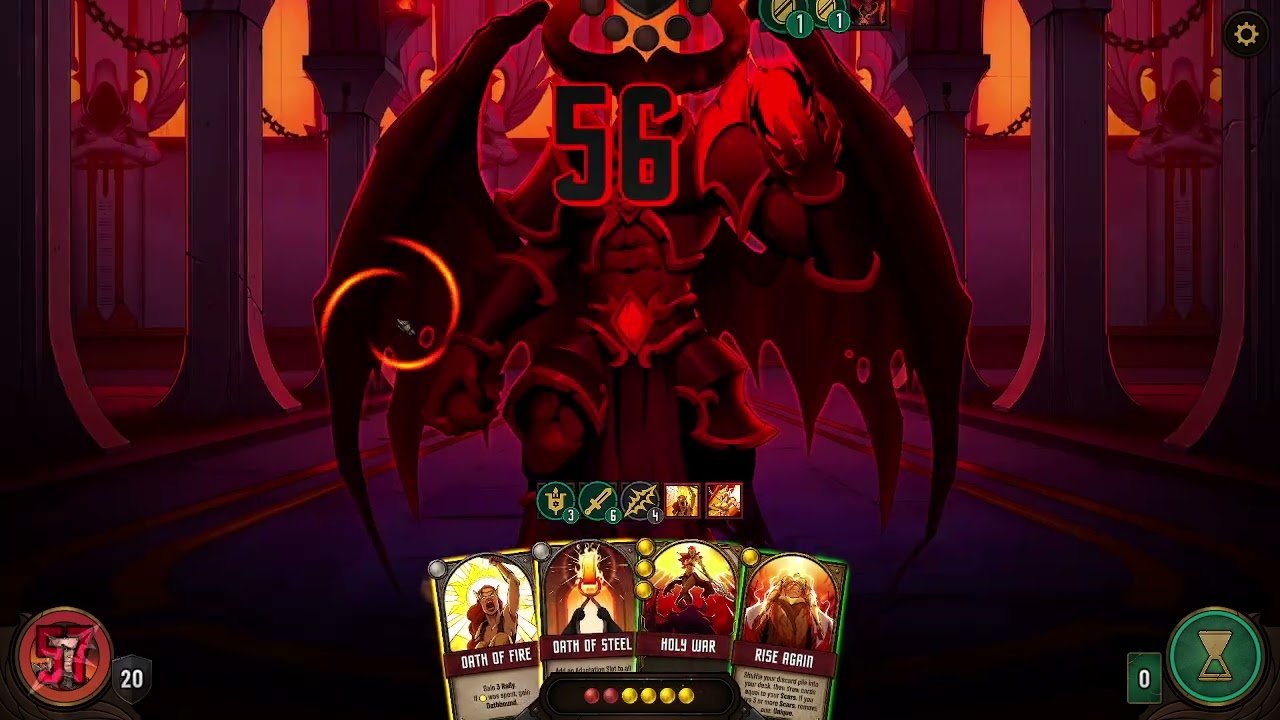
To solve the Sweet Revenge puzzle in Dawncaster: Deckbuilding RPG, you must play your low-cost attacks first to deliberately absorb the enemy's retaliatory counterattacks, then spend your remaining energy on Revenge to deliver lethal burst damage. You must avoid using any defensive cards or shields, as Revenge scales only from true damage dealt to your hero's health pool.
How the Sweet Revenge Mechanics Work
The Sweet Revenge puzzle features a fixed board state with a preset hand and energy pool, requiring you to achieve lethal damage within a single turn. The enemy's health pool is significantly larger than the unamplified base damage of your starting hand, making raw attacks insufficient on their own.
The encounter relies on two interacting mechanics:
- The enemy's retaliatory passive: Every time you hit the enemy, they strike back with an immediate counterattack.
- The Revenge card mechanic: Revenge scales its bonus damage directly from the total damage your hero takes during that turn.
Treat your hero's health pool as an offensive resource. Taking unmitigated damage is normally a misplay in standard runs, but here it is required to reach the mathematical threshold for lethal damage. If you apply armor or barrier before attacking, the counterattacks hit your shield instead of your health pool, which prevents Revenge from scaling.
Step-by-Step Card Execution Sequence
Every point of energy in this encounter is strictly budgeted. Do not play utility or defensive cards. Follow this sequence to clear the puzzle:
| Step | Action | Resource Cost | Outcome |
|---|---|---|---|
| 1 | Primary light attack | Low energy | Deals chip damage and triggers the first retaliatory strike to your health |
| 2 | Secondary light attack | Low energy | Reduces enemy health further and absorbs a second retaliatory strike |
| 3 | Revenge finisher | Remaining energy | Converts total damage suffered into fatal burst damage to eliminate the target |
- Check your board state: Note your starting energy and the enemy's total health. Keep all defensive options in hand.
- Play your primary attack: Target the enemy to deal basic chip damage. Allow the retaliatory counter to hit your hero's unshielded health.
- Play your secondary attack: Strike the enemy again to whittle down their health bar. Absorb the second counterattack, leaving your hero with a narrow margin of surviving hit points.
- Cast Revenge: Spend your remaining energy pool on Revenge. The accumulated recoil damage amplifies the card's output to wipe out the remaining enemy health.
Common Mistakes That Ruin the Puzzle
Most failed attempts are caused by one of two execution errors:
- Playing armor or shields out of habit: In Dawncaster: Deckbuilding RPG, shields mitigate incoming damage before it hits your health points. Blocking the recoil prevents the damage from registering on your hero, leaving Revenge at its base damage value.
- Playing Revenge prematurely: Firing the finisher before spending all available energy on precursor attacks deprives the card of necessary damage scaling. You must trigger every available counterattack before playing the finisher, even if your hero's health drops dangerously low.
Applying the Strategy to Standard Runs
The core lesson of the Sweet Revenge puzzle applies directly to high-risk archetypes such as Berserker or Knight builds in story mode and the Sunforge. When building around cards and mechanics like Revenge, Spite, or Retribution, pairing them with low-health threshold talents—such as Bloodthirst or Last Stand—allows you to convert aggressive enemy encounters into offensive scaling. Intentionally lowering your guard during predictable, manageable enemy attack phases lets you ramp damage and end protracted battles faster than relying strictly on flat-damage attacks.

Free Dawncaster: Deckbuilding RPG Codes
Current active codes and how to redeem them.

Michael Smith
Michael covers live-service games, events, reward systems, and efficient daily routines, turning frequent updates into clear actions for players.
COMMUNITY
Player Comments
141 players commented on this guide.
This helped me understand early game much better.
Good guide for Dawncaster: Deckbuilding RPG players. The early game part was useful.
The tips are practical and easy to follow.
Can you add more details about early game in a future update?