
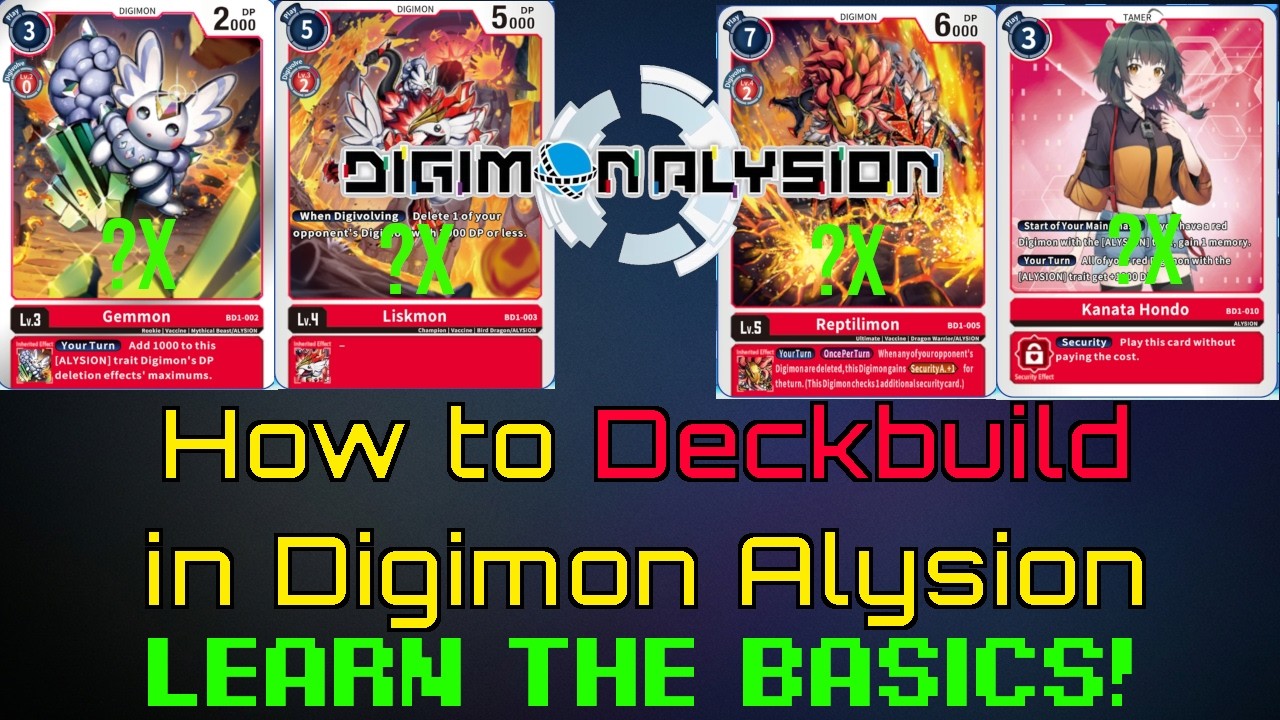
To build a legal and consistent deck in DIGIMON ALYSION, register exactly 50 main deck cards and an optional 0 to 5 Digi-Egg cards, structuring your lineup around a tapering evolution pyramid of 12–14 Level 3s, 10–12 Level 4s, 6–8 Level 5s, 4–6 Level 6s, and 8–12 Tamers or Option cards. Maintaining this card distribution prevents unplayable opening hands and ensures steady card cycling through your digivolution lines.
Deck Construction Rules and Copy Limits
Every deck registered in the DIGIMON ALYSION deckbuilder must meet specific structural parameters:
- Main Deck Size: Exactly 50 cards. Decks with 49 or 51 cards cannot queue into matches.
- Digi-Egg Deck (Digitama): 0 to 5 Level 2 cards, kept separate from the main 50-card deck. Because hatching an egg in the breeding area costs zero memory and initiates your early draw engine, running 4 to 5 Digi-Eggs is strongly recommended over smaller counts.
- Four-Copy Limit: You may run up to four copies of any unique Card ID. Restrictions apply to the printed card number, not the Digimon's character name. You can include four copies of an Agumon from one set and four copies of an Agumon from a different set with a distinct card code, provided no single card code exceeds four copies.
The Standard Evolution Pyramid
Because digivolving on top of an existing Digimon draws one card, ascending through sequential levels forms your primary draw and memory engine. If your opening hand lacks low-level starters, you cannot digivolve efficiently and will fall behind on board development.
Standard midrange and tempo decks distribute card levels across a balanced pyramid:
| Card Tier | Level | Recommended Count | Primary Strategic Function |
|---|---|---|---|
| Digi-Egg | Level 2 | 4–5 cards | Hatched free in breeding to start safe evolution stacks |
| Rookie | Level 3 | 12–14 cards | Turn-one starters, archetype searchers, and memory chokers |
| Champion | Level 4 | 10–12 cards | Bridge digivolutions, early security attacks, and blockers |
| Ultimate | Level 5 | 6–8 cards | Mid-game engine pieces, inherited traits, and utility skills |
| Mega | Level 6 | 4–6 cards | Primary win conditions, removal effects, and board control |
| Ultra / Tech | Level 7 | 0–2 cards | Optional late-game finishers to break stalled boards |
Running fewer than 12 Level 3 Digimon creates a severe failure point: opening hands flooded with high-cost Megas that you cannot afford to hard-cast. Conversely, overloading on Champions or Ultimates dilutes your finisher count, leaving early stacks without game-ending top-end threats.
Tamers and Option Card Allocation
Dedicate the remaining 8 to 12 slots in your 50-card deck to Tamers and Option cards. These cards provide horizontal support that persists independently of your Digimon stacks:
- Memory-Fixing Tamers (3–4 copies): These Tamers ensure that if your turn begins with less than three memory, your gauge automatically resets to three. Including 3 to 4 copies helps you establish one early, preventing opponents from choking your plays by repeatedly passing the turn at one memory.
- Removal and Utility Options (4–6 copies): Option cards provide direct deletion, searches, or defensive tricks. High-cost deletion Options often possess Security Effects, allowing them to activate for free when checked in your security stack and turn an opponent's attack into a board clear.
Ratios for Specialized Archetypes
Deviating from the baseline pyramid is appropriate only when your deck targets a specialized strategy:
- Rookie Rush (Aggro): Cuts Level 5 and Level 6 Digimon entirely to run 16 to 20 Level 3 Digimon alongside cheap Level 4s and low-cost Options. This build floods the field to pressure security before opponents set up high-level boards, but it lacks the DP needed to overcome large defensive blockers.
- Tall Stack (Combo): Focuses on raising a single protected Digimon in the breeding area from Level 3 to Level 6 before moving to the battle area. These decks run 14 search-heavy Level 3s, full four-card playsets of key Level 4 and 5 bridge cards with vital inherited effects, and defensive Options. They trade early board tempo for high single-turn burst damage.
Using Deckbuilder Filters
To assemble a deck quickly without illegal inclusions, use the in-game deckbuilder's search tools in this sequence:
- Filter by Color: Digimon generally require matching colors to digivolve. Restricting your view to your deck's primary color prevents adding incompatible cards.
- Filter by Level: Move through the card pool level by level (starting at Level 3) to assemble your counts against the pyramid guidelines.
- Filter by Text and Trait: Search for specific Digimon typings (such as Dinosaur or Machine) to find cards that share tribal synergy, or filter by keywords like "Blocker," "On Deletion," or "Security Attack +" to fill specific mechanical gaps.

Free DIGIMON ALYSION Codes
Current active codes and how to redeem them.

Michael Smith
Michael covers live-service games, events, reward systems, and efficient daily routines, turning frequent updates into clear actions for players.
COMMUNITY
Player Comments
127 players commented on this guide.
This helped me understand base building much better.
The tips are practical and easy to follow.
Can you add more details about base building in a future update?
I tried this today and it worked better than my old setup.