
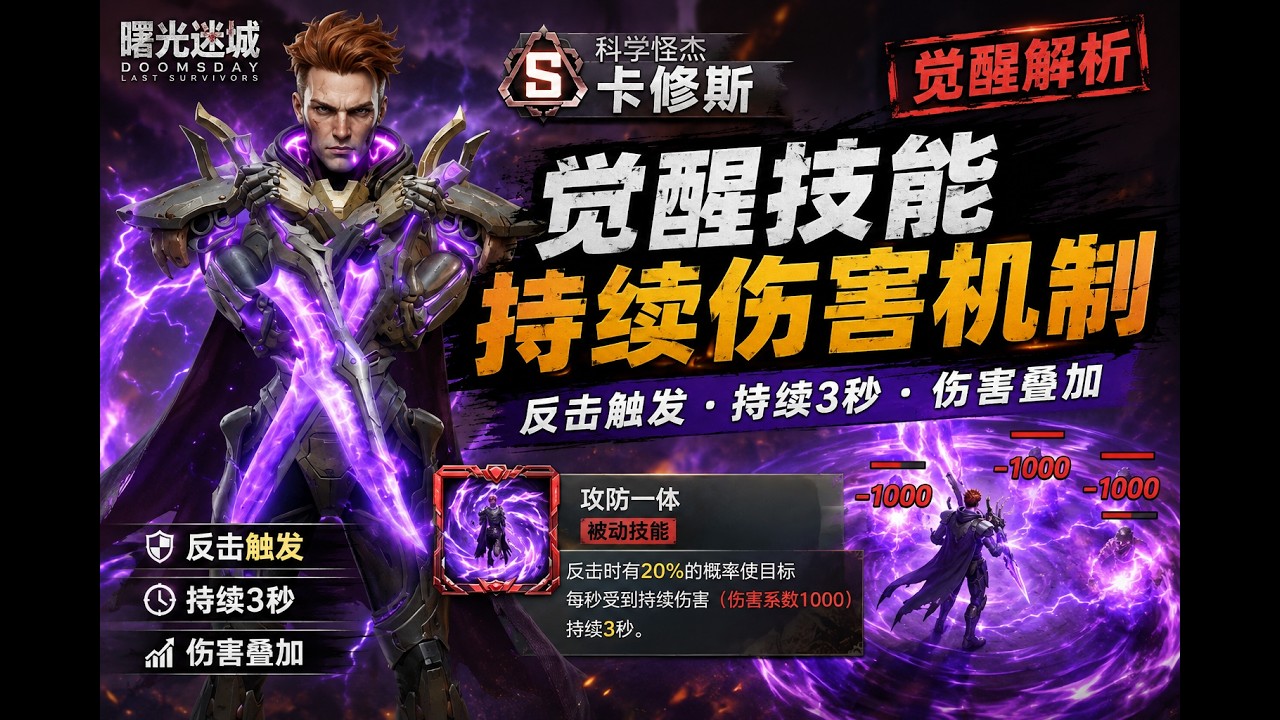
In Doomsday: Odysseus Returns, Cassius's awakening skill adds a multi-second continuous damage-over-time (DoT) effect to his primary active skill rotation. To maximize this damage, build around squad Attack, Skill Damage modifiers, and target Defense reduction, while tuning your rage generation so new skill casts do not overwrite active damage ticks before they finish.
Continuous Damage Mechanics and Stat Scaling
Cassius's awakening skill distributes damage across sequential intervals rather than delivering a single instantaneous hit. This continuous delivery allows damage ticks to outlast short-duration enemy defensive shields and mitigation windows, continuing to inflict damage once temporary barriers expire.
Continuous damage instances snapshot your squad's active offensive modifiers at the exact moment Cassius casts his skill. If an Attack or Skill Damage buff is active upon execution, every tick in that cycle retains the amplified multiplier. Buffs triggered after the DoT begins ticking do not retroactively boost that active cycle.
Because these ticks are classified strictly as skill damage, modifiers tied to basic attacks or counterattacks do not improve your DoT output.
| Stat / Modifier | Impact on Awakening DoT | Priority & Usage |
|---|---|---|
| Skill Damage Bonus | Directly multiplies the damage of each tick | High priority on armaments and talent nodes |
| Squad Attack | Increases baseline damage calculation per tick | Essential primary stat on infantry equipment |
| Lethality | Boosts casualty conversion on resolved damage | Secondary offensive priority for field trades |
| Defense Debuffs | Increases damage taken per tick on the target squad | Pair with heroes who shred enemy defense |
| Normal Attack Bonus | Has zero effect on continuous damage ticks | Do not invest in this stat for Cassius DoT |
| Counterattack Bonus | Has zero effect on continuous damage ticks | Do not invest in this stat for Cassius DoT |
Preventing Overwritten Ticks with Rage Pacing
In Doomsday: Odysseus Returns, landing Cassius's awakening skill while a previous DoT instance is active resets the duration timer rather than creating a separate, stacking DoT pool.
If your squad generates rage too quickly, the next skill cast resets the timer prematurely. This clips the final ticks of the previous cycle and wastes potential damage.
- Ideal Rage Loop: Cassius fills his rage meter and fires his active skill just as the final tick of the previous DoT resolves.
- Over-Accelerated Loop: High rage generation triggers the active skill mid-duration, wiping remaining damage instances from the earlier cast without adding extra ticks.
If your squad composition or talent setup cycles rage faster than the DoT duration, shift secondary talent investments away from pure rage engine nodes and into raw infantry survivability or direct Skill Damage amplification.
Hero Roles and Tactical Placement
Cassius needs prolonged engagements to deliver the full value of multiple continuous damage cycles. Fast, fragile pairings cut battles short before his sustained attrition can outpace upfront burst commanders.
- Defense-Shredding Partners: Secondary commanders who apply incoming Skill Damage amplification or Defense debuffs before Cassius casts ensure that all subsequent ticks hit softened targets.
- Sustained Tanking Partners: High-durability infantry commanders provide troop healing, shields, and damage reduction, keeping Cassius on the field through multiple 4–6 skill rotations.
- Crowd Control Support: Heroes with movement-speed slows prevent opposing squads from disengaging while active damage ticks are still rolling.
Deploy Cassius primarily in frontline chokepoints, alliance anchors, and garrison defenses where enemy squads are forced to stay in contact. Avoid chasing high-mobility cavalry squads across open terrain, as targets that retreat out of range can minimize the value of remaining DoT ticks.
Free Doomsday: Odysseus Returns Codes
Current active codes and how to redeem them.

Emily Johnson
Emily writes practical mobile strategy guides with a focus on resource planning, base progression, and the early decisions that shape a long-term account.
COMMUNITY
Player Comments
92 players commented on this guide.
I tried this today and it worked better than my old setup.
Can you add more details about strategy in a future update?
This saved me time in the early game.
I wish I had read this before upgrading the wrong thing.