
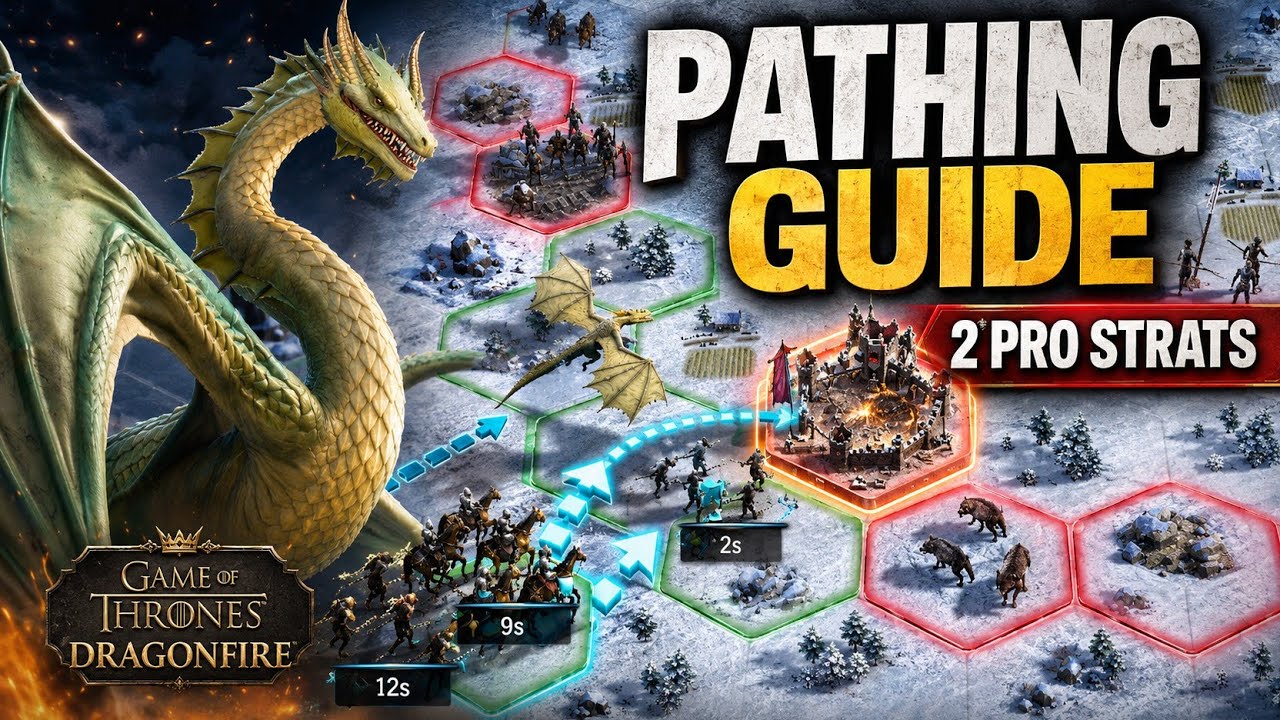
In Game of Thrones: Dragonfire, territory is the lifeblood of your empire. Whether you are aiming to secure high-yield resource nodes or create defensive buffers against rival alliances, understanding the mechanics of map movement—specifically "pathing"—is the single most important skill for a growing lord or lady. Pathing is not just about moving from Point A to Point B; it is about managing time, resource efficiency, and spatial control in a 4X environment where every tile counts.
The Core Mechanics of Pathing in Game of Thrones: Dragonfire
At its most basic level, pathing in Game of Thrones: Dragonfire is the system by which your forces claim land. Every movement command you issue creates a "path" of connected tiles. The game engine automatically calculates the shortest route, but "shortest" does not always mean "best."
Pathing follows a grid-based system where connectivity is strictly enforced. To claim a new tile, it must be adjacent to an existing tile that you already control or connected via a continuous chain back to your capital. If you attempt to path through a tile occupied by an enemy or an impassable mountain range, the system will either block your movement or force a detour. Understanding how to manipulate these constraints allows you to outmaneuver opponents who rely solely on the game’s default pathing algorithms.
Mastering Straight-Line Expansion
Straight-line pathing is the gold standard for early-game growth and rapid regional acquisition. When you target a node that lies along a direct, unobstructed vector from your base, you minimize the "Action Point" cost and the time required for your troops to secure the claim.
Why Straight-Line Works:
- Speed: Direct paths require fewer tiles to be processed, allowing you to reach high-value nodes before your neighbors.
- Resource Efficiency: Because you are moving in a linear fashion, you spend the minimum amount of movement resources per tile claimed.
- Predictability: It is the fastest way to build a "highway" toward distant objectives or high-tier resource zones.
Pro-Tip: During the first week of a server launch, ignore high-value nodes if they are hidden behind terrain. Instead, focus on straight-line expansion toward the center of the map. By securing a straight corridor, you establish a logistics backbone that makes later expansion in any direction significantly faster.
Implementing Curved Pathing for Obstacle Avoidance
In the mid-to-late game, the map becomes cluttered with "dead zones"—mountains, deep forests, and water features that cannot be captured. If you simply click your final destination, the game may attempt to path through these obstacles, which will cause your movement command to fail or force an inefficient, automated detour.
Curved pathing is the manual art of "waypointing." Instead of clicking your final target, you must manually click intermediate tiles that hug the perimeter of the obstacle.
- The "L-Turn" Technique: When approaching a mountain range, move your units to the corner tile of the obstacle, then issue a second command to wrap around it. This prevents the "pathing error" message that often occurs when the AI tries to find a path that doesn't exist.
- Edge-Hugging: By keeping your pathing tight to the edge of impassable terrain, you create a "shield" where one side of your expansion is naturally protected by the environment, requiring fewer troops to defend that specific border.
Strategic Positioning and Choke Points
Pathing is your primary tool for defensive warfare. In Game of Thrones: Dragonfire, you can "choke" an opponent’s expansion by placing your own territory in their path.
If you see an alliance expanding toward a rich resource node, you don't necessarily need to fight them head-on. By pathing your own units to occupy the "bottleneck" tiles leading to that node, you force the enemy to either halt their expansion or commit to a long, winding curved path that wastes their time. This is known as "pathing denial."
Strategic Checklist for Defensive Pathing:
- Identify Chokepoints: Narrow strips of land between mountains or lakes are the most valuable defensive assets.
- Intercept: If an enemy is pathing toward a node, calculate their arrival time. If you can reach an intermediate tile in their path first, you effectively block them.
- Fragmenting: Try to create "islands" of enemy territory by cutting off their paths to your shared borders. An isolated tile is a weak tile.
The Importance of Node Connectivity
Connectivity is the most common mistake made by new players. In Game of Thrones: Dragonfire, if your territory becomes fragmented—meaning a group of tiles is not connected back to your capital—you will lose the ability to collect resources from those disconnected nodes, and they become significantly easier for enemies to capture.
- Maintain the Chain: Always treat your expansion as a single, unbroken line. If you are forced to expand in two directions, ensure your "trunk" (the main line of tiles) is thick enough that losing one tile won't disconnect your entire outer empire.
- The "Backbone" Strategy: Prioritize capturing tiles in a straight line from your capital to the edge of your territory. Once that backbone is secure, branch out horizontally to claim resource-heavy nodes. This ensures that even if an enemy snipes a side node, your entire supply line remains intact.
Summary Table: Pathing Decisions
| Situation | Recommended Strategy | Why? |
|---|---|---|
| Open Plains | Straight-Line | Maximizes speed and minimizes resource waste. |
| Mountainous Zones | Curved (Manual) | Prevents pathing errors and AI-driven detours. |
| Competitive Borders | Choke-Point Blocking | Forces enemies into inefficient, slow routes. |
| Late-Game Maintenance | Connectivity Focus | Prevents territory fragmentation and resource loss. |
By treating every movement as a strategic decision rather than a simple click, you transition from a casual player to a true ruler of the Seven Kingdoms. Master these pathing techniques, keep your supply lines connected, and you will find yourself dictating the flow of war in Game of Thrones: Dragonfire.

Free Game of Thrones: Dragonfire Codes
Current active codes and how to redeem them.

Sarah Williams
Sarah specializes in RPG and collection games, explaining team building, character growth, and beginner-friendly ways to avoid expensive early mistakes.
COMMUNITY
Player Comments
75 players commented on this guide.
Can you add more details about strategy in a future update?
This saved me time in the early game.
This helped me understand strategy much better.
The explanation is clear, especially for beginners.