
To accurately pinpoint your location in Genshin Impact GeoGuessr on LostGamer, immediately rotate your camera 360 degrees to spot distant horizon anchors, then inspect nearby architecture and ground vegetation to confirm the sub-region. Once you identify your regional zone, align sightlines between two major landmarks to triangulate your pin on the match map.
Reading Visual and Architectural Anchors
When dropped into a panoramic spawn, narrow down the nation within seconds by evaluating structural materials, cultural architectural motifs, and local environmental lighting.
| Nation | Distinct Architectural Features | Local Flora and Ground Materials | Skybox and Atmospheric Tone |
|---|---|---|---|
| Mondstadt | Exposed timber framing, stone masonry, cobblestone paths, canvas awnings | Bright green turf, Dandelions, Calla Lilies | Clear light blue sky with pale cloud cover |
| Liyue | Lacquered timber, curved ceramic roof eaves, stone piers, carved jade | Karst limestone, amber deposits, Glaze Lilies, golden Ginkgo trees | Warm amber haze with sharp ridgeline sunlight |
| Inazuma | Dark wood construction, Torii gates, shoji screens, purple-tiled roofing | Dark volcanic stone, violet grass, Naku Weed, falling Sakura petals | Violet atmospheric fog and Electro cloud formations |
| Sumeru | Domed sandstone houses (desert) or curved tree-root dwellings (rainforest) | Loose dunes or deep green moss, Padisarahs, large lotus pads | High-contrast desert glare or saturated tropical mist |
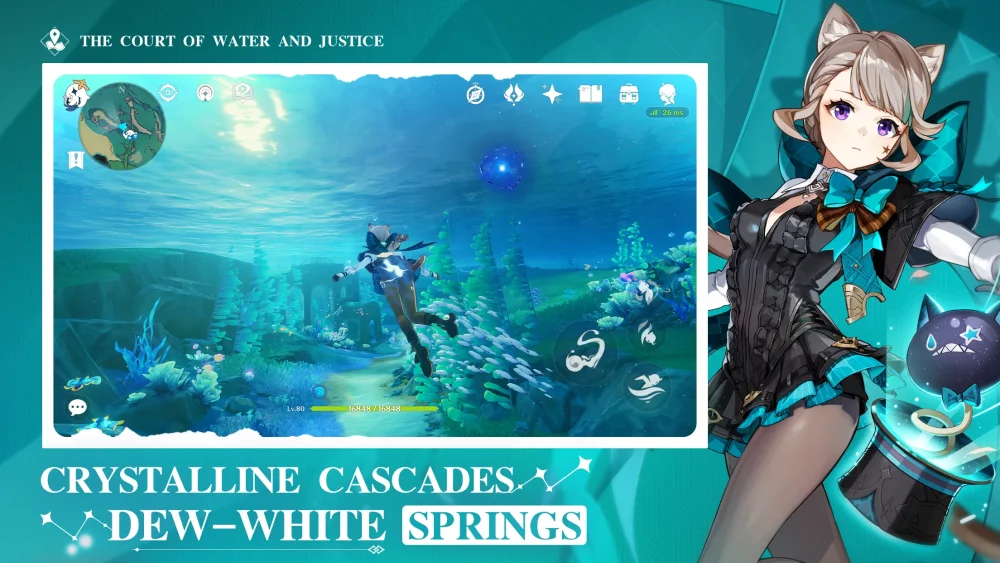
| Fontaine | Neoclassical white stone facades, brass clockwork, aqueducts, paved curbs | Submerged water pipes, manicured lawns, Rainbow Roses | Pale aquamarine horizon and clean diffused light |
Triangulating Coordinates with Horizon Anchors
Pinpointing exact coordinates on the LostGamer map requires sighting two permanent, tall landmarks visible from long render distances.
- Locate Dragonspine: The snow-capped mountain of Dragonspine serves as the primary compass anchor across Mondstadt, northern Liyue, and the Bishui Plain. Note whether the peak sits to your north, south, or east to eliminate the opposite halves of the world map.
- Find a Secondary Anchor: Rotate until you locate a second major visual marker, such as Mount Tianheng, the vertical stone pillars of Guyun Stone Forest, or the floating island of Celestia in the upper skybox.
- Cross the Sightlines: Draw a mental line from each landmark through your camera position. Your coordinate lies at the intersection of those two angles.
Reading Micro-Clues in Enclosed Areas
When spawned in deep ravines, caves, or thick forests where the horizon is obscured, use ground-level assets to determine your position:
- Rock Strata: Tiered, warm-toned sedimentary bluffs belong to Liyue. Dark, porous crags signify Inazuma, while wind-swept orange sandstone belongs to the Sumeru desert.
- Harvestable Plants: Native specialty plants strictly define borders. Windwheel Asters confirm open Mondstadt plains, Qingxin flowers grow primarily on high Liyue peaks, and Padisarahs indicate central Sumeru settlements.
- Canopy Leaves: Pan your view upward to inspect tree crowns. Conifers and fan-shaped yellow ginkgo boughs place you in high-elevation northern zones or Liyue valleys, whereas broadleaf deciduous trees dominate Mondstadt and Fontaine.
Navigating Border Regions
Border zones frequently mix environmental assets and lead to inaccurate guesses:
- Stone Gate Boundary: The crossing between Mondstadt and northern Liyue features Mondstadt-style flora alongside Liyue stone bridges. Look closely at the cliff geometry: sharp karst rock spires indicate you have crossed onto the Liyue side.
- Fontaine and Chenyu Vale Borders: Examine road construction. Fontaine border routes feature polished masonry and brass lampposts, whereas adjacent Liyue routes shift immediately to packed dirt roads and rustic wooden railings.
- Sumeru Transitional Edges: Moving from the Avidya Forest into the desert features a rapid thinning of grass cover into loose sand drift; check the soil texture before locking in your pin.

Free Genshin Impact Codes
Current active codes and how to redeem them.

Emily Johnson
Emily writes practical mobile strategy guides with a focus on resource planning, base progression, and the early decisions that shape a long-term account.
COMMUNITY
Player Comments
87 players commented on this guide.
Good guide for Genshin Impact players. The strategy part was useful.
This helped me understand strategy much better.
The explanation is clear, especially for beginners.
This guide answered the exact question I had.