
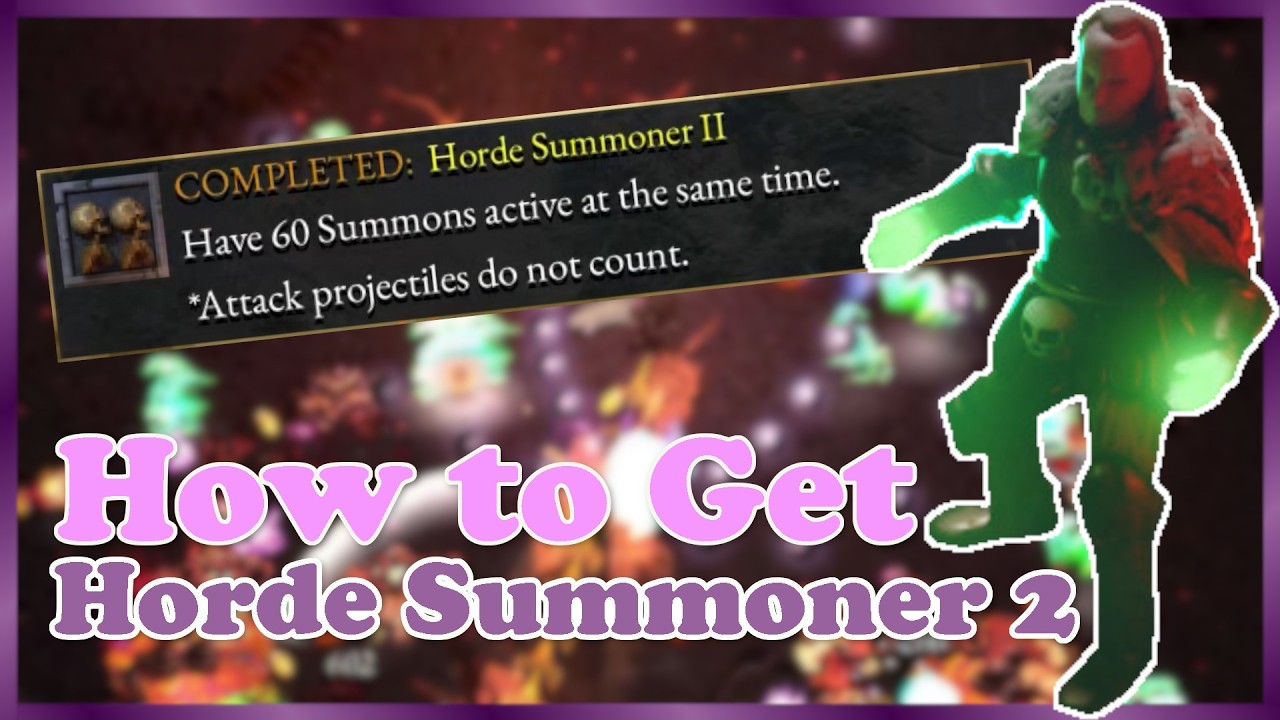
Achieving the "Horde Summoner 2" milestone in Halls of Torment requires more than just picking a summon-focused class; it requires a deliberate, math-driven approach to your build. To unlock this achievement, you must maintain 60 active summons simultaneously on the screen. Because the game’s late-game density is chaotic, your summons will naturally take damage and expire, meaning your build must focus on high-volume spawn rates and aggressive scaling to cross that threshold.
The Foundation: Why the Necromancer is Non-Negotiable
While other classes in Halls of Torment offer utility, the Necromancer is the only class designed with a core kit that naturally supports a massive army. The Necromancer’s base weapon ability, "Living Dead," summons skeletons as a primary attack.
To reach 60, you must treat your Necromancer not as a damage dealer, but as an engine for unit generation. Focus your early level-up points exclusively into the "Summon Count" and "Summon Duration" traits. Do not get distracted by generic damage or critical hit upgrades; they provide zero utility toward the achievement. Every point spent on improving your skeletons is a point toward the 60-unit goal.
Optimized Ability Selection for Minion Density
Your active ability slots are the most significant limiting factor. To hit 60, you cannot afford to waste a single slot on a non-summoning ability. You need to stack abilities that generate entities continuously.
Recommended Ability Priorities:
- Summon Golem: Provides a sturdy, high-health unit that stays on the field for a long time.
- Archer/Warrior Summons: If available, prioritize abilities that manifest physical units rather than stationary turrets or spells.
- Ability Rerolls: Save your rerolls for the mid-game. If you are offered a choice between a damage-boosting upgrade and a summon-count upgrade, always pick the count.
Avoid any ability that creates stationary zones (like fire patches or shockwaves) unless they explicitly generate a minion. The goal is to flood the screen with individual entities that count toward the game’s internal limit.
Essential Equipment for Summon Scaling
In Halls of Torment, gear is what separates a standard run from an achievement-hunting run. You must equip items that provide multipliers to your summons. If you rely solely on leveling traits, you will likely peak in the mid-40s.
Look for the following gear archetypes:
- Summoner’s Gear: Look for items that specifically boost "Minion Damage" or "Summon Count."
- Attack Speed Buffs: Since many summons are tied to the frequency of your attacks or the cooldown of your abilities, boosting your attack speed effectively increases how many minions you can produce before the old ones expire.
- Cooldown Reduction: Items that lower ability cooldowns are critical. The faster your "Living Dead" or "Golem" ability triggers, the more units you can maintain on the field simultaneously.
Strategic Positioning and Management
Managing 60 summons isn’t just about the build; it’s about how you traverse the map. If you run too fast and move away from your summons, they may be forced to despawn or get caught on map geometry.
- Stay Central: Keep your character toward the middle of the horde. This ensures your summons stay in a tight cluster, allowing them to focus fire on enemies.
- Kiting vs. Camping: While you want your summons to hit enemies, you don’t want them to constantly die to elite-level damage. If you find your count dropping, kite in smaller circles to keep your army consolidated.
- The "Attrition" Check: If your summons are dying faster than you can create them, you have a survivability problem. In this case, prioritize "Minion Health" traits over "Minion Damage" for a few levels. A skeleton that lives 5 seconds longer is worth more than a skeleton that does 10% more damage.
Troubleshooting the "Achievement Wall"
If you reach the 20-minute mark and find your count hovering in the 40s or 50s, perform a quick audit of your build:
- Trait Audit: Did you accidentally pick a "Weapon Damage" trait instead of a "Summon Count" trait? If you have rerolls left, use them now to pivot back to your summon-focused path.
- Ability Check: Did you pick an ability that doesn't scale well into the late game? If you have an ability that isn't providing a steady stream of units, it is a dead slot.
- Enemy Density: If you are playing on a map with very low enemy density, your summons may not be engaging enough to trigger their "kill-to-spawn" mechanics (if applicable to your specific items). Ensure you are on a map with high mob density to keep your minions active and "working."
Why This Strategy Works
This approach works because it respects the game's internal scaling mechanics. Halls of Torment rewards specialization. By ignoring all standard DPS stats in favor of quantity, duration, and frequency, you move from playing the class as a "Necromancer" to playing it as a "Summoner." The game engine tracks active entities; by maximizing the uptime of your primary weapon's skeletons and supplementing them with secondary minion abilities, you force the game to handle a count that meets the achievement requirements. Stay focused on your trait selection, keep your gear optimized for minion quantity, and maintain tight control of your army's positioning to secure the Horde Summoner 2 achievement.
Free Halls of Torment Codes
Current active codes and how to redeem them.

Michael Smith
Michael covers live-service games, events, reward systems, and efficient daily routines, turning frequent updates into clear actions for players.
COMMUNITY
Player Comments
63 players commented on this guide.
This guide answered the exact question I had.
The tips are practical and easy to follow.
This saved me time in the early game.
Can you add more details about strategy in a future update?