
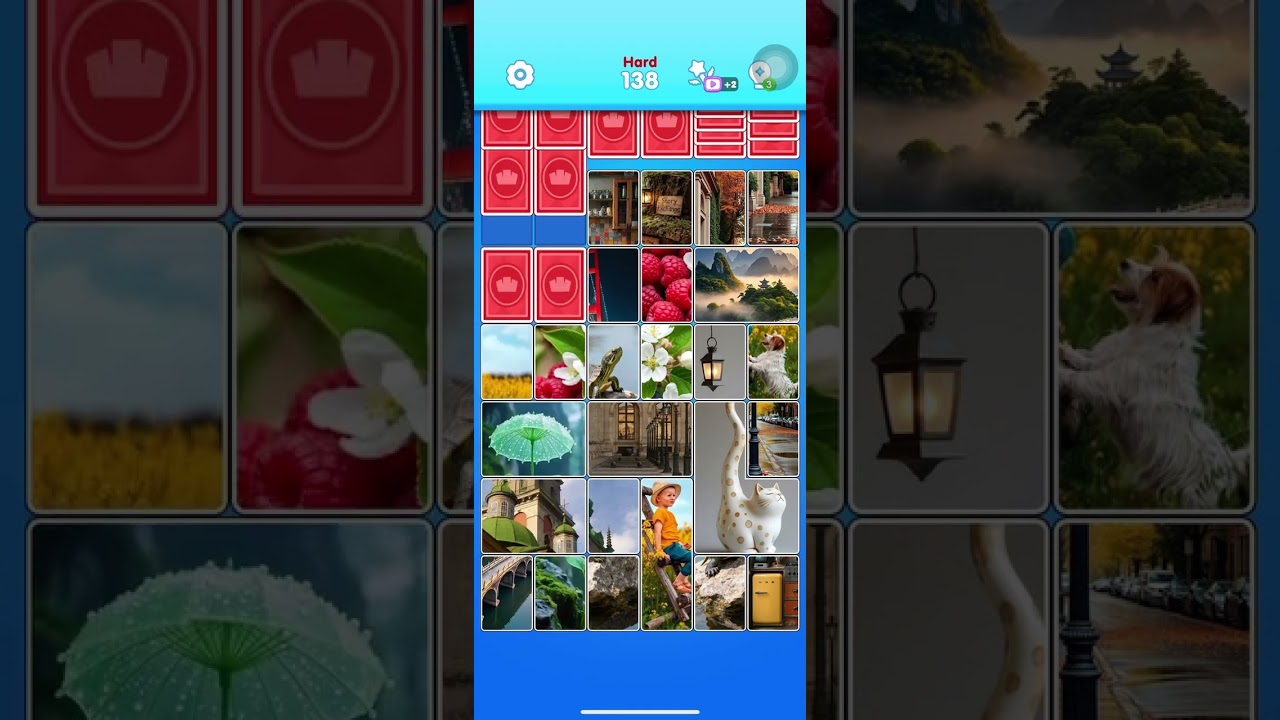
Levels 136, 137, and 138 in Jigsaw Drop: Solitaire Puzzle represent a significant difficulty spike, primarily due to the "Final Move Surprise"—a gravity-based board shift that triggers upon the placement of specific anchor pieces. To successfully navigate these stages, players must move away from reactive play and toward a strategy of board stabilization and predictive clearing. The secret to beating these levels lies in understanding that the board is not static; your goal is to clear the periphery to create a "safe zone" that absorbs the unpredictable shifts of the final pieces.
Analyzing the Final Move Surprise Mechanic
The "Final Move Surprise" is not a random event; it is a scripted gravity shift that occurs when the last of the primary structural pieces is placed. In these levels, the developers have designed the board to collapse or shift downward once certain thresholds are met.
Many players fail here because they treat the board as a standard jigsaw puzzle. Instead, you must treat it like a physics-based management game. When you remove an anchor piece, the pieces above it will drop. If those pieces fall into a configuration that blocks your remaining required matches, you reach a dead end.
Expert Tip: Before placing a piece, look at the "ghost" outline of the board. If a piece you are holding sits directly beneath a column that is nearly full, consider that the drop might lock that column permanently. Always calculate the "post-drop" state before confirming your move.
Prioritizing Peripheral Tile Removal
In levels 136–138, the center of the board is often a trap. The game lures you into building the most obvious parts of the picture in the middle, but this creates a "choke point" that makes the final moves impossible to complete.
Focus on the edges first. Clearing peripheral tiles serves three critical functions:
- Gravity Management: By clearing the sides, you create empty columns that can absorb falling pieces during the final shift without locking up your progress.
- Visibility: Clearing the edges reveals the hidden "anchor" pieces earlier, allowing you to plan your final moves around the gravity shift rather than reacting to it.
- Flexibility: A clean edge gives you more "buffer" slots. If you make a mistake, having an open column allows you to place a sub-optimal piece without ruining the entire board state.
Mastering the Cascade Effect
The final move in these levels is rarely a single placement; it is almost always a cascade. A cascade occurs when one piece placement triggers a chain reaction of cleared matches. In Jigsaw Drop: Solitaire Puzzle, you can leverage this to your advantage to clear multiple sections at once.
To set up a successful cascade:
- Identify the Bottom Row: Focus on pieces that are at the very bottom of the stack. Clearing these forces the entire column to drop.
- Look for Vertical Alignment: Identify two pieces of the same segment that are vertically stacked. Placing a piece that completes a match with the top one will often cause the bottom one to drop into a position where it can be matched next.
- Avoid "Floating" Pieces: Never leave a piece unsupported if you can avoid it. Floating pieces are often the ones that get caught in the "surprise" shift, landing in locations that are physically impossible to clear.
Strategic Patience and Move Economy
One of the most common mistakes in Jigsaw Drop: Solitaire Puzzle is the "Speed Trap." Because the game is relaxing, players often feel the urge to keep moving pieces as quickly as possible. However, levels 136–138 are designed to punish this.
If you have two moves available, ask yourself: Does this move change the board in a way that limits my future options? If the answer is yes, hold that move. Use the "Hand" area to store pieces that aren't immediately useful. By holding onto pieces, you keep the board state static for longer, giving you more time to analyze the impact of the upcoming gravity shift.
Decision Matrix for Move Selection:
| Board Condition | Recommended Strategy |
|---|---|
| High Congestion | Clear peripheral tiles to open columns. |
| Stable/Open | Focus on central anchor pieces to trigger planned cascades. |
| Final Move Pending | Audit all columns to ensure no piece will block a required slot. |
| Stalled | Hold pieces in your hand to avoid placing a blocker. |
Adapting to Board State Shifts
Even with the best planning, the board can shift in ways you didn't perfectly predict. When this happens, avoid the urge to panic-tap. The "surprise" shift is a reset of the board's gravity, not a game-over mechanic.
If the board shifts and leaves you with an awkward layout, look for the "bottleneck" piece. This is the piece that is currently occupying a space needed for a future match or is sitting on top of a piece you need to access. Prioritize clearing the area around this bottleneck. Often, you can "force" a second shift by placing a piece in a non-intuitive spot to trigger a new cascade, effectively clearing the obstacle that the first shift created.
Why These Strategies Work
Jigsaw Drop: Solitaire Puzzle uses a combination of logic-based puzzle solving and spatial awareness. By clearing the periphery, you are essentially "managing the room" before you do the heavy lifting in the center. The "Final Move Surprise" is a test of your ability to visualize the board in 3D space—understanding that when one piece drops, it shifts the entire vertical column.
When you consistently apply these strategies, you move from playing the game on a tile-by-tile basis to playing it on a board-state basis. This shift in perspective is what separates casual players from those who can clear the most complex, high-level puzzles without relying on power-ups or resets. Remember, the game is designed to be solved; if you are stuck, it is almost always because the board is "cluttered" with pieces that haven't been allowed to settle into their correct columns. Slow down, clear the edges, and let the gravity do the work for you.

Free Jigsaw Drop: Solitaire Puzzle Codes
Current active codes and how to redeem them.

James Brown
James focuses on Android gaming on PC, emulator setup, controls, performance tuning, and practical troubleshooting for longer play sessions.
COMMUNITY
Player Comments
101 players commented on this guide.
Can you add more details about strategy in a future update?
This guide answered the exact question I had.
I tried this today and it worked better than my old setup.
Good guide for Jigsaw Drop: Solitaire Puzzle players. The strategy part was useful.