
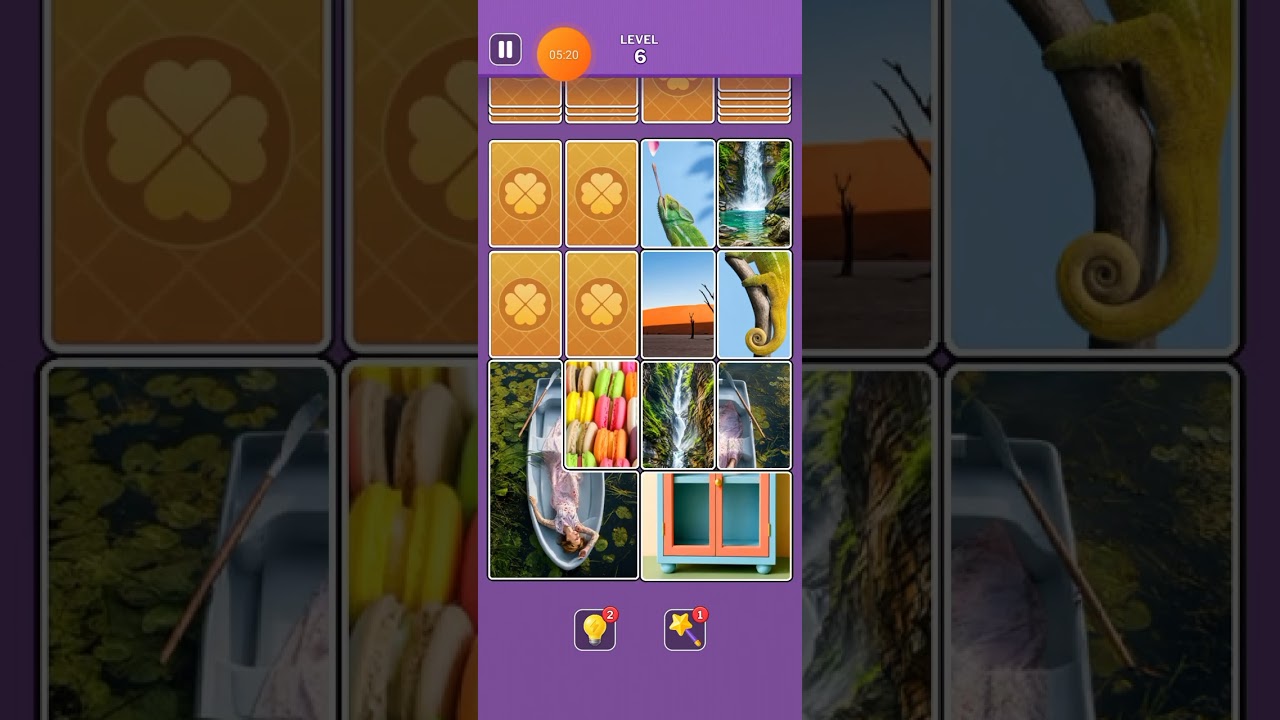
In Jigsaw Drop: Solitaire Puzzle, the secret to clearing complex boards isn't just about matching cards; it is about mastering the vertical landscape. The most effective way to succeed is to focus on column management. By keeping your columns balanced and anticipating the "drop" logic of the game, you can prevent gridlocks and trigger massive cascades that clear the board with minimal effort.
If you find yourself running out of moves or staring at a cluttered screen, it is likely because your vertical lanes have become disorganized. This guide provides the expert strategies needed to master the board mechanics of Jigsaw Drop: Solitaire Puzzle and improve your puzzle-solving efficiency.
Understanding Column-Based Progression
The core mechanic of Jigsaw Drop: Solitaire Puzzle is the vertical drop system. Unlike traditional solitaire where cards move horizontally or onto foundations, here, the board is a series of active, shifting slots. Every card you place or remove alters the weight and height of that specific column.
When a column is cleared, it doesn't just disappear; it provides the essential "breathing room" required for the remaining deck to shift. If you allow one or two columns to grow significantly taller than the others, you effectively limit your future moves to only those specific lanes. To maintain control, you must treat the board as a cohesive unit. Always scan the heights of all columns before making a move; if one lane is nearing the top of the screen, it becomes a "priority zone" that must be cleared immediately to avoid an automatic game-over state.
Strategic Sequencing: The Anchor Technique
Sequencing is the art of knowing which card to place first to unlock the most potential moves later. In Jigsaw Drop: Solitaire Puzzle, players often make the mistake of clearing the easiest matches first, only to realize they have trapped high-value cards beneath a mountain of irrelevant tiles.
To master sequencing, utilize the "Anchor Technique":
- Identify the Anchor: Look for the card at the bottom of a high column that is preventing a major clear. This is your "anchor."
- Clear the Path: Before touching the anchor, clear the cards immediately above it in a way that aligns with your current hand.
- Plan the Cascade: Ensure that by clearing the path, you are setting up a sequence that will naturally drop into place once the anchor is removed.
- Avoid Blocking: Never place a low-value card in a column if it prevents you from accessing a card you need for a higher-value sequence.
Preventing Gridlocks and Board Stagnation
Board stagnation is the primary cause of failure in Jigsaw Drop: Solitaire Puzzle. It occurs when you lose the ability to make a move because the columns have reached their capacity or the cards are mismatched beyond recovery.
To prevent this, you must keep your column heights uniform. A "staircase" pattern—where columns vary slightly in height—is much more manageable than a "flat" or "jagged" board. If you find your columns becoming too tall, stop focusing on specific color matches and start focusing on column reduction. Use your moves to clear the tallest column, even if the match is low-value, to ensure you have enough "buffer" space for the next round of falling tiles.
Mastering Cascade Control
Cascades are the hallmark of an advanced Jigsaw Drop: Solitaire Puzzle player. A cascade occurs when one move triggers a chain reaction, causing multiple sets of cards to clear automatically.
To force a cascade, you need to look for "vertical alignment." When you drop a card into a column, analyze the card directly beneath it. If you can clear that bottom card, the card you just dropped will fall into a new position, potentially matching with the card below that.
Expert Tip: Always prioritize moves that result in a vertical drop. If you have two choices—one that clears a horizontal line and one that triggers a vertical cascade—the vertical cascade is almost always superior. It clears more cards, reduces column height more effectively, and keeps the board dynamic.
The Role of Resources in Difficult Levels
It is tempting to use power-ups or reshuffles the moment a level becomes difficult, but experienced players know that resources are meant for "mathematically blocked" scenarios.
If you are stuck, perform a "move audit" before using a resource:
- Check the bottom: Is there a move you missed at the base of a column?
- Clear the fringes: Are the leftmost or rightmost columns neglected?
- Check for swaps: Does the game allow for a card swap that could open a lane?
Only once you have exhausted these logical steps should you consider using a hint or a reshuffle. In higher levels of Jigsaw Drop: Solitaire Puzzle, the game intentionally creates "trap" columns. If you see a column that has remained stagnant for several turns, that is your signal to prioritize it. Do not let your resources become a crutch; let them be your final safety net when the game's RNG (random number generation) creates an legitimately impossible board.
Practical Steps for High-Level Success
To summarize the path to mastery, follow these practical steps during every session of Jigsaw Drop: Solitaire Puzzle:
- The 30-Second Scan: Spend your first 30 seconds scanning the heights of all columns. Identify the tallest one and make that your primary focus for the first half of the level.
- Prioritize Verticality: Always look for matches that occur vertically. These are the engines that drive cascades.
- Don't Over-Commit: Do not tunnel-vision on one side of the board. If you spend five moves in one column, switch to the other side to balance the heights.
- The "Buffer" Rule: Always aim to keep at least 25% of your board space empty. If your columns reach the top 20% of the screen, stop making "optimal" moves and start making "clearing" moves.
By following these management strategies, you will stop fighting against the board layout and start manipulating it to your advantage. Jigsaw Drop: Solitaire Puzzle is a game of patience and spatial awareness; once you control your columns, you control the game.

Free Jigsaw Drop: Solitaire Puzzle Codes
Current active codes and how to redeem them.

James Brown
James focuses on Android gaming on PC, emulator setup, controls, performance tuning, and practical troubleshooting for longer play sessions.
COMMUNITY
Player Comments
79 players commented on this guide.
This guide answered the exact question I had.
The explanation is clear, especially for beginners.
I tried this today and it worked better than my old setup.
Nice guide. I am checking the other Jigsaw Drop: Solitaire Puzzle articles next.