
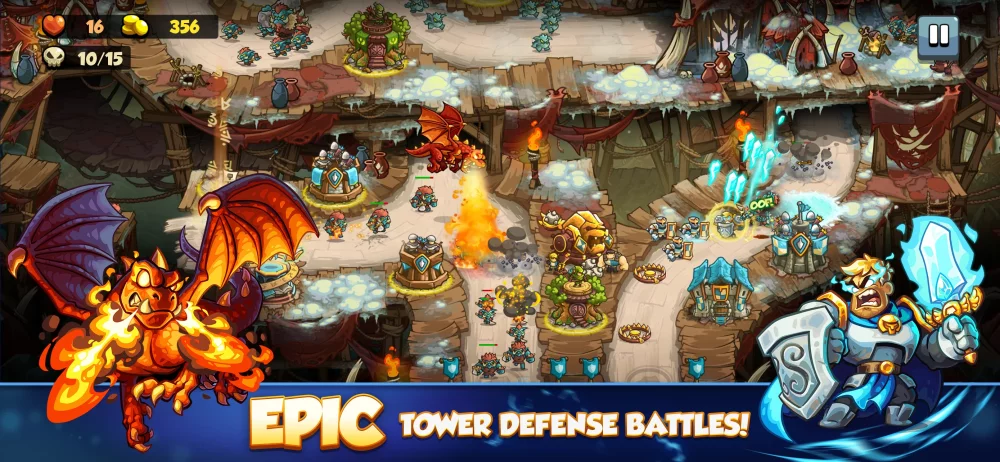
In Kingdom Rush 6: Genesis, your hero is not merely a static unit; they are your most versatile tactical asset. While towers provide the foundation of your defense, the difference between a three-star victory and a narrow defeat often comes down to how effectively you manage your hero’s position and ability cooldowns. Because enemies in the prequel setting of Kingdom Rush 6: Genesis feature diverse movement patterns and resistances, relying on fixed defensive lines is rarely enough to survive the late-game waves.
Mastering "dynamic engagement"—the art of moving your hero to intercept, stall, and destroy—is the definitive skill for high-level players. This guide explores how to leverage mobility and ability timing to gain total control over the battlefield.
The Tactical Advantage of Dynamic Hero Positioning
In Kingdom Rush 6: Genesis, static playstyles are a trap. If your hero remains anchored at the start of a path, you lose their utility as soon as the enemies pass them. To maximize your efficiency, you must treat your hero as a mobile "plug" for your defensive leaks.
Why Mobility Matters
- Intercepting Leakers: If a fast scout or a high-HP unit slips past your primary barracks, your hero can be repositioned to intercept them before they reach the exit.
- The "Chokepoint Anchor": By placing your hero at the mouth of a chokepoint, you can force enemies to clump together. This density is essential for maximizing the value of your Area-of-Effect (AoE) towers, such as artillery or magic towers, which are otherwise wasted on single-target units.
- Resetting Engagement: If a wave is too dense, move your hero slightly forward to engage the vanguard. Once the vanguard is engaged, pull your hero back just before the main body arrives. This "kiting" technique forces the enemy into a longer path, giving your towers additional seconds of uptime.
Timing Active Abilities for Maximum Impact
One of the most common mistakes in Kingdom Rush 6: Genesis is "panic-triggering" hero abilities. Every hero has a unique set of active skills, and using them prematurely often leaves you defenseless against the subsequent wave.
The Three-Phase Timing Strategy
- The Assessment Phase: Identify the composition of the incoming wave. Are they high-armor, high-speed, or high-volume? Never activate a crowd-control ability on a lone scout when a mass of armored infantry is five seconds behind.
- The Engagement Phase: Wait until the enemies are fully within the effective range of your most powerful damage towers. Only then should you trigger hero abilities that stun, root, or slow. By stacking your hero’s CC (Crowd Control) with tower damage, you ensure that no enemy leaves the "kill zone."
- The Recovery Phase: If your hero’s health drops below 30%, prioritize movement over ability usage. Pull your hero behind a robust barracks or a high-damage turret. In Kingdom Rush 6: Genesis, heroes regenerate health passively when out of combat; utilizing this "hit-and-run" cycle is the secret to keeping your hero on the field for the entire level.
Managing Hero Trade-offs and Strategic Limitations
Every hero in the game is balanced by specific trade-offs. Some excel at stalling large groups, while others are "assassins" designed to delete high-priority targets. Understanding your hero's archetype is vital for your broader defensive strategy.
- The Tank Archetype: These heroes should be placed in the front-most chokepoint. Their role is to occupy as many lanes as possible. Use their abilities to buff their own defense or sustain health.
- The Utility Archetype: These heroes focus on debuffing enemies or providing support to nearby towers. These should be placed in the center of your "Kill Box," where they can affect the maximum number of towers and enemy units simultaneously.
- The Sniper Archetype: These heroes should avoid direct melee contact. Use their mobility to keep them at the maximum range of the path, picking off high-value targets while your barracks handle the fodder.
Avoiding Over-Extension: The biggest risk in Kingdom Rush 6: Genesis is moving your hero too far forward to chase a retreating enemy. Always ensure that if your hero engages, they are doing so within the range of at least one defensive structure. If they are alone, they are vulnerable; if they are supported, they are a force multiplier.
Strategic Adaptation to Map Layouts
Kingdom Rush 6: Genesis features complex, multi-lane maps that punish players who try to defend everywhere at once.
Lane Prioritization
When facing maps with multiple paths, do not split your focus. If you move your hero to the "weak" lane, you risk the "strong" lane overwhelming your defenses. Instead:
- Identify the Danger Lane: Determine which path has more incoming traffic or closer exit points.
- Commit Your Hero: Your hero should live on the Danger Lane. Use your gold to build towers on the secondary lane, but use your hero to handle the primary threat.
- The "Pivot" Maneuver: If one lane becomes quiet, don't wait for the hero to walk across the map. Use their ability to "teleport" or move rapidly if the game’s mechanics allow, or reposition them well in advance of the next wave.
Summary: The Expert Mindset
Success in Kingdom Rush 6: Genesis requires you to stop viewing your hero as a static unit and start viewing them as a dynamic force of nature. By focusing on active repositioning, patient ability management, and strict lane prioritization, you can overcome even the most difficult waves. Remember: towers are the wall, but the hero is the spear. Keep them moving, keep them supported, and keep them focused on the highest threat on the map. With these principles, you will master the challenges of the prequel setting and secure your legacy as a master of the Kingdom Rush series.

Free Kingdom Rush 6: Genesis Codes
Current active codes and how to redeem them.

Emily Johnson
Emily writes practical mobile strategy guides with a focus on resource planning, base progression, and the early decisions that shape a long-term account.
COMMUNITY
Player Comments
32 players commented on this guide.
This saved me time in the early game.
This helped me understand heroes much better.
This guide answered the exact question I had.
Nice guide. I am checking the other Kingdom Rush 6: Genesis articles next.