
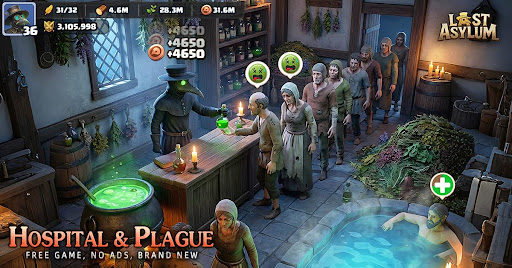
The Buried Treasure mini-game within the Last Asylum: Plague: Plague Mystic Treasure event is a primary source of frustration for many players, largely because it is often mistaken for a game of pure luck. In reality, the event utilizes a structured logic system that rewards observation over random clicking. By learning how to interpret the grid’s visual cues and applying a systematic approach to your excavations, you can stop wasting event stamina and start consistently pulling high-tier rewards from the board.
Understanding the Grid Mechanics
In Last Asylum: Plague: Plague, the Buried Treasure grid is not a random distribution of traps and loot. The game engine generates a hidden map at the start of each round, and your objective is to clear as much of the high-value loot as possible before your limited excavation tools are exhausted.
Many players fail because they treat every tile as an independent event. Instead, you should view the grid as a connected field. When you interact with a tile, the game evaluates your move based on proximity to hidden treasure zones. Selecting a "dead" tile—one that contains traps or empty soil—not only wastes a move but often alerts the game to tighten the RNG for that specific session. Understanding that the grid has a internal hierarchy of loot density is the first step toward moving from a novice to a master excavator.
Identifying Tile Patterns and Visual Cues
Successful excavation in Last Asylum: Plague: Plague relies on identifying subtle environmental clues. While the game does not give away the treasure location explicitly, the tiles are not visually uniform.
- Luminance Shifts: Pay close attention to the lighting on the tiles. Tiles that hide treasure often have a slightly different "glow" or saturation level compared to empty tiles. If you stare at the grid for a few seconds before your first move, you may notice certain tiles reflecting light differently.
- Edge-to-Center Progression: The game’s algorithm often anchors high-value rewards toward the center-diagonal lines of the grid. While not a hard rule, starting your exploration from the corners allows you to "map" the outer perimeter, which often provides clues regarding the heat signatures or treasure density in the center.
- The "Failed Click" Tell: If you click a tile and receive a minimal resource return, observe the tiles immediately adjacent to it. In many iterations of this event, the game clusters rewards in 2x2 or 3x3 blocks. A "near miss" on a low-value reward is often an indicator that you are one tile away from a high-value hoard.
Strategic Resource Management
Your primary constraint in the Mystic Treasure event is your limited pool of excavation tools. If you run out of tools, your session ends regardless of how much treasure remains. To maximize efficiency, you must calculate the "Cost-per-Tile" (CPT) ratio.
The Systematic Excavation Strategy:
- The Perimeter Sweep: Begin by clearing the four corners. This establishes a baseline for the grid’s current logic.
- The Cross-Pattern: If the corners yield nothing, move to the center of each side, forming a cross. This covers 40% of the grid with minimal movement.
- Cluster Harvesting: Once you successfully uncover a treasure, immediately prioritize the tiles touching that successful tile. Do not jump to a random area of the board; the probability of "chaining" rewards is significantly higher when you stay within the discovered cluster.
- The "Stop-Loss" Limit: If you use three consecutive tools without finding a reward, reset your strategy. Move to the opposite quadrant of the grid. Do not fall for the "gambler's fallacy" by assuming that because you missed five times, you are "due" for a win in that specific spot.
Avoiding Common Pitfalls
Even experienced players in Last Asylum: Plague: Plague fall into predictable traps. Avoiding these mistakes will put you ahead of the majority of the player base.
- Ignoring the Timer: While the event has a time limit, it is almost always more than enough time to think. Do not feel rushed. The game designers include the timer to induce panic, which leads to sloppy, random clicking.
- Pattern Bias: You might have noticed a successful pattern yesterday—perhaps clicking in a "snake" formation worked perfectly. However, the game resets its randomization logic periodically. If the snake pattern fails twice, abandon it immediately.
- Over-Investing in Empty Zones: If you have cleared a 3x3 area and found nothing, move on. Many players spend 50% of their tools trying to "clear" an empty zone, hoping for a hidden reward that isn't there. Accept the loss, move to a new sector, and save your remaining tools for a fresh start.
Why This Strategy Works
The logic behind this approach is based on the way Last Asylum: Plague: Plague distributes assets. By using a systematic grid search (Perimeter -> Cross -> Cluster), you are essentially reducing the "search space" for the game's RNG. When you click randomly, you provide the game with no useful data to narrow down the loot location. When you click systematically, you effectively force the game to reveal the proximity of high-value items through the process of elimination.
This is the most effective way to ensure that your limited event tools yield the maximum amount of rare materials. By treating the Buried Treasure as a logic puzzle rather than a gambling mechanic, you remove the element of chance.
Conclusion: Turning Luck into Logic
Mastering the Buried Treasure mini-game in Last Asylum: Plague: Plague is entirely achievable with patience and a methodical mindset. By focusing on visual cues, resisting the urge to guess, and staying disciplined with your resource management, you ensure that you walk away from the Mystic Treasure event with the highest possible tier of rewards.
Stop relying on luck and start relying on your observation skills. The next time the Mystic Treasure event goes live, apply these strategies, keep your cool, and watch your inventory fill with the rare loot that separates top-tier survivors from the rest of the pack. Remember: in Last Asylum: Plague: Plague, the most valuable treasure is the one you extract through precision, not chance.

Free Last Asylum: Plague Codes
Current active codes and how to redeem them.

Sarah Williams
Sarah specializes in RPG and collection games, explaining team building, character growth, and beginner-friendly ways to avoid expensive early mistakes.
COMMUNITY
Player Comments
78 players commented on this guide.
I tried this today and it worked better than my old setup.
Nice guide. I am checking the other Last Asylum: Plague articles next.
This guide answered the exact question I had.
Good guide for Last Asylum: Plague players. The updates part was useful.