

To reach 3,000 points in Last War Frontline Breakthrough, you must maximize your squad size before the end of the run by switching from flat addition gates to multiplier gates, destroying explosive barrels before they make contact, and burning down the final boss quickly. High-scoring runs require keeping troop casualties near zero so your active formation scales exponentially through late-stage multiplier gates.
Prioritizing Gate Choices for Squad Scaling
Your gate selection must change dynamically based on your current troop total. Early in a run, flat additions provide more raw units than low multipliers. Once your formation reaches mid-tier numbers, multipliers yield significantly higher gains.
| Current Squad Size | Priority Choice | Mechanical Reason |
|---|---|---|
| 1–25 soldiers | Flat additions (+10 to +30) | Outperforms low multipliers when starting with a small base count. |
| 26–50 soldiers | Comparative value | Take whichever gate yields the higher gross unit sum immediately. |
| 50+ soldiers | Multipliers (x2 or higher) | Multipliers deliver rapid unit growth that flat additions cannot match. |
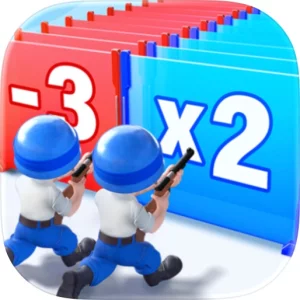
Always calculate the yield before passing through split gates. If you hold 15 soldiers, an addition gate of +20 yields 35 total units, whereas an x2 gate yields only 30. Conversely, if you hold 50 soldiers, an x2 gate increases your squad to 100, easily beating standard flat additions.
Clearing Barrels and Navigating Obstacles
Red explosive barrels and numeric barriers destroy active soldiers on impact. Because final point calculations depend heavily on maintaining a high squad volume, running into obstacles directly lowers your score ceiling.
Execute these firing and movement habits to navigate lanes cleanly:
- Pre-fire center lanes: Keep your primary firing cone focused down the center of the track so bullets weaken upcoming obstacles before you have to commit to a lane.
- Break low-value numeric barriers: When forced to shoot through barricades that require a set number of hits, concentrate fire on the lowest number available to breach the lane quickly.
- Detonate barrels near enemy clusters: Triggering an explosive barrel adjacent to enemy groups eliminates the entire wave immediately without draining your squad's direct gunfire.
- Avoid late lane shifts: Jerking sideways at the last second frequently drives your formation into obscured explosive barrels or negative deduction gates.
Preserving Squad Footprint and Positioning
As your squad expands into dozens of soldiers, your formation spreads horizontally across the track. Steer carefully around hazards, because outer-edge troops will trigger negative deduction gates (-10 or ÷2) even if your center hero passes through safe space.
- Watch the top edge of the track: Focus your attention two to three seconds ahead of your squad to spot hazard layouts early.
- Make gradual micro-adjustments: Steer using gentle arcs to keep your formation compact and avoid swinging your trailing flanks into split-wall dividers.
- Favor safe paths over risky bonuses: Never cross multiple rows of hazards to reach a multiplier gate, as the unit losses sustained while reaching it often erase the gate's net gain.
Optimizing the Boss Encounter
Entering the final boss encounter with at least 50 soldiers ensures the damage output necessary to earn a rapid-kill time bonus. Bosses feature deep health pools and deploy attacks that quickly whittle down underpowered squads.
Align your formation directly with the boss's center hitbox as soon as it appears so all units maintain continuous fire. If the boss unleashes area-of-effect attacks or charges forward, sidestep with short, deliberate adjustments rather than wide sweeps across the lane. Keeping continuous fire focused on the target eliminates the boss in seconds, locking in the remaining time bonus and pushing your final score toward the 3,000-point mark.
Free Last War Codes
Current active codes and how to redeem them.

Emily Johnson
Emily writes practical mobile strategy guides with a focus on resource planning, base progression, and the early decisions that shape a long-term account.
COMMUNITY
Player Comments
138 players commented on this guide.
This helped me understand early game much better.
The explanation is clear, especially for beginners.
I tried this today and it worked better than my old setup.
This guide answered the exact question I had.