
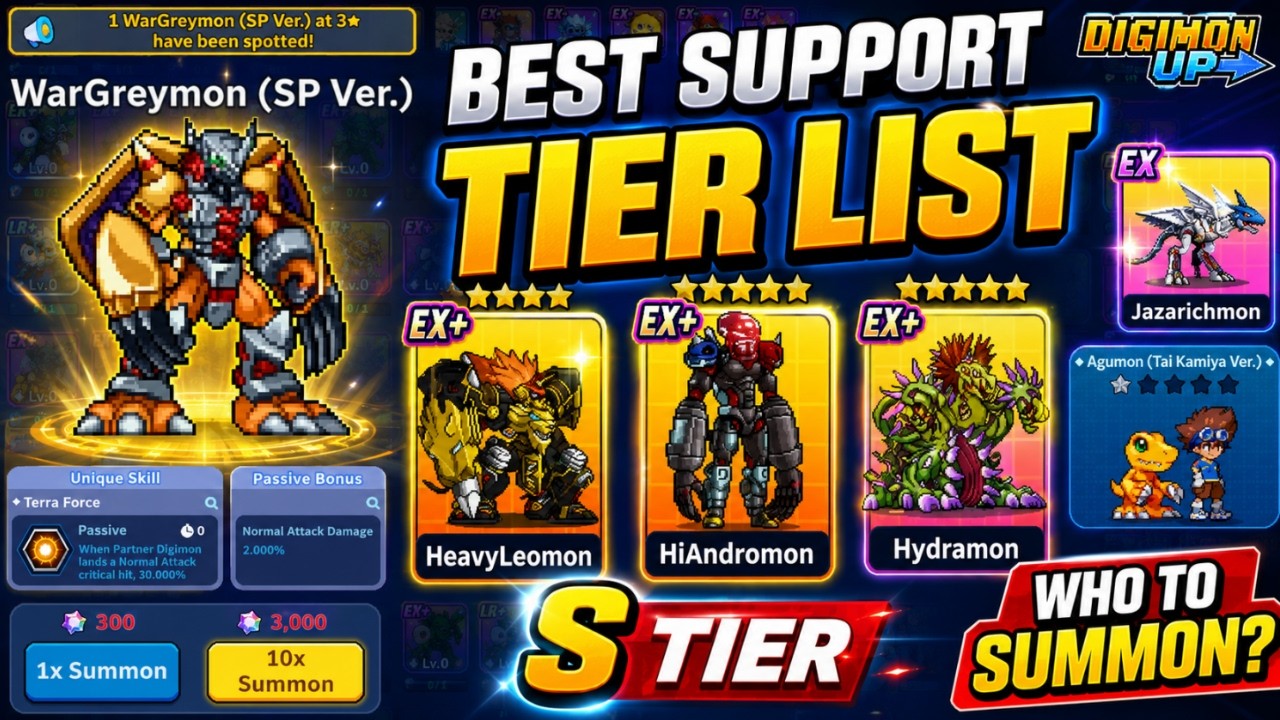

To dominate early-game content in DIGIMON UP, focus your summons on high-impact Support Digimon that provide essential utility, healing, and damage amplification. While the game is still in its infancy, specific units currently outclass others in survivability and team synergy. By investing your resources into the correct banners—specifically targeting SP-ranked support units—you can significantly increase your efficiency in boss encounters and general progression, ensuring your team remains viable as you reach mid-game challenges.
Prioritizing SP-Ranked Support Digimon
The most significant power spikes in DIGIMON UP come from SP-ranked support units. These characters are not just niche additions; they are foundational pillars for any competitive team. WarGreymon SP stands out as a primary target for your summons due to his unique ability to influence the flow of combat. When you are deciding where to spend your premium currency, prioritize these units over standard summons, as their kit depth offers long-term value that standard units struggle to match.
Evaluating Regular Support Digimon
While SP units are the goal, your team will rely heavily on regular Support Digimon during the initial grind. Units like HeavyLeomon, HiAndromon, Hydramon, and Jazarichmon serve distinct roles that can stabilize your squad. HeavyLeomon and HiAndromon are particularly effective for players needing reliable frontline presence, whereas other units in this tier specialize in specific buffs or utility. Assess your team’s current gaps—whether you lack a healer, a defensive buffer, or a debuffer—before finalizing your investment in these regular units.
Strategic Role Fulfillment: Healing and Bossing
A balanced team in DIGIMON UP requires more than just raw DPS; it requires a dedicated support structure to handle boss mechanics and sustained encounters. For bossing, look for support units that offer defense reduction or consistent party-wide healing. These mechanics are essential for overcoming the attrition damage found in higher-level stages. If your team is struggling to survive through the duration of a boss fight, prioritize swapping your secondary DPS for a dedicated healer or defensive buffer from the regular pool.
Resource Management for Free-to-Play Players
If you are playing without spending, resource management is the most critical aspect of your progression. Do not spread your summons thin across every new banner. Instead, focus your tickets and currency on targeted support banners that offer the most significant upgrades to your current roster. By saving for high-value SP support units and using your regular summons to fill specific utility roles, you maintain a leaner, more effective team that can tackle difficult content without needing a massive roster of duplicates.
Building Early-Game Team Compositions
Your early-game team should revolve around a core synergy between your primary attacker and your support units. A common mistake is to overlook the support slots in favor of more damage dealers. However, the game’s difficulty spikes often necessitate at least one dedicated support unit that can keep the party alive or provide necessary damage-boosting skills. As you progress, experiment with different combinations of HiAndromon or Hydramon to see which defensive or offensive utility best complements your current main damage dealer.
Limitations of Current Early-Game Rankings
Because DIGIMON UP is a new release, keep in mind that tier lists are subject to change as the meta evolves. As more players reach the late-game and begin testing units in PvP environments, the perceived value of certain support Digimon may shift. Treat current rankings as a guide for your immediate needs rather than an absolute truth. Always test units in actual combat scenarios to see how they perform within your specific team composition before committing heavy resources to them.

Sarah Williams
Sarah specializes in RPG and collection games, explaining team building, character growth, and beginner-friendly ways to avoid expensive early mistakes.
COMMUNITY
Player Comments
152 players commented on this guide.
This helped me understand early game much better.
This guide answered the exact question I had.
I tried this today and it worked better than my old setup.
I wish I had read this before upgrading the wrong thing.