
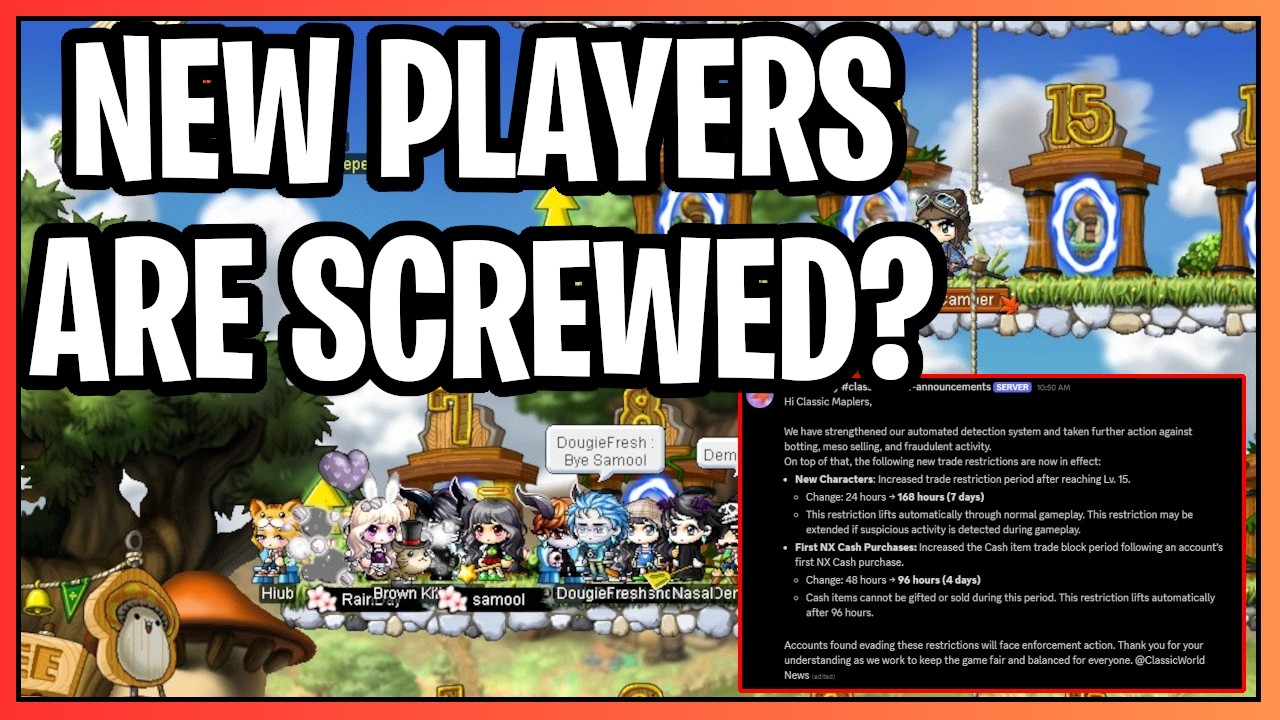

To survive the mandatory seven-day trade ban on a new Classic MapleStory account, you must play entirely self-sufficiently: pick a low-upkeep class, rely on early quest rewards for potions and equipment, and sell monster drops to NPC vendors for basic meso income.
How the 7-Day Trade Restriction Works
The trade restriction lasts exactly 168 hours from account creation. Designed as an anti-bot measure to stop automated currency transfers, it completely isolates new accounts from the player-driven economy:
- No Player-to-Player Trading: Trade windows cannot be opened with other characters.
- No Free Market Access: You cannot buy or sell items via player shops or merchant stalls.
- No Ground Transfers: Dropped items vanish or remain invisible to other players, preventing friends or alternate accounts from passing down gear, mesos, or potions.
Because you cannot receive starter mesos or low-cost gear from other players, running out of funds before level 30 can stall your progression entirely.
Choosing an Economically Sustainable Class
Class selection heavily dictates early survival. Classes that burn through consumable items will rapidly deplete your limited meso reserves.
- Magicians (Best Solo Economy): Magicians provide the highest sustainability during the trade lock. Early access to Magic Claw provides reliable damage, while MP Eater offsets Blue Potion costs. Advancing to Cleric at level 30 grants Heal, which eliminates HP potion costs when fighting undead monsters.
- Bowmen (Moderate Upkeep): Bowmen have steady ranged damage, but purchasing NPC arrows consistently cuts into early meso profit.
- Warriors (High Upkeep): Melee range and low early accuracy force frequent damage intake, requiring steady White Potion purchases before second-job defensive tools unlock.
- Thieves (Highest Upkeep): Assassins struggle most under trade-locked conditions because upgraded throwing stars (such as Kumbis or Tobis) cannot be bought from players, while claw upgrades and constant potion usage quickly drain starter mesos.
Managing NPC Consumables and Meso Flow
Preventing bankruptcy requires matching your potion purchases to your character's actual stat pools and taking advantage of passive recovery.
| Resource Category | Recommended Action | Costly Mistake to Avoid |
|---|---|---|
| HP Restoration | Buy Red or Orange Potions sized to your maximum health pool. | Purchasing expensive White Potions while maximum HP is still below 500. |
| MP Recovery | Sit on chairs or town benches during downtime to recover MP naturally. | Chugging Blue Potions continuously during low-yield mob grinding. |
| Monster Loot (Etc) | Pick up every monster drop and sell all non-essential items to NPC shops. | Leaving monster drops on the ground to save inventory space. |
| Travel | Walk between linked maps or use regular taxis only when necessary. | Spending excessive mesos on VIP Cab services early on. |
Essential Early Quests for Free Supplies
Victoria Island quests grant potions, equipment, and mesos that bypass NPC store markups. Prioritize these quests as soon as you meet their level requirements:
- Pio's Quest (Maple Island): Complete this before leaving Maple Island to obtain the Relaxer chair, which accelerates resting HP recovery.
- Maya and the Weird Medicine (Henesys): Rewards a Level 20 Hat and substantial early experience, saving you the expense of buying merchant headgear.
- John’s Pink Flower Basket (Lith Harbor): Accessible by completing the Sleepywood jump quest, granting a direct supply of mesos and restorative potions.
- Jane and the Wild Boar (Lith Harbor): Unlocks at Level 25 and rewards a valuable weapon scroll. Store this scroll safely rather than selling it to an NPC.
- Nella’s Kerning City Requests: Completing Nella's item delivery tiers awards bulk potion packs, gloves, and refined ores.
Transitioning to the Free Market After Day Seven
Do not sell rare monster drops, equipment with above-average stat rolls, or weapon scrolls to NPC vendors. Shopkeepers pay a negligible fraction of their actual player-market value.
Place all tradeable scrolls, valuable equipment, and surplus crafting materials into your town storage during your first week. Once the 168-hour timer expires, list these accumulated items in the Free Market to fund your mid-game gear upgrades, class-specific consumables, and secondary equipment.

Emily Johnson
Emily writes practical mobile strategy guides with a focus on resource planning, base progression, and the early decisions that shape a long-term account.
COMMUNITY
Player Comments
128 players commented on this guide.
This saved me time in the early game.
I tried this today and it worked better than my old setup.
The tips are practical and easy to follow.
This guide answered the exact question I had.