
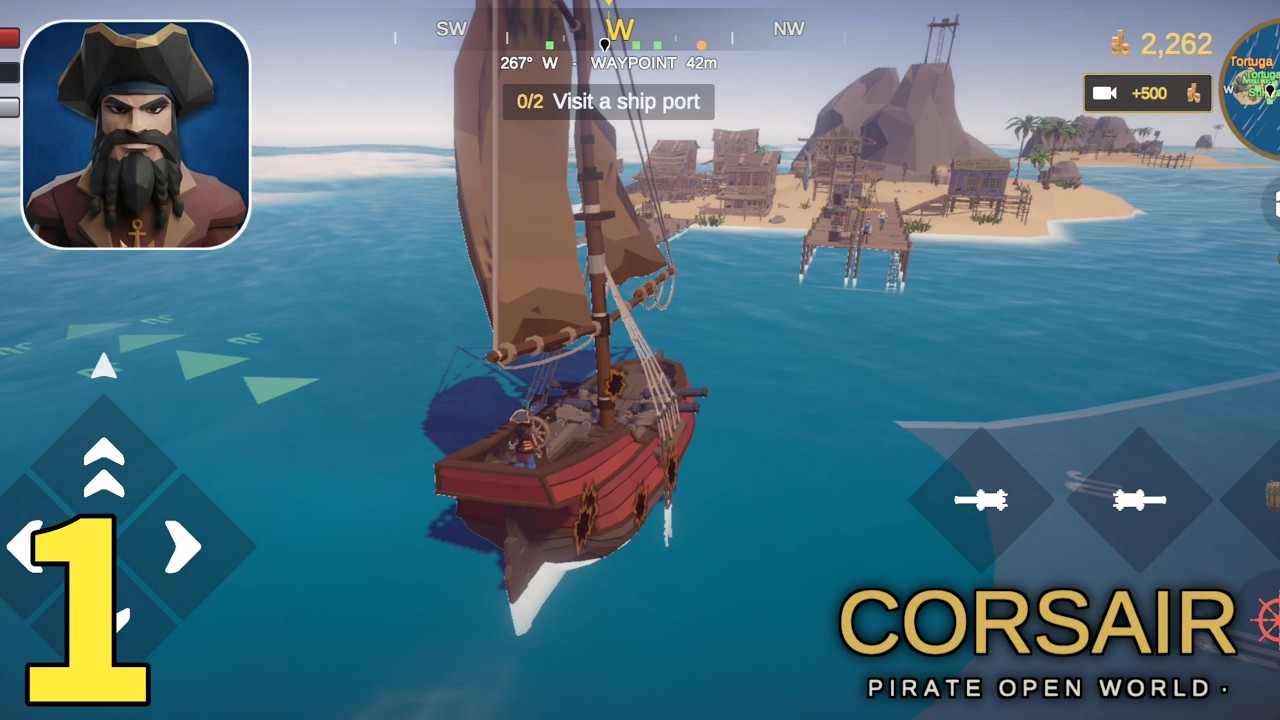

Corsair: Pirate Open World offers a focused, offline pirate simulation experience that rewards tactical patience and environmental awareness. Unlike many arcade-style mobile games, success here is dictated by your ship's positioning, the management of your hull integrity, and your ability to exploit the AI’s movement patterns. Whether you are hunting for sunken gold or engaging in high-stakes naval duels, this guide will provide the foundational knowledge needed to transition from a novice captain to the most feared pirate on the seven seas.
Mastering Naval Combat Mechanics
Combat in Corsair is defined by the "broadside" mechanic. Your ship’s cannons are mounted on the port and starboard sides, meaning your front and back are your weakest points.
The Art of the Broadside
To maximize damage, you must maneuver your ship so that your cannons are facing the enemy. Avoid attacking head-on, as this leaves you vulnerable to incoming fire while preventing you from using your own primary weapons. Instead, use a circling maneuver:
- The Approach: Maintain a parallel course to your enemy.
- The Volley: Wait until the enemy ship is broadside to you before firing.
- The Reset: If your shots miss or the enemy begins to turn, adjust your rudder immediately to create distance or reposition for another pass.
Accounting for Physics
Because the game utilizes a physics-based ocean, your ship will naturally pitch and roll. If you fire while your ship is tilting significantly due to a wave, your accuracy will suffer. Experienced captains wait for the moment of stability—the "crest" or "trough" of the wave—to unleash their broadside. Firing during these stabilized moments significantly increases the number of direct hits, which is vital for conserving ammunition during extended skirmishes.
Strategic Navigation and Coastal Fort Raids
The open world is segmented into zones that scale in difficulty. Raiding coastal forts is the most reliable way to gain significant wealth and reputation, but these structures are heavily defended.
Approaching Forts
Never sail directly into the firing range of a fort’s cannons. Most AI-controlled fortifications have fixed firing arcs. Before committing to an attack:
- Reconnaissance: Circle the fort at a distance to identify its "blind spots"—areas where the shore-mounted cannons cannot depress or rotate to reach you.
- Engagement: Park your ship in a blind spot and rain fire upon the fort until its defenses are neutralized.
- The Landing: Once the defensive fire ceases, move closer to secure the objective.
Environmental Awareness
Navigation isn't just about reaching a destination; it's about pathfinding. Use the game’s map to identify shallow waters and reefs. While these areas might provide a shortcut, they can also damage your hull if you are not careful. As an offline game, you have the luxury of time; use it to plot routes that pass by smaller merchant vessels, which can serve as "target practice" to hone your aim before tackling more challenging fortifications.
Treasure Hunting and Resource Management
Exploration is the backbone of your income. However, the open sea is unforgiving, and poor resource management will leave you stranded.
Efficient Treasure Hunting
Sunken treasure is often located in deep-sea zones or near dangerous shipwrecks. Before you dive or stop to loot, follow this checklist:
- Clear the Area: Ensure no hostile ships are on your radar. AI ships are opportunistic; if they see you idling or "anchored," they will often initiate combat.
- Ship Integrity: Never dive for treasure if your hull health is below 40%. A surprise encounter with a roaming rival could result in your ship sinking before you can return to the helm.
Managing Your Supplies
Resource management is critical for long-term survival. Your ammunition and ship health are your most valuable assets.
- Ammo Conservation: Only fire when you have a clear shot. Firing wildly into the water is a waste of gold and time.
- Return to Port: If your ship takes critical damage, prioritize returning to a port for repairs. Attempting to "push through" a voyage with a damaged ship slows your maneuverability, making you a sitting duck for faster, healthier vessels.
Strategic Progression: Choosing Your Path
Corsair allows for a non-linear progression, meaning you can choose to be a merchant-hunter, a professional explorer, or a dedicated naval combatant.
The Combat vs. Exploration Trade-off
- Combat Focus: High risk, high reward. You gain gold quickly by plundering ships and forts, but you will spend a significant portion of your profits on ship repairs and ammunition replenishment.
- Exploration Focus: Lower risk, steady growth. By focusing on treasure hunting and discovering new points of interest, you maintain a healthier ship and avoid the constant repair bills associated with aggressive warfare.
Investing in Upgrades
When you reach a port, always prioritize upgrades in the following order:
- Hull Integrity: A stronger ship allows for more mistakes in combat.
- Cannons: Increased damage output shortens the duration of fights, which in turn reduces the damage you take.
- Speed/Maneuverability: Essential for escaping overwhelming odds or positioning yourself for the perfect broadside.
By scaling your ambitions—tackling smaller, singular ships before moving to massive fortresses—you build a sustainable gameplay loop. Remember that in Corsair: Pirate Open World, the goal is not to win every fight, but to survive until you have the resources to conquer the entire map. Patience, steady aim, and calculated movement are the tools that will elevate your status from a mere sailor to a legend of the seven seas.

Sarah Williams
Sarah specializes in RPG and collection games, explaining team building, character growth, and beginner-friendly ways to avoid expensive early mistakes.
COMMUNITY
Player Comments
24 players commented on this guide.
Good guide for HOT players. The resources part was useful.
This helped me understand resources much better.
Nice guide. I am checking the other HOT articles next.
I wish I had read this before upgrading the wrong thing.