
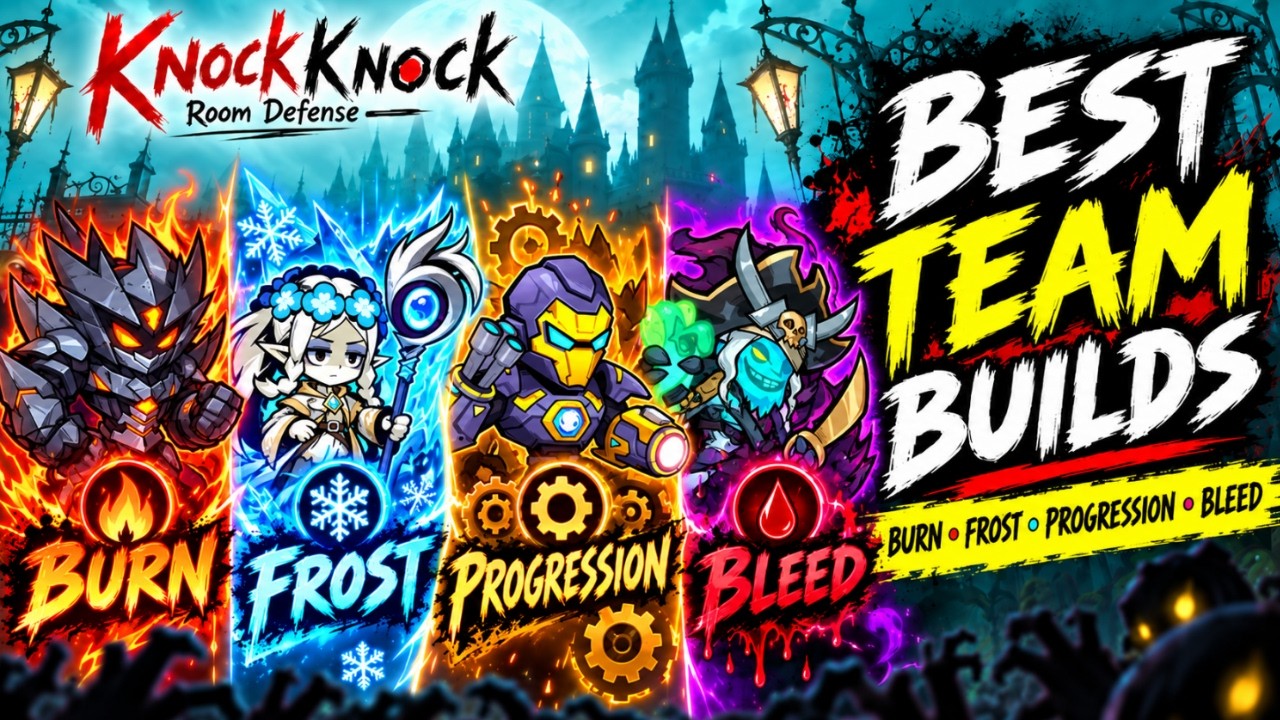

To clear stages efficiently in Knock Knock: Room Defense, build your team around synchronized damage-over-time debuffs or dedicated crowd control rather than picking random heroes. Standard campaign progression relies on a single main damage dealer backed by support units, while specialized encounters demand focused elemental setups.
General Campaign and Boss Setup
When pushing general campaign stages, your primary goal is balancing sustained damage with debuff utility.
- Main Carry Focus: Select one primary damage dealer as your core focus and upgrade their levels first to raise your team's damage ceiling.
- Support Synergy: Fill secondary slots with heroes that apply damage-amplifying debuffs or status utility rather than running multiple defensive units.
- Boss Adjustments: Shift away from broad area-of-effect (AoE) units during boss encounters. Swap in characters offering high single-target burst, damage stacking, or percentage-based health reduction to bypass boss armor and health regeneration.
Team Composition Comparison
| Team Archetype | Core Focus | Key Advantage | Trade-Off / Limitation |
|---|---|---|---|
| Burn | Wave clearing & mob damage | High damage-over-time uptime and fire attack bonuses | Requires constant debuff application to avoid damage resets |
| Frost | Room control & stalling | Keeps high enemy density frozen and safe from the frontline | Lower single-target DPS; risks running out of stage time |
| Bleed | High-health target / Boss shred | Continues ticking damage during repositioning or stuns | Requires time to stack; demands backline survivability |
| Wave Clear | Resource farming & speed | Rapid AoE clearing of standard mob waves | Weak performance against isolated single-target bosses |
Building Elemental DoT Teams (Burn & Bleed)
Damage-over-time (DoT) strategies rely on keeping debuff stacks active throughout the entire wave.
Burn Team Rules
- Establish a Primary Applier: Assign a main fire hero whose base attacks consistently apply burn status.
- Add Synergy Partners: Pair your applier with heroes that gain bonus attack speed or extra damage against fire-afflicted targets.
- Maintain Uptime: Deploy enough fire units to ensure burn stacks do not expire between wave spawns.
Bleed Team Rules
- Prioritize Stacking Speed: Select heroes capable of placing multiple flat or percentage-based Bleed stacks per attack.
- Equip Armor Reduction: If you lack a core Mythic Bleed hero, substitute units with armor reduction capabilities to amplify existing Bleed damage.
- Protect Backline Units: Maintain defensive support so your heroes survive long enough for Bleed stacks to drain boss health bars completely.
Controlling Waves with Frost and AoE Builds
When under-leveled for a mission or farming resources, shift your setup to stall mechanics or wide-coverage AoE skills.
- Frost Stall-and-Shred: Use Frost teams to slow down heavy enemy waves when your raw damage output is insufficient. If a Frost build fails due to the stage timer expiring, swap out one crowd-control hero for a high burst DPS character to trade safety for speed.
- Wave Clear Positioning: Place your strongest AoE damage dealers in the center of your defensive line to maximize hit coverage across incoming lanes.
- Disruption Support: Pair AoE damage dealers with secondary heroes providing knock-back or stun abilities, giving your main damage units time to refresh their ability cooldowns.

Sarah Williams
Sarah specializes in RPG and collection games, explaining team building, character growth, and beginner-friendly ways to avoid expensive early mistakes.
COMMUNITY
Player Comments
71 players commented on this guide.
This helped me understand heroes much better.
I wish I had read this before upgrading the wrong thing.
Can you add more details about heroes in a future update?
Good guide for HOT players. The heroes part was useful.