
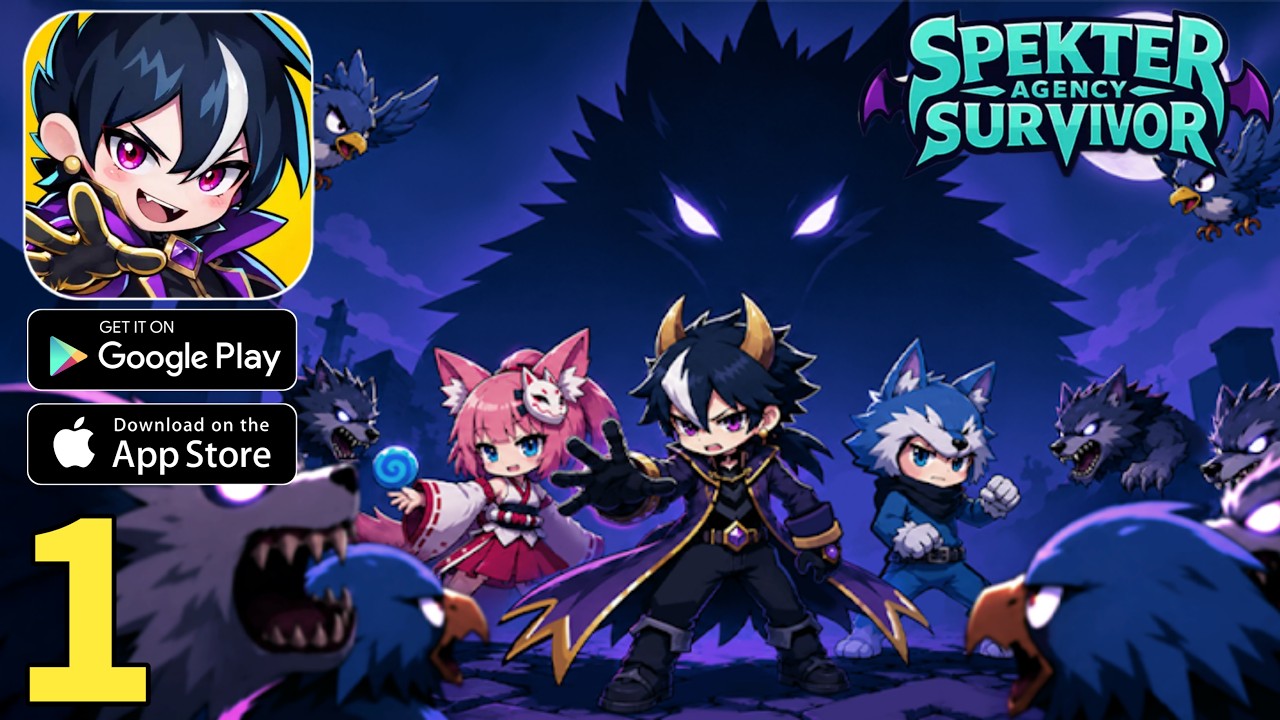

Spekter Agency: Survivor is a high-octane rogue-lite that punishes hesitation and rewards tactical positioning. In a game where the screen is constantly flooded with aggressive monsters and formidable bosses, your survival depends on more than just raw firepower—it requires a deep understanding of your chosen Agent’s mechanics and the ability to control the flow of the battlefield. This guide provides the strategic framework necessary to move from early-game struggle to consistent, high-level survival.
Understanding Agent Archetypes and Selection
In Spekter Agency: Survivor, your Agent choice is the foundation of your build. Each character features distinct base stats and personality-driven ability sets that cater to different tactical preferences. Selecting the right one for your skill level is the first step toward clearing higher dimensions.
- Nox (The Cunning): Designed for high-mobility players. Nox relies on hit-and-run tactics, making them ideal for players who excel at dodging and weaving through tight enemy clusters.
- Vel (The Relentless): Best suited for players who prefer to stay in the heart of the fray. Vel’s kit is built to sustain damage while aggressively pushing forward, turning the tide of dense swarms.
- Zen (The Focused): A precision-based character. Zen excels at picking off high-priority targets from a distance, making them a top choice for players who struggle with boss damage output.
- Shu (The Powerful): The heavy-hitter archetype. Shu possesses raw area-of-effect capabilities, allowing you to clear massive groups of minor enemies with ease.
Expert Insight: If you are a beginner, prioritize Shu or Vel. Their ability to handle groups simplifies the chaotic early game, allowing you to focus on learning enemy patterns rather than struggling to clear basic mobs.
The Art of Combat Mobility: Mastering "Kiting"
Movement is your primary defensive stat in Spekter Agency: Survivor. Because you are outnumbered, standing still is effectively a death sentence. You must master "kiting"—the technique of moving away from enemies while consistently firing backward or toward them.
To execute this effectively:
- Maintain Constant Motion: Never move in a straight line for too long. Use circular or zig-zag patterns to force enemies to group up rather than surround you.
- The "Stop-and-Go" Check: If you feel the pressure of the swarm, stop shooting for half a second. Use this window to identify gaps in the enemy formation and dash through them.
- Avoid the Edges: Treat the screen edges as danger zones. Always try to pull the swarm toward the center of the map to ensure you have 360-degree room to maneuver if a boss suddenly spawns.
Strategic Wave Management and Target Prioritization
The difficulty in Spekter Agency: Survivor scales based on time, not just location. As the timer ticks down, the density of the swarm increases exponentially. Your ability to manage "enemy budget"—how many enemies are alive at once—is crucial.
- Thin the Herd Early: Prioritize killing the fastest, weakest enemies first. If you allow fast units to reach you, they will force you to change your movement path, which inevitably leads to getting trapped by larger, slower units.
- Avoid "Pinched" Scenarios: If you see a cluster forming on your left and right, do not try to fight your way through the center. Pick one side and focus all your damage to create an opening, then reposition to a clear area of the map.
- Boss Focus: When a boss appears, ignore the minor mobs unless they are blocking your path. Keep the boss at the edge of your screen and focus your fire until their health bar depletes.
Synergizing Upgrades for Maximum DPS
As you progress through a run, you will earn experience and select upgrades. A common mistake is choosing upgrades based solely on "Damage" stats. Instead, look for mechanical synergies that complement your Agent’s playstyle.
- Rate-of-Fire vs. Impact: If you are using an Agent with high base fire rate, prioritize upgrades that add elemental effects (like burn or freeze) or piercing. This turns your rapid-fire attacks into a screen-clearing force.
- The Mobility Trap: Many players pick high-damage upgrades that come with a movement speed penalty. In the mid-to-late game, being slightly slower is often fatal. Always favor movement speed and defensive utility over a minor 5% damage increase if your survivability feels shaky.
- Piercing Priority: If you find yourself frequently surrounded, prioritizing piercing or area-of-effect (AOE) upgrades is mandatory. Single-target damage is for bosses; piercing damage is for survival.
Environmental Awareness and Boss Tactics
The haunted dimensions in Spekter Agency: Survivor are not just flat planes; they often contain environmental obstacles. These are your best tools for crowd control.
- Chokepoints: Use obstacles to your advantage. Lead large waves into narrow gaps or around corners. This slows their advance and causes them to "clump," making it much easier for your AOE skills to hit them all at once.
- Boss Animations: Learn the telegraphs. Every boss has a "wind-up" animation before a heavy attack. When you see this, stop attacking and move perpendicularly to the boss. Do not try to tank the damage—the penalty for losing health is often a loss of momentum that you cannot recover from.
- Patience: If your damage output is low, do not force an engagement with a boss. Keep kiting and clearing small mobs to level up. Often, one or two lucky upgrade rolls are all you need to turn a difficult boss fight into a breeze.
By focusing on movement discipline, smart upgrade synergy, and aggressive wave management, you will find yourself surviving significantly longer in Spekter Agency: Survivor. Remember: the game is about attrition. Stay mobile, stay focused, and keep your escape routes open.

Emily Johnson
Emily writes practical mobile strategy guides with a focus on resource planning, base progression, and the early decisions that shape a long-term account.
COMMUNITY
Player Comments
104 players commented on this guide.
Good guide for HOT players. The strategy part was useful.
The explanation is clear, especially for beginners.
This helped me understand strategy much better.
I tried this today and it worked better than my old setup.