
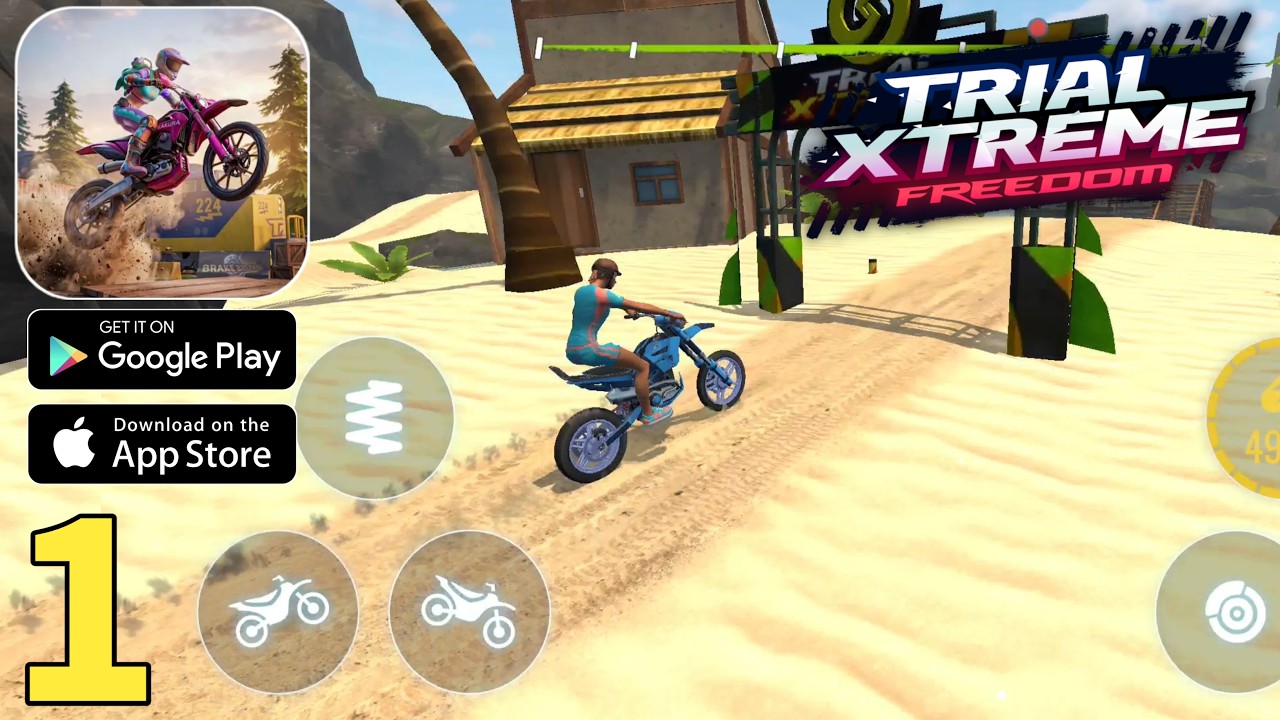

Trial Xtreme Freedom challenges players to navigate high-speed, obstacle-heavy tracks that demand more than just holding the accelerator. To succeed, you must balance your bike’s physics, effectively manage your rider's posture, and understand the timing of jumps and landings. This guide breaks down the essential movement mechanics required to master the early stages, helping you maintain momentum and avoid the frustration of frequent restarts on challenging terrain.
Mastering Throttle Control for Surface Traversal
Success in Trial Xtreme Freedom relies heavily on understanding that constant full-throttle acceleration is often a recipe for disaster. While reaching high speeds is necessary for clearing wide gaps, the game’s realistic physics engine means that excessive power on uneven terrain will cause your bike to flip backward or lose traction.
To optimize your speed, apply throttle in pulses when navigating bumpy sections or debris. This allows your suspension to absorb the impact of smaller obstacles without sending the rear tire into a spin. When approaching steeper inclines, you should lean into the throttle to generate the necessary torque, but be prepared to ease off the moment your front tire clears the ledge to prevent an over-rotation.
Utilizing Rider Weight Distribution
Managing the rider's center of gravity is the most critical mechanic for surviving vertical obstacles. Your bike behaves like a pendulum; by shifting your rider's weight forward or backward, you can influence the angle of your jump or the stability of your landing.
- For Ascending: Lean backward as you approach a steep ramp or step. This keeps the front wheel light, allowing it to "walk" up the obstacle rather than slamming into it.
- For Descending: Keep your rider centered or slightly forward. This prevents the bike from tipping backward when you hit the flat ground at the bottom of a drop, which is a common cause of crashes.
- For Gap Jumps: Use a slight backward shift just before leaving the ramp to maximize your lift, then transition to a neutral position while in the air to ensure a level landing.
Navigating Complex Obstacle Sequences
The game tracks feature sequences of obstacles that require a rhythmic approach. Trying to brute-force through these areas typically results in a loss of momentum or a crash. Instead, focus on the "landing zone" for every major jump, as landing on your front wheel is almost guaranteed to end your run prematurely.
Always aim to land with your rear wheel first, or both wheels simultaneously, to maintain control. If you find yourself in the air and realize your angle is off, release the throttle immediately. In many cases, the game’s physics will allow you to "drift" the bike slightly in mid-air if you are not actively accelerating, giving you a split second to correct your alignment before impact.
Managing Momentum and Recovery
Momentum is your best friend in Trial Xtreme Freedom, but it must be controlled. There are specific segments where the track will force you into a near-stop, such as rock piles or narrow balance beams. In these instances, the goal is not speed, but consistency.
When you encounter these slow-speed segments, tap the brake lightly to keep the bike upright. If you feel the bike beginning to tilt, use small, rhythmic leans to re-center yourself. Remember that the penalty for crashing is a reset to the last checkpoint; it is almost always better to lose two seconds by navigating an obstacle slowly than to lose ten seconds by crashing and respawning because you were trying to clear it too quickly.
Identifying Your Upgrade Priorities
As you progress through the tracks, you will earn resources that can be funneled into bike upgrades. While it is tempting to dump all your currency into top speed, focus your early upgrades on acceleration and traction. Better traction allows you to recover from mistakes on slippery or loose surfaces, while higher acceleration allows you to get back up to speed quickly after clearing a difficult jump.
Do not ignore the suspension upgrades if they become available. Better suspension reduces the bounce of your bike upon landing, which makes it significantly easier to transition immediately into the next obstacle without losing your line. By prioritizing these mechanical improvements over pure speed, you will find it much easier to clear the technical challenges presented in the later parts of the first tier of tracks.

Sarah Williams
Sarah specializes in RPG and collection games, explaining team building, character growth, and beginner-friendly ways to avoid expensive early mistakes.
COMMUNITY
Player Comments
58 players commented on this guide.
Nice guide. I am checking the other HOT articles next.
This guide answered the exact question I had.
Can you add more details about strategy in a future update?
This saved me time in the early game.