
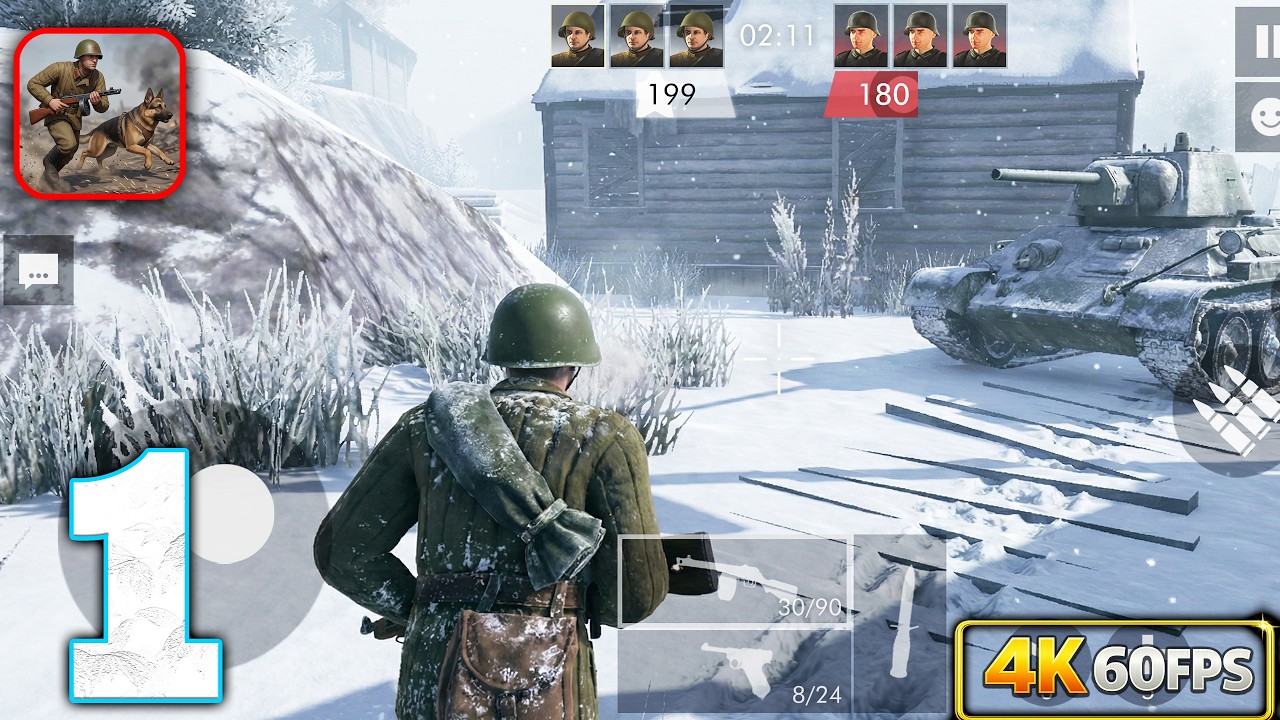

To succeed in Warfare 1942, you must transition from basic run-and-gun tactics to a loadout-focused approach that emphasizes authentic historical weapon handling. Whether you are engaging in high-intensity Team Deathmatch or securing critical nodes in point-capture modes, your survival depends on matching your firearm choice to the specific engagement distance of the map. This guide outlines how to leverage classic WW2 weaponry and tactical positioning to dominate the frontlines on mobile.
Selecting the Right Firearm for the Battlefield
Success in Warfare 1942 begins with understanding the distinct mechanical differences between weapon classes. The game features a variety of authentic 1940s-era firearms, each requiring a different approach to recoil management and target acquisition. Players should prioritize experimenting with both heavy machine guns for suppressive fire and precision sniper rifles for long-range engagements to find a playstyle that complements their team's current composition.
- Heavy Machine Guns: Best utilized for holding down choke points and providing covering fire. These weapons have high ammunition capacity but require careful recoil compensation during sustained bursts.
- Sniper Rifles: Essential for maps with open sightlines. Focus on finding elevated vantage points where you can minimize your exposure while picking off advancing enemies.
- Assault Rifles/SMGs: These are your bread-and-butter for close-quarters combat inside trenches or urban environments where speed and maneuverability are paramount.
Mastering Objective-Based Team Combat
While individual skill is important, Warfare 1942 is fundamentally a team-based experience. In point-capture modes, rushing into the fray alone often leads to quick respawns. Instead, coordinate with your teammates to create a defensive perimeter around strategic points. By synchronizing your attacks with squad members, you can overwhelm enemy positions that would otherwise be impossible to breach solo.
Effective team movement involves staggered positioning, where players with long-range weapons provide cover for those rushing to capture objectives. Always be aware of your minimap to identify clusters of allies, as sticking with a group significantly increases your survivability against coordinated enemy fire.
Tactical Positioning and Environment Usage
The battlefields in Warfare 1942 are designed to reward players who utilize the environment for protection. Trench systems and ruined structures are not just aesthetic; they are your primary defense against incoming fire. When navigating the map, avoid crossing wide-open spaces where you are vulnerable to sniper fire. Instead, hug the edges of structures and move from one piece of cover to the next.
When capturing a point, always scan the surrounding high ground for potential ambushes. Many players make the mistake of standing in the center of an objective while capping it, making them easy targets. Instead, stay near the perimeter of the capture zone, allowing you to quickly retreat to cover if you come under fire while still maintaining control of the area.
Managing Loadout Customization for Success
Customization is the key to maintaining a competitive edge as you progress through the ranks. Before deploying into a match, take time in the loadout menu to refine your gear. Ensure your secondary weapons complement your primary choice; for example, pairing a high-recoil machine gun with a reliable sidearm allows you to stay in the fight if you run dry mid-engagement.
Monitor your performance in different game modes to determine which loadouts work best in specific scenarios. If you find yourself frequently losing close-range duels while carrying a sniper rifle, it is a clear indicator that your current loadout is ill-suited for the map's layout. Adapting your gear between rounds is a crucial habit for high-level players looking to climb the leaderboards.
Strategic Limitations and Combat Trade-offs
It is vital to recognize the limitations of your equipment. High-damage weapons often come with significant recoil or slow reload speeds, creating windows of vulnerability that observant opponents will exploit. If you choose a high-firepower weapon, you must accept that your mobility will be lower, forcing you to play a more stationary or defensive role.
Furthermore, recognize when to retreat rather than force a losing engagement. If your health is low or you are caught out of position, falling back to regroup with teammates is almost always better than attempting a "hero" play. By managing your aggression and respecting the mechanical limitations of your weapons, you ensure that you stay in the fight longer, contributing more points to your team’s total and securing more consistent victories.

Emily Johnson
Emily writes practical mobile strategy guides with a focus on resource planning, base progression, and the early decisions that shape a long-term account.
COMMUNITY
Player Comments
137 players commented on this guide.
The tips are practical and easy to follow.
This guide answered the exact question I had.
This helped me understand base building much better.
Can you add more details about base building in a future update?