
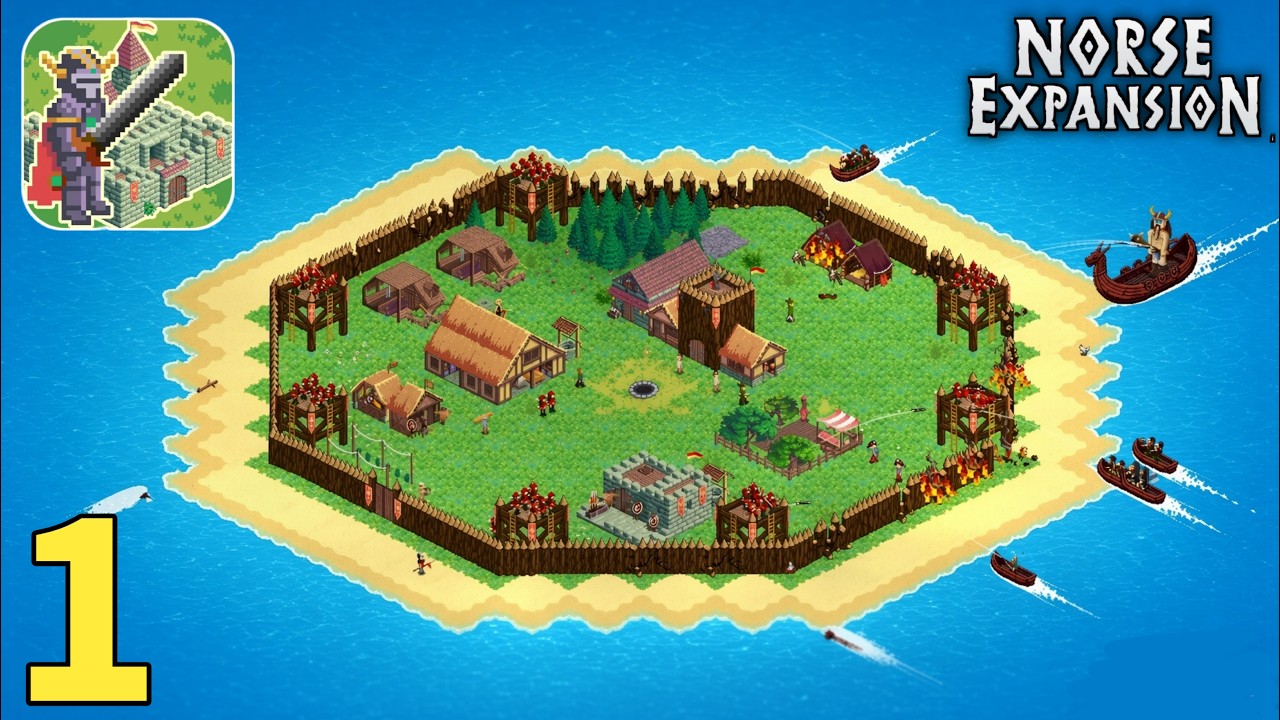

In Norse Expansion Medieval RTS, success is not determined by raw military might alone, but by your ability to manage a fragile economy while under the constant threat of siege. Whether you are facing standard infantry, giants, or mystical wizards, the core of your survival lies in the efficiency of your resource cycle and the strategic layout of your base. This guide provides the tactical framework necessary to transition from a vulnerable village to an unbreakable medieval stronghold.
Mastering the Resource Economy
The backbone of any successful kingdom in Norse Expansion is the efficiency of your workforce. In the early game, your primary goal is to minimize "non-productive time."
Optimizing Resource Nodes
Workers spend a significant portion of their time traveling between collection points and your storage buildings. To maximize your yield:
- Proximity Placement: Always construct your lumber mills and mining outposts as close to the resource nodes as possible.
- Pathing Efficiency: Ensure there is a clear, unobstructed path between your collectors and your storage. A cluttered base layout is the silent killer of an efficient economy.
- Avoid Over-Diversification: While you need both wood and gold, focusing on one primary resource to hit a specific building upgrade is often more effective than spreading your workers thin across all nodes simultaneously.
Managing Storage Caps
Nothing halts progress faster than a full warehouse. If your storage is capped, your workers become idle, and the time spent gathering is effectively wasted. Monitor your resource bars constantly; if you find yourself hitting the limit, prioritize building a storage upgrade or spending the surplus on defensive structures or unit recruitment before the materials go to waste.
Strategic Base Layout and Fortification
In Norse Expansion, your base is your most valuable asset. A poor layout makes you a target for bandits, while a well-fortified perimeter can hold off massive enemy waves with minimal troop intervention.
Designing a Defensive Perimeter
- The Heart of the Kingdom: Place your Castle at the center of your base. All production buildings should be clustered around it, with military structures forming an outer ring.
- Choke Point Manipulation: Use walls to funnel enemy pathing. If enemies are forced to walk through a single gate or narrow gap, you can concentrate your archer fire on that specific point, drastically increasing your damage-per-second (DPS) output.
- Layered Defense: Never rely on a single wall. Create a "buffer zone" of towers and traps outside your main wall. This forces enemies to engage your defenses while they are still in range of your archery towers, softening them up before they ever reach your primary gates.
Advanced Military Composition and Recruitment
Managing an army in Norse Expansion is a balancing act of cost versus utility. You must field an army capable of countering the game's diverse enemy roster, which ranges from swarming bandits to high-health giants.
Understanding Counter-Play
- Melee "Tanks": Always keep a contingent of high-armor melee units at the front. Their role is to soak up damage and keep enemies stationary so your ranged units can operate safely.
- Ranged Support: Archers and siege units should be positioned behind your walls. In this game, range is a force multiplier. If your archers are forced into melee combat, they lose their efficiency, so guard them jealously.
- Anti-Magic Tactics: When facing wizards, target them immediately. Their debuffs can cripple your army's stats or destroy your walls from afar. Use your fastest units to harass them early, preventing them from casting their most damaging spells.
The Dangers of Over-Recruitment
A common mistake for beginners is to queue up as many soldiers as possible. This creates a massive drain on your food supply. If your population exceeds your food production capacity, your entire economy will suffer, and your workers will stop producing resources. Always ensure your food production is at least 15-20% higher than your consumption rate before starting a large-scale military recruitment drive.
Proactive Defense and Scouting
The most experienced Norse Expansion players never wait for the enemy to reach their gates. By the time an enemy is at your wall, you have already lost the advantage of positioning.
The Importance of Scouting
Use your scouts or fast-moving infantry to patrol the outskirts of your territory. Identifying an enemy raid early gives you time to:
- Repair Weakened Walls: Use the precious seconds before the encounter to shore up your defenses.
- Position Your Army: Move your units to the specific side of the base being attacked, rather than having them run across the entire map once the alarm sounds.
- Counter-Attack: Sometimes the best defense is an intercept. If you catch a smaller bandit group in the open field, you can destroy them with minimal loss, whereas if they reach your base, they might damage your buildings, costing you resources in repair fees.
Balancing Expansion and Internal Stability
It is tempting to expand your borders as quickly as possible, but in this game, "wide" play is riskier than "tall" play. Every new settlement requires an investment of resources and defensive support.
- When to Expand: Only move to expand your territory when your main base is fully upgraded and your resource output is so high that you have a constant surplus.
- The "Security-First" Rule: If your resources are fluctuating and you aren't constantly in the green, do not expand. Focus on consolidating your power. A single well-fortified, highly productive base will almost always outperform two weak, vulnerable outposts.
- Strategic Retreats: If a campaign mission is overwhelming, do not be afraid to pull back your defensive line. It is better to lose a secondary building than to lose your entire army and your Castle in a desperate stand.
Final Expert Insights
As you progress through the campaign, you will notice that the game rewards adaptability. There is no single "best army" that wins every level. Before starting a mission, observe the enemy types you are likely to face. If the map is heavy on giants, prioritize high-damage ranged units and slow-down tactics. If you are facing bandits, invest in sturdy walls and quick-response melee units to mop up the swarms. By focusing on your economic foundation first and maintaining a flexible defensive strategy, you will find that even the most difficult levels in Norse Expansion become manageable challenges. Remember: the best king is the one who plans for the storm before the clouds even appear.

Emily Johnson
Emily writes practical mobile strategy guides with a focus on resource planning, base progression, and the early decisions that shape a long-term account.
COMMUNITY
Player Comments
89 players commented on this guide.
This guide answered the exact question I had.
This saved me time in the early game.
I wish I had read this before upgrading the wrong thing.
This helped me understand early game much better.