
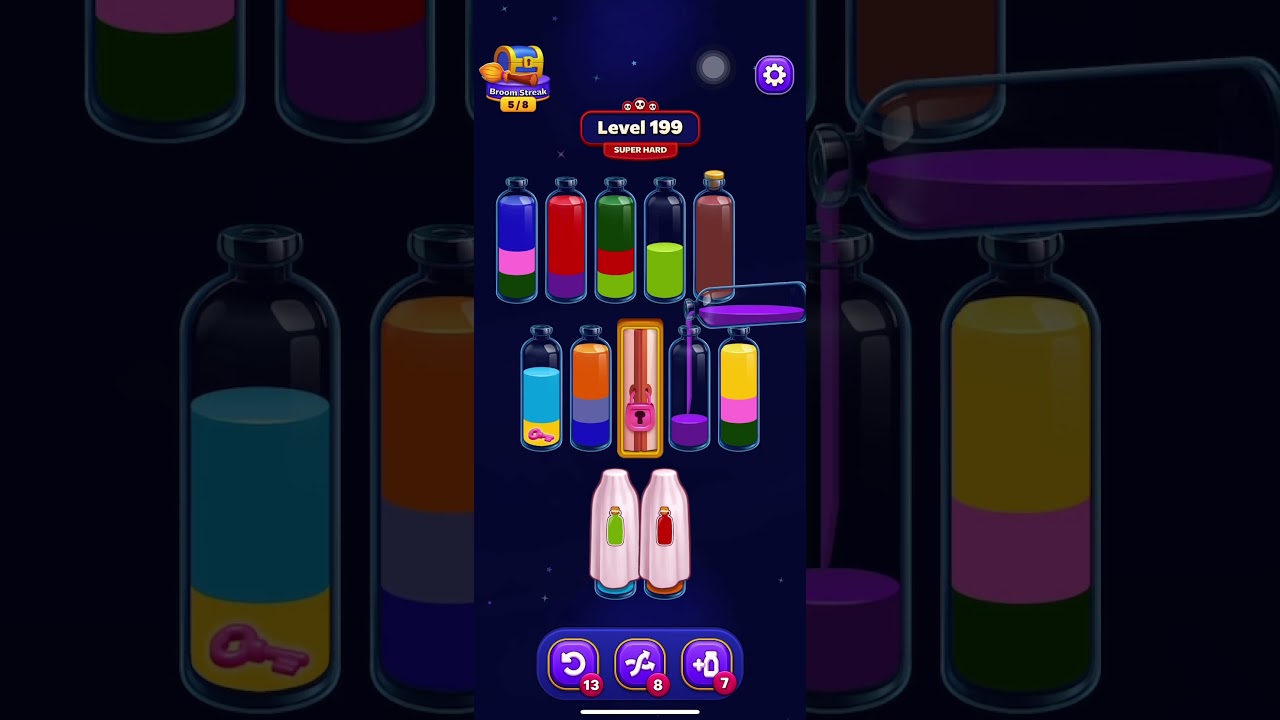
To beat the Super Hard challenge of Magic Sort! Level 199 without spending coins on extra vial boosters, immediately merge exposed matching colors across existing tubes and keep at least one of your two starting empty buffer vials completely open at all times. Level 199 fragments color segments across four-slot tubes, creating quick deadlocks if you scatter mismatched colors into both empty slots early.
Managing the Four-Slot Buffer Constraints
In Magic Sort!, liquid can only pour onto a matching color with remaining capacity or into an entirely vacant tube. Level 199 gives you two empty buffer vials at the start, but almost every filled vial contains an irregular mix of three or four colors across its four slots.
If you commit different colors into both empty buffer vials simultaneously, your available routing space drops to zero. Without an open tube to shuttle intermediate colors, any buried segment remains locked. Treat one empty vial as your active working lane and protect the second as an emergency transfer buffer.
Step-by-Step Opening Move Sequence
Begin the stage by scanning for direct top-to-top transfers before placing any liquid into an empty tube. Merging matching top layers creates headroom in source tubes, making it easier to reveal lower segments.
Follow this sequence to open the board safely:
- Scan top layers: Identify identical colors sitting on top of multiple vials. Pour smaller top stacks onto larger matching stacks to free up upper slots.
- Inspect second-layer colors: Check the color directly beneath your target top layer. Only pour that top layer away if doing so immediately exposes a color that can merge into another existing stack.
- Open a single working buffer: When a blockage forces you to use open space, pour into only one empty vial. Leave the second buffer tube untouched.
- Clear the working buffer: As soon as the exposed underlying color transfers to its target, merge the temporary buffer liquid onto an available matching stack to restore both empty vials.
Color Consolidation Strategy
Progress in the middle phase relies on completing full four-unit vials rather than spreading partial stacks across the board. When you fill all four slots of a vial with a single color, that set is finished, permanently freeing up board space for subsequent moves.
| Strategy | Buffer Impact | Board Flexibility | Deadlock Risk |
|---|---|---|---|
| Full Color Consolidation | Empties source tubes once all four matching units merge | Keeps transfer lanes open for multi-step layer access | Low when moves are planned sequentially |
| Fragmented Partial Stacks | Traps multiple colors across working buffer vials | Limits available landing spots for blocking layers | High due to rapid loss of empty working space |
When two colors block each other across separate vials, use your single working buffer to break the circular lock:
- Pour the first blocking color into the designated working buffer.
- Transfer the fully unblocked second color to its destination tube.
- Pour the first color out of the buffer onto its newly exposed matching stack.
Preventing Deadlocks and Finishing the Board
Deadlocks in Level 199 occur when an odd-colored segment sits on top of a partially filled column with no open destination available. Never make a pour that strands a mismatched color on an active stack unless an immediate follow-up move clears it.
If your sorting sequence stalls, apply these corrections:
- Use Undo immediately: If a move leaves both buffer vials filled with mismatched, non-mergeable colors, tap Undo right away rather than making random pours.
- Save coin boosters: You do not need to buy an extra tube booster (+1 vial) if you keep one buffer vial empty during routine transfers.
- Consolidate from largest to smallest: Once you clear and seal the first two or three full vials, use the newly emptied tubes as staging space to group the remaining colors down to the final single segments.

Free Magic Sort! Codes
Current active codes and how to redeem them.

Sarah Williams
Sarah specializes in RPG and collection games, explaining team building, character growth, and beginner-friendly ways to avoid expensive early mistakes.
COMMUNITY
Player Comments
71 players commented on this guide.
I wish I had read this before upgrading the wrong thing.
Nice guide. I am checking the other Magic Sort! articles next.
Can you add more details about early game in a future update?
The explanation is clear, especially for beginners.