
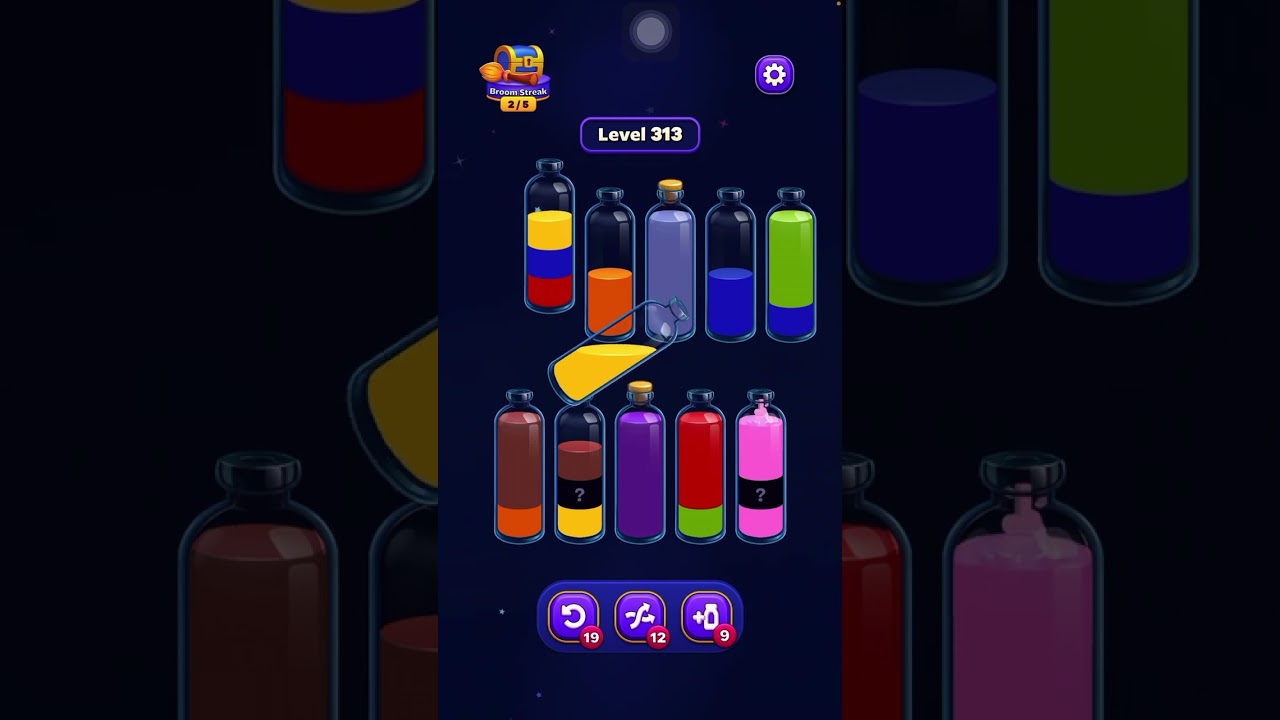
To clear Level 313 in Magic Sort!, pair matching exposed surface colors directly before pouring into empty vials, and reserve at least one of your two starting empty tubes strictly as an open transit lane. Do not scatter split single units across separate bottles. If you run out of valid moves due to contaminated buffer tubes, use the in-game undo feature to backtrack rather than spending restart boosters.
Level 313 Starting Layout and Constraints
Level 313 challenges players with heavy color fragmentation across standard four-unit tubes.
- Fragmented Vials: Almost every starting bottle contains three or four different color segments. No complete monochrome stacks exist at the start.
- Limited Buffer Space: The level provides exactly two completely empty tubes at the opening.
- Trapped Foundation Colors: High-priority base colors sit at the bottom of vials beneath mismatched single-layer caps.
- Headroom Limits: Pouring into an existing color requires matching that color and having enough empty capacity in the receiving bottle.
Because you only have two blank vials, pouring mismatched colors into both creates an immediate bottle lock. You must treat those two empty slots as controlled transit resources rather than general overflow storage.
Step-by-Step Clearing Sequence
Clear Level 313 by working through three distinct phases: surface pairing, base excavation, and permanent color sealing.
- Execute Zero-Cost Surface Merges: Before touching either empty buffer tube, scan the board for matching top layers across existing vials. Pour these identical surface colors together immediately. This consolidates that color into a thicker block and creates vertical headroom in the donor tube.
- Excavate Buried Base Colors: Select a donor tube that holds a key foundation segment at the bottom. Pour its top obstructing layers into your designated building buffer tube, ensuring incoming layers match the color already placed there.
- Keep the Transit Hub Clear: Use your second empty tube solely for short-term pass-through moves. Route an obstructing color into this slot only if you can transfer it to a permanent destination within two turns.
- Lock Monochromatic Tubes: Assemble complete four-unit stacks of a single color to seal them out of the puzzle. Confirm that locking the tube leaves sufficient open headroom across remaining active vials before committing the final pour.
Buffer Tube Management
Maintaining the correct functional separation between your two empty slots prevents mid-game gridlock.
| Buffer Slot Type | Primary Function | Accepted Pour Rule | Deadlock Risk Level |
|---|---|---|---|
| Dedicated Consolidation Tube | Builds towards a completed four-unit stack | Single color hue only | Low; preserves progress toward sealing a bottle |
| Open Transit Hub | Holds temporary obstruction caps | Any color with an immediate destination | High; filling this with mixed layers halts legal moves |
If both buffer tubes become filled with multi-colored fragments, the board enters a lock state where no vial has the empty capacity to receive newly revealed colors.
Common Traps and Recovery Moves
Most failures on Level 313 stem from two common execution mistakes:
- The Split-Color Trap: Never pour a color segment into a clean or uncommitted tube if another active bottle already holds that color with available vertical space. Splitting four units of the same color across three separate vials traps them beneath other colors and blocks completion.
- Premature Buffer Contamination: Avoid dumping two distinct single-unit colors into an empty buffer tube merely to reveal a single hidden layer. This cuts your operational buffer capacity in half for minimal structural gain.
- Undo Recovery: If a transfer sequence leaves you with no legal pours, tap the undo button two or three times immediately. Backtracking to re-route an obstruction is always more efficient than restarting the entire level from scratch.

Free Magic Sort! Codes
Current active codes and how to redeem them.

Emily Johnson
Emily writes practical mobile strategy guides with a focus on resource planning, base progression, and the early decisions that shape a long-term account.
COMMUNITY
Player Comments
25 players commented on this guide.
Good guide for Magic Sort! players. The base building part was useful.
This saved me time in the early game.
Nice guide. I am checking the other Magic Sort! articles next.
Can you add more details about base building in a future update?