
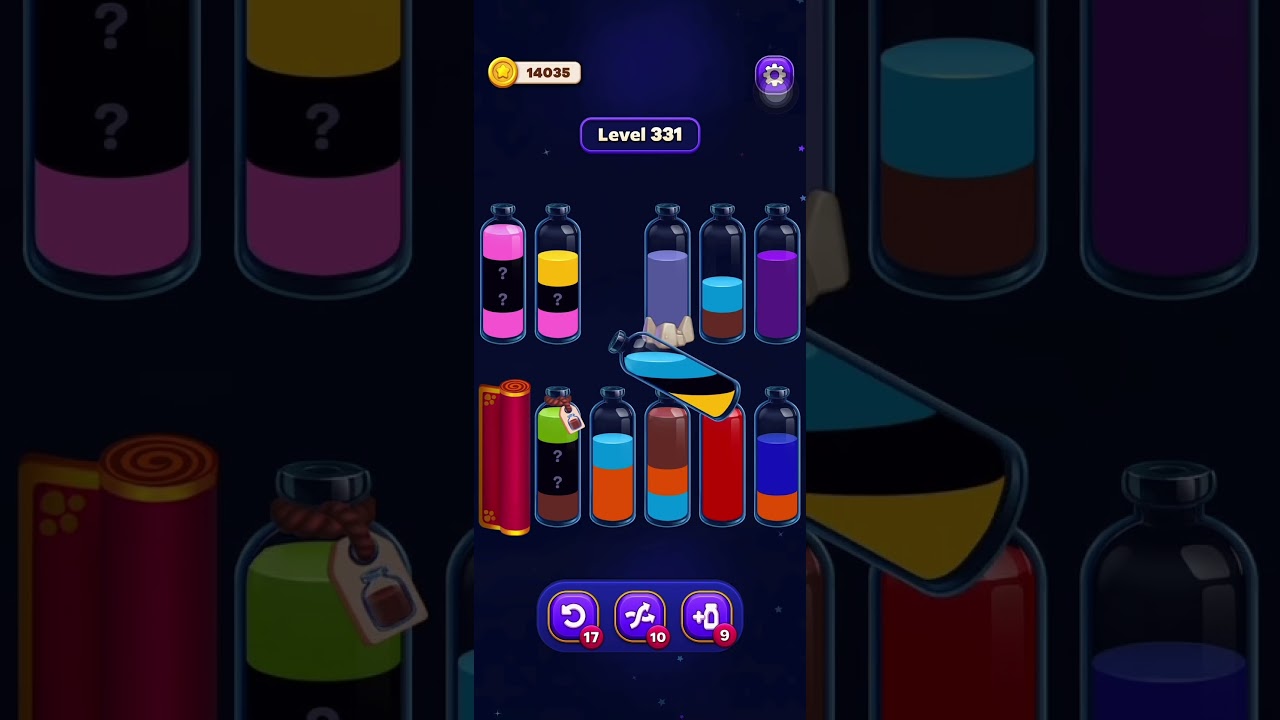
To beat Level 331 in Magic Sort!, use your two empty buffer tubes to consolidate matching surface colors and empty your first starting flask as quickly as possible. The board begins in a congested state where each starting tube holds four units of heavily interleaved liquid across three or four colors. If you scatter mismatched colors across both open buffers, you eliminate your maneuvering space and cause an immediate deadlock. Your primary opening goal is uncovering buried layers while maintaining at least one fully empty four-unit tube to route intermediate transfers.
Opening Moves: Clear Your First Buffer Flask
Before making a transfer, inspect the top layer of every tube to identify which color appears most frequently across the board. Pouring instances of this shared color into a single buffer opens multiple starting tubes simultaneously.
- Locate the color that appears most frequently on the surface across all starting vials.
- Pour the first unit of this color into Empty Tube A to establish a consolidated stack.
- Transfer matching surface units from other vials directly onto Tube A, grouping two or three units of that color together.
- Examine the newly exposed second-layer liquids in the tubes you just poured from to identify potential pairings.
- Use Empty Tube B as a temporary holding slot to shift blocking segments aside so you can completely drain one mixed vial.
Emptying a starting vial restores a clean four-unit flask. This provides a revolving transfer lane that allows you to dig toward base-layer segments without clogging your board.
Mid-Game Layer Routing and Buffer Rules
Once you establish a revolving empty tube, focus on extracting trapped lower-tier segments. Never cap a partial uniform stack of two or three units with an unrelated color. Placing an incompatible liquid on top of an incomplete stack locks that color and turns a near-complete tube into a dead end.
Instead, cycle blocking layers through your revolving empty vial to reach matching base units. Give top priority to bottom segments that can immediately merge into an existing partial stack. If a planned transfer neither uncovers a usable color beneath it nor empties an entire tube, avoid the move and look for an alternative route.
| Transfer Decision | Board Impact | Risk Level | Tactical Rule |
|---|---|---|---|
| Pouring two different orphan colors into both empty tubes | Fills all available free space without completing a color | Extreme | Never split different colors across both open buffers. |
| Stacking matching surface colors into one empty tube | Groups two to three units together and uncovers buried layers | Low | Execute immediately when matching top segments are visible. |
| Capping a 3-unit stack with an unrelated color | Traps the partially completed stack and blocks consolidation | High | Keep the final slot open exclusively for its matching shade. |
| Emptying a mixed vial completely | Restores a fully open four-unit transfer lane | None | Prioritize this above lateral shifting to maintain routing space. |
Endgame: Finishing Sealed Tubes
As soon as you assemble four units of a single color, that tube is permanently solved and requires no further moves. Each completed vial reduces the number of competing colors on the board, opening up more space for remaining transfers.
Use your open buffer lanes to cycle through the remaining two-unit and three-unit segments. With fewer mixed colors contesting the board, you can transfer exposed layers directly into their destination flasks until every tube is filled with a single, uniform color.

Free Magic Sort! Codes
Current active codes and how to redeem them.

Emily Johnson
Emily writes practical mobile strategy guides with a focus on resource planning, base progression, and the early decisions that shape a long-term account.
COMMUNITY
Player Comments
102 players commented on this guide.
I wish I had read this before upgrading the wrong thing.
I tried this today and it worked better than my old setup.
The explanation is clear, especially for beginners.
Nice guide. I am checking the other Magic Sort! articles next.