
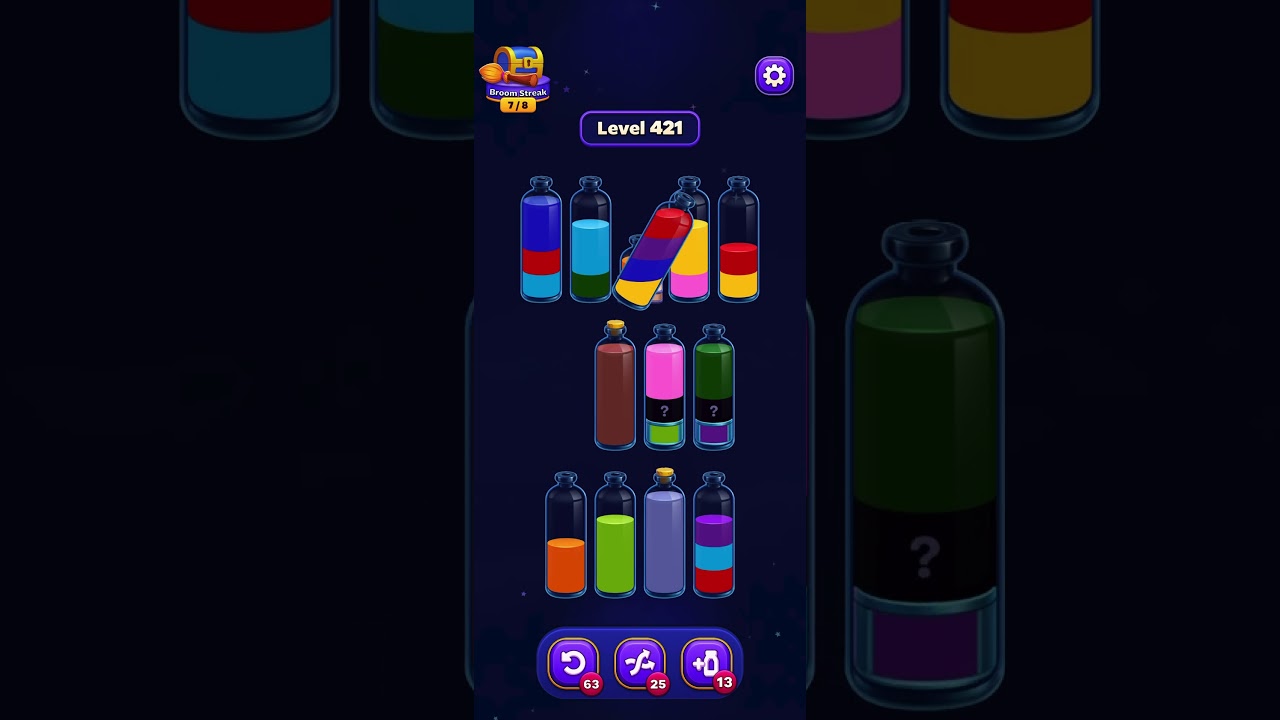
To beat Level 421 in Magic Sort!, prioritize merging exposed matching top colors to empty your first bottle, then reserve at least one empty tube as an operational buffer to untangle locked base layers.
Level 421 Rules and Move Constraints
Every bottle in Magic Sort! holds four liquid units. Liquids transfer only if the receiving bottle is completely empty or if the receiving top layer matches the incoming color and has enough free capacity. Contiguous segments of the same color pour together automatically up to the available capacity limit.
| Move Type | Board Requirement | Risk Level | Primary Function |
|---|---|---|---|
| Direct Merge | Target tube has matching top color and open slots | Low | Consolidates color stacks and reveals underlying layers |
| Buffer Transfer | Target tube is completely empty | Medium | Temporarily stages a blocking color to reach buried units |
| Split Pour | Target tube holds a different base with limited room | Critical | Traps isolated colors and frequently triggers deadlocks |
Phase 1: Unlocking the First Empty Bottle
Level 421 begins with most tubes filled to capacity with fragmented, multi-colored bands. Your opening objective is clearing a single tube down to zero units to establish routing space.
- Scan top-layer colors: Locate colors that are exposed at the top of two or more bottles.
- Consolidate identical layers: Pour matching top units together to free up vertical space in the donating bottles.
- Target the shallowest stack: Focus your merges on the bottle containing the fewest total color transitions until only its bottom segment remains.
- Empty the container: Move that bottom segment onto a matching base elsewhere on the board or into an initial staging slot.
Do not fill this newly emptied bottle with a random, single-unit color. Leaving it open provides the operational buffer needed for the next phase.
Phase 2: Resolving Color Dependency Chains
The middle phase of Level 421 requires navigating interconnected color dependencies without clogging your buffer space. A common failure point occurs when players place single, mismatched segments into both open buffer tubes, removing all movement flexibility.
- Trace the chain before pouring: If Bottle A has a needed blue base trapped beneath a purple layer, and Bottle B has a purple base trapped under green, clear the green layer first. Uncovering the purple base gives your purple layer a permanent destination.
- Maintain a revolving buffer: Use an empty bottle strictly for temporary holding. Only place a color into a vacant tube if the move directly exposes a layer that completes another stack or instantly frees a replacement bottle.
- Avoid capping single foreign units: Never pour three units of a matching color on top of a single, unmatching base unit. Because bottles cap at four units, that single base unit remains permanently locked until all three top units are transferred back out.
Phase 3: Completing Sets and Closing the Board
Once dependency chains are resolved, shift your focus from staging moves to locking in completed bottles.
- Finish the highest-count colors first: Consolidate four identical units into dedicated bottles one shade at a time. A filled four-unit bottle is permanently solved and requires no further interaction.
- Retain one buffer bottle: Keep a single empty or flexible bottle active until only two unsolved colors remain on the board.
- Alternate the final two colors: Use your final open slots to shift the remaining split segments into their matching sets to clear the stage.

Free Magic Sort! Codes
Current active codes and how to redeem them.

Sarah Williams
Sarah specializes in RPG and collection games, explaining team building, character growth, and beginner-friendly ways to avoid expensive early mistakes.
COMMUNITY
Player Comments
124 players commented on this guide.
This helped me understand early game much better.
This saved me time in the early game.
Nice guide. I am checking the other Magic Sort! articles next.
Good guide for Magic Sort! players. The early game part was useful.