
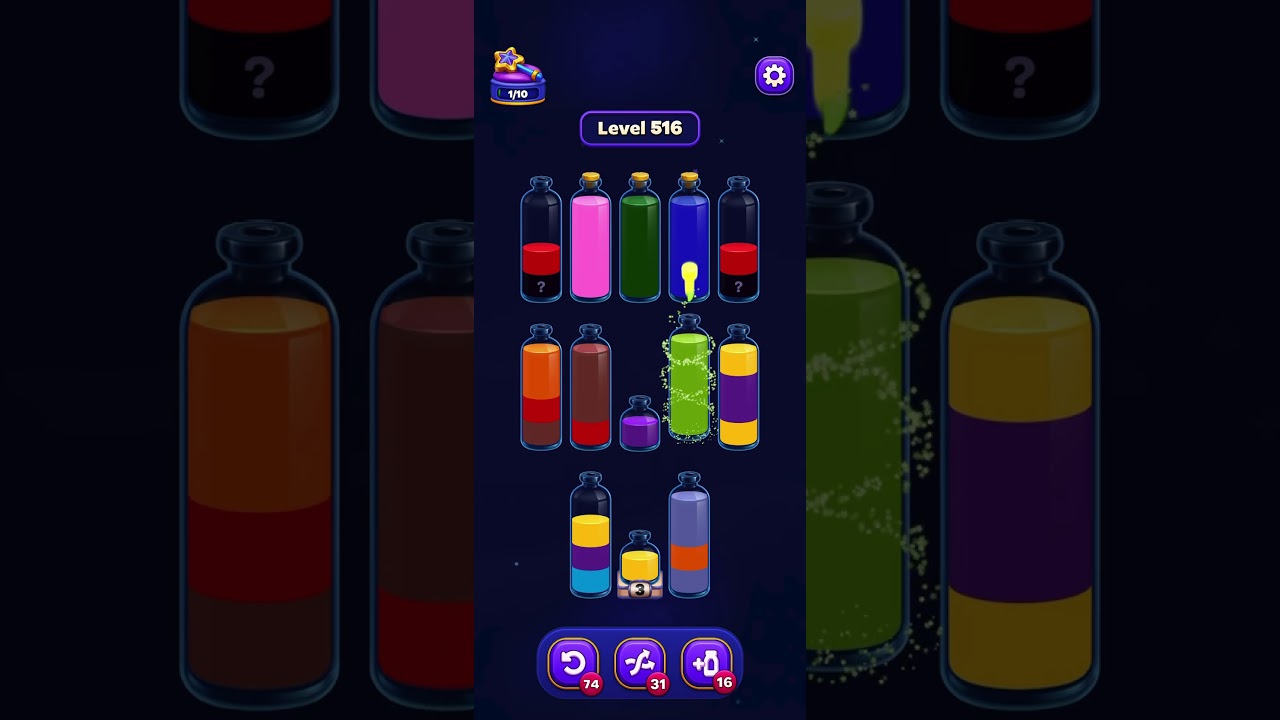
To clear Level 516 in Magic Sort!, prioritize direct color merges between populated flasks before using your empty buffer space, and always keep at least one buffer tube completely open. Dedicating both empty tubes to static liquid fragments early creates an immediate deadlock. Consolidate matching top layers across active vials to uncover buried colors, and use temporary buffer cycling to clear out split flasks without spending coins on undo boosts or extra tubes.
Stage Layout and Core Pour Mechanics
Level 516 presents a board of filled vials containing mixed, fragmented liquid layers, supported by two empty buffer tubes. Each vial has a strict capacity of four units. A pour is only permitted if the destination flask is completely empty or if its topmost liquid matches the pouring color and has enough capacity to receive the volume.
Understanding these mechanics is necessary to prevent unrecoverable board states:
| Board Element | Rule | Tactical Impact on Level 516 |
|---|---|---|
| Vial Capacity | 4 units maximum | Requires exact unit counting before pouring multi-segment blocks. |
| Surface Matching | Liquid must match top color | Limits legal transfers and demands deliberate layer peeling. |
| Buffer Tubes | Two empty tubes at start | Act as temporary staging areas; must be vacated promptly. |
| Sealed Vial | 4 matching units completed | Permanently solves a color, but removes that tube from routing play. |
Opening Sequence: Preserving Buffer Space
Do not pour single liquid segments into both empty buffer tubes at the start of the level. Doing so cuts your routing capacity to zero and leaves you with no options if the top colors on the board do not align.
Execute your opening moves using this priority order:
- Execute direct merges: Scan the exposed top colors across all filled flasks. If two tubes share an identical top color and one has available headroom, pour them together immediately. This frees vertical space in the source flask without consuming an empty buffer.
- Expose secondary colors: If direct merges are unavailable, transfer a surface color into the first buffer tube only if doing so reveals a layer that can immediately merge into another active flask.
- Protect the second buffer: Keep the second buffer tube completely vacant as an emergency transit lane for multi-step extractions.
Mid-Game Strategy: Layer Peeling and Buffer Cycling
As the board develops, tubes frequently end up split into two units of one color trapped under two units of another. When several tubes reach this split state, legal moves run out quickly. Break this gridlock by performing a coordinated buffer cycle:
- Pour the top two units of a split flask into an empty buffer tube.
- Pour the bottom two units into their matching home column elsewhere on the board.
- Transfer the buffered units back into their dedicated, consolidated column.
Completing this sequence leaves the original vial completely empty, effectively creating a fresh buffer slot that restores routing freedom.
When choosing which layers to peel, prioritize tubes that trap colors already present in tall receiving columns. Peeling a surface color is only productive if that layer has an immediate destination or reveals a segment that unlocks a direct transfer.
Endgame: Assembling Monocolor Tubes
Combining four units of a single color permanently seals that flask. While sealing a vial marks progress, it also permanently removes that container from your available routing pool.
Only seal a four-unit monocolor flask when doing so leaves enough open vials to manage the remaining mixed colors. Once the puzzle is reduced to three active colors and multiple cleared flasks, use every remaining transfer to direct-fill the final matching columns until the stage is complete.

Free Magic Sort! Codes
Current active codes and how to redeem them.

Sarah Williams
Sarah specializes in RPG and collection games, explaining team building, character growth, and beginner-friendly ways to avoid expensive early mistakes.
COMMUNITY
Player Comments
123 players commented on this guide.
This saved me time in the early game.
The explanation is clear, especially for beginners.
This helped me understand strategy much better.
The tips are practical and easy to follow.