
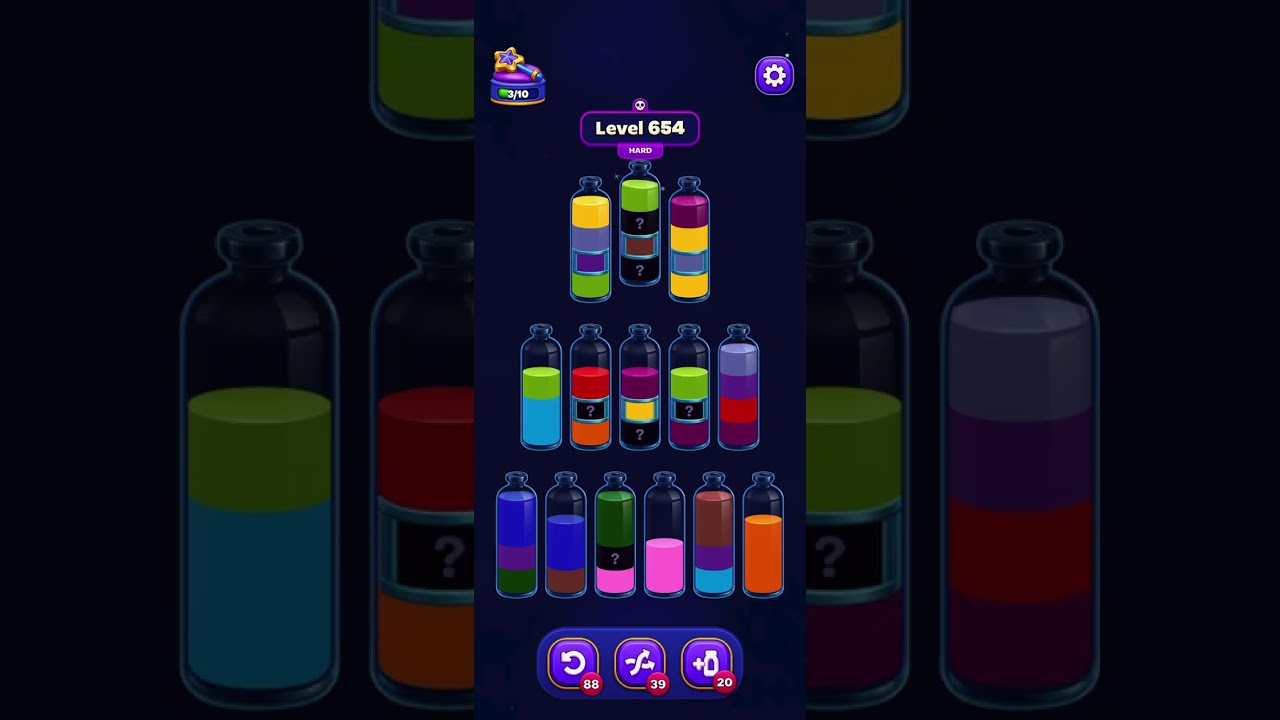
To beat Level 654 in Magic Sort!, prioritize surface merges that reveal matching colors underneath, and always preserve at least one empty buffer tube to maintain an active escape route. The stage fragments color layers across multiple columns, making careless transfers fatal. By systematically unlocking deep colors, consolidating matching units into full four-segment tubes, and preventing premature buffer clog, you can clear the board without relying on extra tube boosters.
Board Bottlenecks and Opening Priorities
Level 654 restricts your movement by burying foundational colors beneath single-segment caps across nearly every filled tube. Each standard tube holds up to four segments. At the start of this stage, multiple columns conceal up to three distinct colors, and lower slots contain matching hues that you cannot reach directly.
Before making your first pour, inspect the entire board from top to bottom. Identify which colors appear most frequently across the bottom two slots. These lower units represent your target foundations. Execute opening pours in this order of priority:
- Direct Surface Merges: Combine matching top layers across existing filled tubes without touching your empty buffer tubes. This condenses fragmented units while keeping holding space open.
- High-Yield Column Peels: When a single top segment blocks two matching colors beneath it, pour that top segment into a compatible open space to expose the double-stack.
- Singleton Consolidation: Group isolated single segments of the same hue into one column rather than leaving individual units scattered across multiple tubes.
Do not move a color simply because an open space exists. An opening move must free a new segment, reveal a matching hue beneath, or combine fragmented units into a larger stack.
Managing Buffer Tubes to Avoid Deadlocks
Deadlocks on Level 654 occur when you fill both empty buffer tubes with mismatched colors before securing an exit path. An empty tube accepts any color, but the moment it receives a segment, it becomes a restricted column governed by standard color-matching rules.
Follow the single-buffer rule: you may park an inconvenient surface color into one buffer tube to expose a deep layer, but you must keep the second buffer tube empty for cyclical transfers.
| Move Category | Safe Routing Strategy | Deadlock Risk Scenario |
|---|---|---|
| Opening Pours | Merge surface layers directly onto matching tops | Depositing unrelated single units into both empty tubes |
| Mid-Game Routing | Park one color temporarily to free a two-segment stack | Splitting three different colors across half-filled tubes |
| Tube Consolidation | Fill a four-segment column to lock it permanently | Stacking two non-matching colors into an unsealed tube |
| Buffer Reset | Drain an auxiliary tube back into completed stacks | Leaving orphan segments trapped under unrelated colors |
Never pour an off-color into your second empty tube unless you can immediately empty it out on the subsequent move.
Mid-Game Consolidation and Locking Strategy
The turning point of Level 654 occurs when you assemble your first complete four-segment tube. Fully sorted tubes seal permanently and exit your active decision pool, reducing visual clutter and preventing that color from obstructing future moves.
Target the color with the highest number of exposed segments across the board for your first consolidation. As you lock four matching segments into a single vial, the tube that surrendered the final segment either becomes completely empty or exposes a usable lower layer. A newly freed empty tube restores your buffer safety net, allowing you to repeat the consolidation cycle with the next most accessible color.
Resolving Endgame Reciprocal Locks
When only three or four mixed tubes remain, you will often encounter reciprocal locks where two columns mutually block each other. Do not rush to pour colors without checking remaining tube capacities; a standard tube caps at four segments, and attempting to force a multi-segment pour into a tube with insufficient space will split your color group.
To resolve reciprocal locks:
- Transfer the top blocking segment into an empty buffer tube.
- Pour the newly exposed underlying color into its corresponding base column to complete that stack.
- Move the buffered segment into its dedicated tube to finalize the board.

Free Magic Sort! Codes
Current active codes and how to redeem them.

Sarah Williams
Sarah specializes in RPG and collection games, explaining team building, character growth, and beginner-friendly ways to avoid expensive early mistakes.
COMMUNITY
Player Comments
151 players commented on this guide.
Good guide for Magic Sort! players. The strategy part was useful.
I tried this today and it worked better than my old setup.
I wish I had read this before upgrading the wrong thing.
The explanation is clear, especially for beginners.