
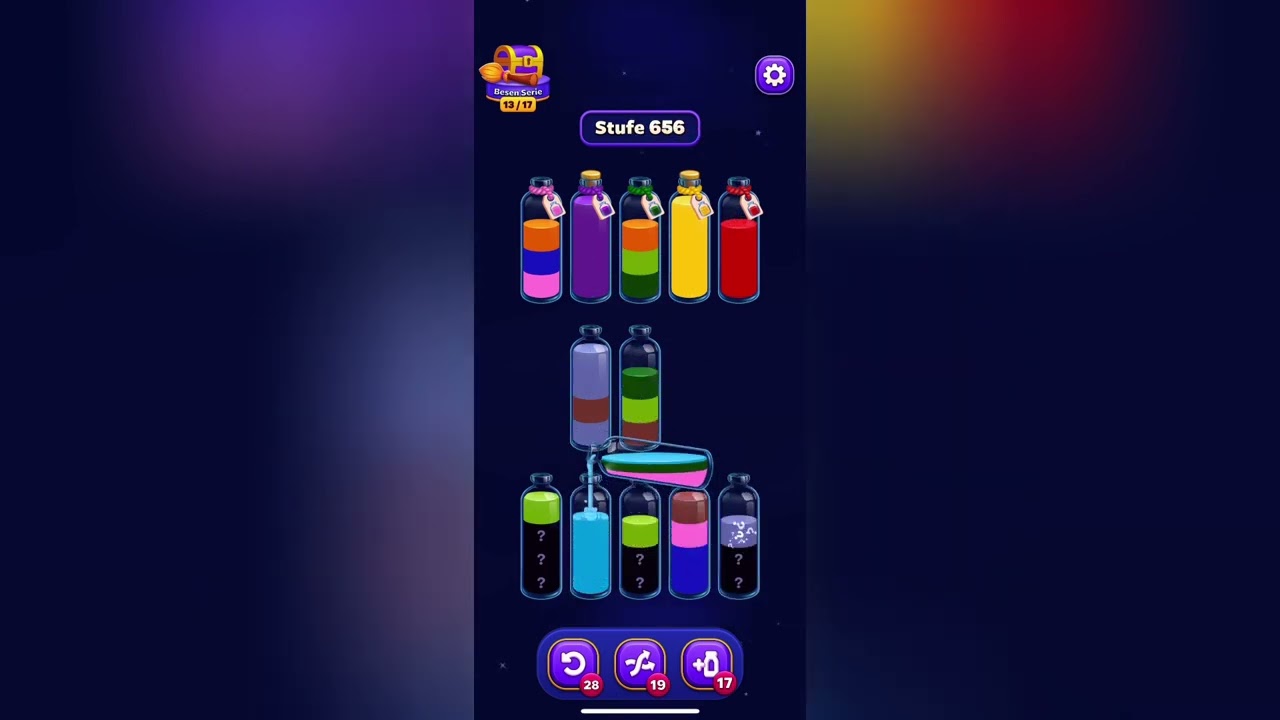
To beat Level 656 in Magic Sort!, immediately clear one entire bottle to create an empty transit buffer, then use that buffer strictly for temporary holding while uncovering matching base colors. Pouring fragments into empty tubes without an exit plan locks the board within a few moves.
Core Rules and Level Constraints
Every standard container in Magic Sort! holds four units of liquid. A pour is valid only when pouring into an empty bottle or onto an identical color, provided the receiving container has open capacity. Once a bottle holds four identical units, it locks permanently and cannot receive or transfer liquid.
In Level 656, colors are distributed across nearly full bottles in fragmented stacks. Because starting space is minimal, clearing a single bottle as early as possible provides the maneuvering room needed to shuffle blocking layers.
Step 1: Open an Initial Buffer Bottle
Your opening objective is finding a "donor" bottle that can be emptied completely by distributing its upper layers onto existing, matching stacks elsewhere on the board.
- Scan top layers: Identify which exposed colors match the top colors of other partially filled bottles.
- Select the donor: Pick the bottle whose exposed segments can all be transferred to matching containers without needing an empty bottle to hold them.
- Consolidate matching pairs: Pour the top layers from the donor bottle into the matching receiving tubes to free the layers beneath.
- Empty the container: Transfer the final base layer of the donor bottle onto its matching color stack to leave one container completely open.
Once this bottle is empty, do not fill it with a multi-colored stack. It must remain a temporary staging area to shuttle single blocking segments.
Step 2: Uncover Buried Base Colors
With an empty buffer available, work through the board by grouping colors around their base layers.
- Target shared bases: Check the bottom segment of each remaining bottle. If multiple bottles share the same bottom color, designate one as the permanent collection tube for that color.
- Use the pass-through method: Move a blocking top layer into your empty buffer bottle only when doing so immediately exposes a color you can pour into its permanent stack.
- Reset the buffer immediately: As soon as the exposed target piece is moved, shift the piece from your buffer bottle back onto a matching color stack. Keeping the buffer clear ensures you never deadlock mid-sequence.
- Never split colors: If you already have two units of a color in one tube and one unit in another, do not deposit a matching color into a third container. Keep matching colors consolidated to avoid clogging the upper layers of multiple bottles.
Phase Strategy and Space Management
Managing capacity prevents your active bottles from stalling before you can lock your first four-unit stack.
| Phase | Primary Objective | Main Risk | Key Action |
|---|---|---|---|
| Opening | Empty one full bottle to zero | Filling empty slots with mixed colors | Consolidate top layers only onto existing matching colors. |
| Mid-Game | Uncover trapped base segments | Splitting a single color across three tubes | Use the empty buffer solely as a single-step pass-through. |
| Endgame | Complete and lock 4-unit bottles | Locking a tube before all matching units are accessible | Focus on filling bottles that already hold three matching units. |
Step 3: Execute the Endgame Transfers
The endgame begins once two or three mono-color bottles are locked, reducing the number of active tubes.
- Identify two-and-two splits: Look for bottles split evenly with two units of one color on top and two units of another on the bottom.
- Clear the top pair: Transfer the top two-unit block into a matching receiver or an open slot to immediately free the two units underneath.
- Chain the remaining colors: Shift the exposed bottom pairs directly into their matching three-unit stacks.
- Fill the final tubes: With fewer mixed layers competing for space, direct the remaining loose units into their matching tubes to finish the stage.

Free Magic Sort! Codes
Current active codes and how to redeem them.

Michael Smith
Michael covers live-service games, events, reward systems, and efficient daily routines, turning frequent updates into clear actions for players.
COMMUNITY
Player Comments
85 players commented on this guide.
The tips are practical and easy to follow.
Nice guide. I am checking the other Magic Sort! articles next.
This helped me understand early game much better.
This saved me time in the early game.