
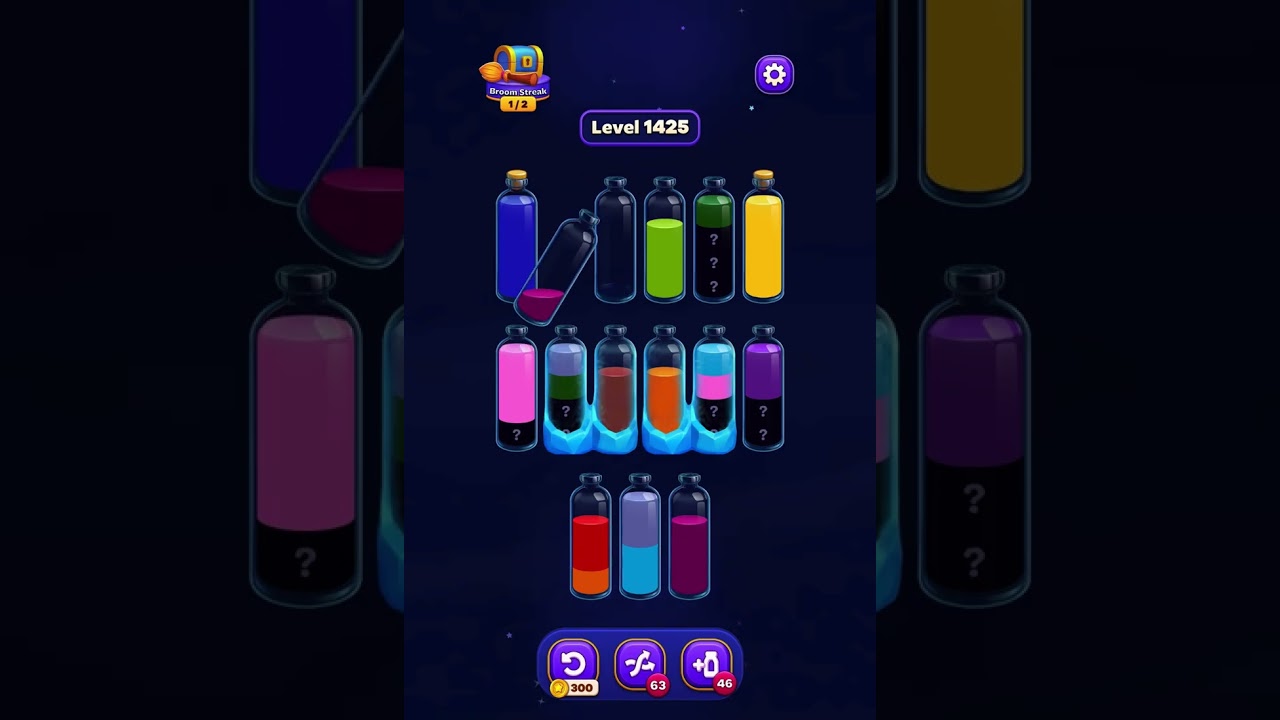
To clear Magic Sort! levels 1421 through 1430, protect your two starting empty buffer bottles and prioritize unblocking liquid colors that anchor the bases of multiple tubes. Rushing partial color pours into empty bottles without an immediate chain reaction creates deadlocks across these dense, fragmented puzzle boards.
Core Rules for Managing Buffer Bottles
Levels 1421 through 1430 feature tightly packed racks with segmented colors and only two empty bottles for maneuvering. Committing an empty tube to hold a color that does not immediately free up another container removes your operating margin. Use empty containers strictly as active conduits rather than passive storage.
| Tube State | Immediate Action | Tactical Purpose |
|---|---|---|
| Completely Empty | Reserve for full-stack dumps or deep unearthing | Preserves board maneuverability |
| 1–2 Units of Mixed Color | Avoid creating unless a clear merge sequence follows | Prevents early board lockouts |
| 3 Units of One Color | Locate and pour the fourth matching segment | Readies the container for completion |
| 4 Units of One Color | Leave sealed (permanently completed) | Reduces active board complexity |
To prevent early stalemates:
- Never place a single color unit into a clean tube unless that move instantly empties another bottle on the same turn.
- Confirm an escape path before pouring. If you pour two yellow segments into an empty tube to uncover a buried purple segment, ensure the purple segment can merge immediately into an existing purple stack.
- Do not split unified color blocks. If a tube holds two joined segments of a single color, keep them together unless splitting them finishes two separate bottles.
Target Base Colors Before Middle Layers
The most effective starting color in this level band is rarely the one resting on the top layer. Inspect the bottom segment of every starting tube. If a specific color occupies the base of two or more bottles, make that color your primary sorting priority.
Because bottom segments cannot move until every layer above them is cleared, excavating upper units that match those base foundations stabilizes the board early. Concentrating matching upper segments into a buffer container lets you unearth the bases and assemble full four-unit stacks in rapid succession. Attempting to assemble colors that only exist in middle layers leaves base layers trapped and clogs your open space.
Step-by-Step Clearing Sequence
Follow this four-step loop to clear crowded tube layouts without losing track of your available capacity:
- Execute direct merges: Scan top-level colors and pour them directly onto matching top-level colors in other partially filled tubes without using an empty bottle.
- Excavate a single target tube: Choose one bottle holding an essential unblocking color beneath one or two thin layers. Funnel those top layers into matching stacks or your buffer until the container is completely empty.
- Anchor a color in the cleared tube: Move your largest consolidated block of a single color into the newly vacated container to establish a permanent stack.
- Fill and seal the stack: Pull the remaining matching units from across the board into that container to reach four units, locking the color out of your active pool.
How to Break Stalemates
If you reach a point where no top-level colors match and matching segments remain locked under other liquids, evaluate your board before making arbitrary moves:
- Identify low-variety bottles: Find the container holding the fewest distinct liquid types. If a bottle holds three segments of one color resting on a single segment of another, moving that three-unit stack opens up an entire column in a single transfer.
- Execute reciprocal swaps: If Tube A has green covering pink, and Tube B has pink covering green, move one cap into an available two-unit slot. This allows the newly exposed color to merge into the opposing tube, immediately breaking the bottleneck.
- Restart dead boards promptly: If every empty slot is filled and no valid transfers exist between partially filled bottles, restart the stage immediately. Resetting is faster than attempting to cycle liquid through a board with zero open buffer space.

Free Magic Sort! Codes
Current active codes and how to redeem them.

Sarah Williams
Sarah specializes in RPG and collection games, explaining team building, character growth, and beginner-friendly ways to avoid expensive early mistakes.
COMMUNITY
Player Comments
98 players commented on this guide.
This saved me time in the early game.
This guide answered the exact question I had.
I tried this today and it worked better than my old setup.
This helped me understand base building much better.