
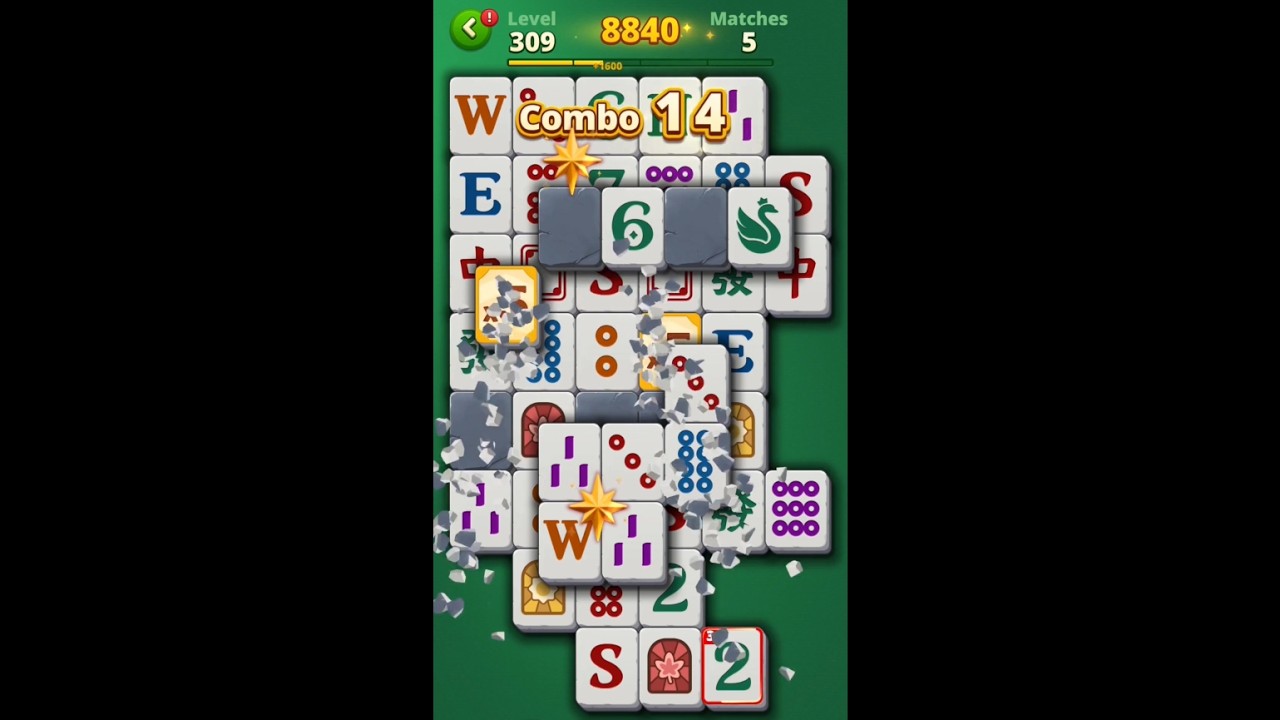
To clear levels 301 through 310 in Mahjong Blast, prioritize dismantling deep vertical stacks over matching accessible outer tiles. At this stage, boards feature multi-tiered towers four to five layers deep alongside locked horizontal rows. Clearing loose edge tiles too early removes your escape routes and leaves stacked central columns locked, causing unavoidable stalemates.
Prioritize Vertical Stacks Over Perimeter Matches
Always locate and work through the tallest tile stacks first. In mahjong solitaire rules, a tile cannot be selected if another tile rests on top of it. Deep stacks conceal the highest number of hidden tiles and restrict board progress the most.
When starting a level, apply these targeting rules:
- Target stack apexes immediately: If a tile on top of a tall column matches an accessible outer wing tile, make that match right away.
- Preserve loose wing pairs: If two matching tiles sit completely free on flat outer edges with nothing beneath them, leave them untouched.
- Use outer tiles as unlocks: Treat unstacked perimeter tiles as safety reserves, saving them until a matching twin emerges from a central stack.
Matching flat perimeter pairs just because they are open reduces the board's flexibility without exposing buried layers.
Track Quadruplets to Prevent Unsolvable Columns
Standard suit tiles—Characters, Dots, and Bamboo—appear in sets of four identical copies. The most frequent failure in levels 301 to 310 occurs when players pair two visible tiles while the remaining two copies are trapped directly on top of each other within a single column.
Before confirming any pair, check the state of the remaining copies:
- Both remaining copies are visible and free: The match is safe to execute immediately.
- One copy sits on a tall stack and one is buried: Pair the high-stack tile with an open perimeter tile to expose the column.
- Two remaining copies are stacked vertically: Do not match the two free outer copies. If you clear them, the buried twin can never be freed because the twin on top cannot be matched.
- Three copies are currently visible: Always pair the tile on the deepest stack with whichever open tile frees the most board space.
Work Inward on Horizontal Ribbons
Horizontal strips pinned against central structures can only be cleared from their outer ends. A tile is blocked laterally whenever neighboring tiles press against both its left and right sides.
To clear ribbons without getting stuck:
- Take matches that remove the extreme left or extreme right tile of a row to expose the next adjacent tile.
- Do not ignore ribbon ends in favor of random edge moves; failing to open ribbons early creates rigid roadblocks around central stacks.
- Clear outer ribbon ends that touch central spires to simultaneously create lateral clearance for those stacks.
Identify the Board Layout
While tile faces are randomized on each attempt, the structural formations in levels 301 through 310 follow consistent layouts that require specific opening approaches:
| Board Formation | Primary Tactical Hazard | Recommended First Move |
|---|---|---|
| Dual Central Pyramids | Deep column stacks concealing required twins | Match top apex tiles using outer flanking pairs |
| Horizontal Ribbon Spine | Pinned middle tiles with no lateral clearance | Clear outer ends inward to open side exits |
| Stepped Terraces | Overlapping shelves blocking lower layers | Clear upper shelf tiers before flat lower steps |
| Dense Symmetrical Cross | Interlocked center junction with few free edges | Whittle outer arms inward toward the intersection |
Reserve Boosters for Inevitable Deadlocks
Save Undo and Shuffle boosters for situations where legal moves are completely exhausted rather than using them when visual matches are simply difficult to spot.
When you suspect you are stuck, scan systematically through the suits: inspect Dots 1 through 9, followed by Bamboo, Characters, and special tiles. Look carefully along dark borders and under tile drop shadows where open tiles are easily overlooked.
If a deliberate move immediately reveals a dead-end or locks a vertical column beneath it, use the Undo booster right away to revert that specific action. Undo is more reliable for fixing an identified tactical mistake than Shuffle, which rearranges all remaining tiles and resets your planned routes.
Free Mahjong Blast Codes
Current active codes and how to redeem them.

Emily Johnson
Emily writes practical mobile strategy guides with a focus on resource planning, base progression, and the early decisions that shape a long-term account.
COMMUNITY
Player Comments
44 players commented on this guide.
Nice guide. I am checking the other Mahjong Blast articles next.
This helped me understand updates much better.
The explanation is clear, especially for beginners.
I wish I had read this before upgrading the wrong thing.