
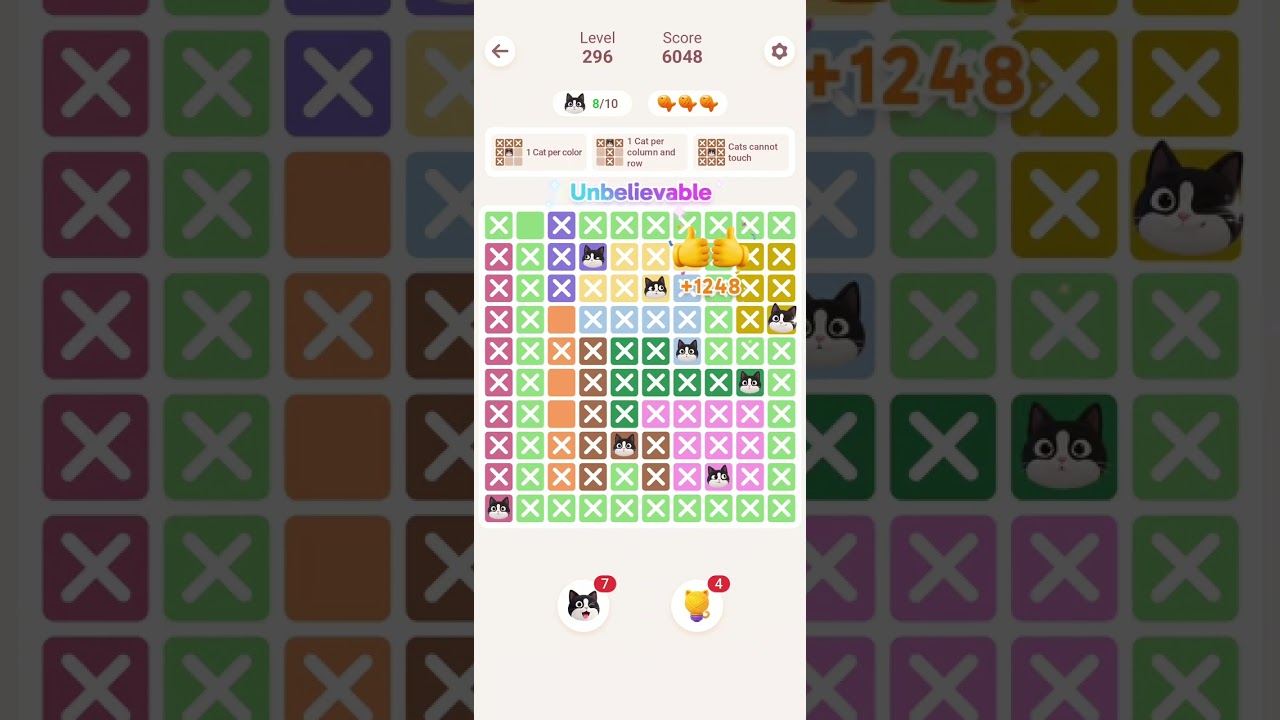
To solve puzzles in Meowdoku! efficiently, you must master the process of elimination by cross-referencing existing symbols across rows and columns. By identifying which specific icons are restricted from certain cells, you significantly reduce guesswork and minimize the risk of forced restarts. This fundamental logic approach is essential for players looking to progress through complex grids without relying on trial and error, ensuring every move is backed by deductive reasoning rather than chance.
Understanding the Core Grid Constraints
The foundation of every Meowdoku! puzzle is the rule that each row and column must contain a unique set of symbols without any repetition. Unlike traditional Sudoku, which relies on numerical digits, Meowdoku! uses distinct feline-themed icons that require a keen eye for pattern recognition.
Before placing a tile, always perform a "scan" of the intersecting axes. If a row already contains a "Tabby Cat" icon, you can immediately rule out that icon for every other empty cell in that same row. The most common mistake beginners make is focusing on what could go into a box rather than what cannot. By identifying the symbols that are blocked by existing row and column entries, you narrow down the possibilities until only one valid candidate remains.
The Power of Systematic Scanning
When you start a new Meowdoku! board, your first priority should be to identify the most populated rows or columns. These lines are your "anchor points."
- High-Density Scanning: Locate rows or columns that already have 50% or more of their cells filled. These provide the highest amount of information.
- Intersection Analysis: Once you identify a high-density line, compare it against empty cells in intersecting lines. If a row has only one empty space left, that cell must contain the missing symbol from that row's set.
- The "One-Candidate" Rule: Always look for cells that have only one possible option after checking both their horizontal and vertical constraints. Completing these "forced" moves early creates a cascade effect, as each newly placed tile provides additional constraints for the rest of the board.
Leveraging Deduction to Rule Out Candidates
Deduction is the primary tool for solving expert-level puzzles where basic scanning isn't enough. When a cell seems ambiguous, use the process of elimination to rule out candidates one by one.
If you are struggling to place a specific icon, look at the entire column. If you know that a "Calico Cat" must appear in that column, but two of the three empty cells are blocked by rows that already contain a Calico, the third cell is the only logical placement. This method—often called "Hidden Singles" in logic puzzle terminology—is the fastest way to resolve bottlenecks in the middle stages of a game. Keep a mental tally of which symbols are excluded from a cell to avoid circular reasoning errors.
Prioritizing High-Confidence Placements
Efficiency in Meowdoku! is driven by prioritizing "obvious" moves over speculative ones. When you encounter a grid with many open spaces, avoid the urge to guess. Guessing in Meowdoku! creates a chain reaction of errors that is often impossible to untangle, leading to a "forced restart."
If you cannot find a 100% certain placement, shift your focus to a different part of the grid. Often, the logic for a difficult area is hidden in a seemingly unrelated corner of the board. By completing the easier sections first, you reveal the constraints necessary to solve the more complex, dense clusters. Think of the board as a jigsaw puzzle: always secure the edges and the high-information areas before attempting to solve the "empty" center.
Managing Mistakes and Board Resets
Even the most experienced Meowdoku! players hit walls. If you reach a state where a row or column contains duplicate symbols, you have made a logical error.
- Immediate Undo: Use the game’s undo feature as soon as you notice an inconsistency. Trying to "fudge" a move often leads to a board-wide failure.
- The Reset Strategy: If you find that more than 20% of your board is based on shaky logic, a reset is often more time-efficient than trying to reverse-engineer your mistakes.
- Pattern Recognition: Use the reset as a learning opportunity. Identify the specific intersection that caused your previous logic to fail. Did you misread a column? Did you overlook a row constraint? Learning these patterns is how you transition from an intermediate player to a master.
Maintaining Logical Consistency
Consistency is the final hurdle in solving high-level Meowdoku! puzzles. As you fill the grid, it is easy to satisfy a row constraint while accidentally violating a column constraint. This is the most common cause of "Game Over" states.
To prevent this, adopt a "Verify-Before-Click" habit. For every placement, briefly double-check the intersecting line. While this may feel like it slows down your pace, it actually increases your speed by preventing the need for late-game corrections. Once this systematic verification becomes second nature, you will find that even the most intricate Meowdoku! grids become manageable. Remember: a single misstep can invalidate a 10-minute session, so prioritize accuracy over speed until your pattern recognition skills are fully honed.
Summary of Advanced Tactics
By following these steps, you can tackle any Meowdoku! puzzle with confidence:
- Scan for density: Focus on the most filled lines first.
- Eliminate the impossible: If a symbol is present in a row or column, it cannot be placed in the intersecting cell.
- Identify forced moves: If a cell has only one valid option, fill it immediately.
- Avoid guessing: Never place a tile unless you can prove it is the only valid candidate.
- Audit your work: Regularly re-check your placements against both horizontal and vertical constraints to ensure consistency.
Through consistent practice and logical discipline, you will master the grid and clear every level in Meowdoku! with ease.

Free Meowdoku! Codes
Current active codes and how to redeem them.

Emily Johnson
Emily writes practical mobile strategy guides with a focus on resource planning, base progression, and the early decisions that shape a long-term account.
COMMUNITY
Player Comments
157 players commented on this guide.
This saved me time in the early game.
Nice guide. I am checking the other Meowdoku! articles next.
The explanation is clear, especially for beginners.
I tried this today and it worked better than my old setup.