
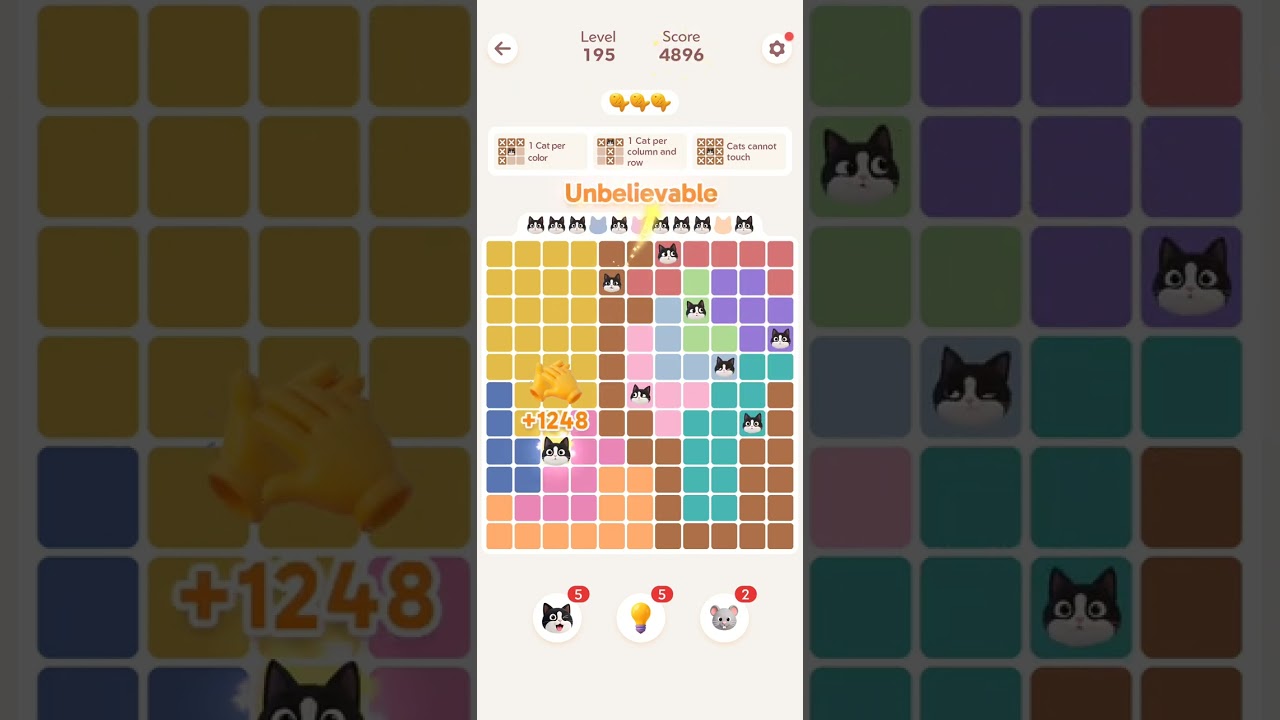
To solve Level 195 in Meowdoku!! with zero mistakes, identify the most constrained border territory on the grid and lock in its single legal cat placement first. Immediately cross out every horizontally, vertically, and diagonally adjacent square alongside the full intersecting row and column. Eliminating these blocked perimeters reduces ambiguity across neighboring shapes, turning complex multi-cell territories into forced single-cell placements.
Core Rules and Spatial Constraints
Level 195 requires satisfying four spatial conditions simultaneously:
- Row Restriction: Each horizontal row must contain exactly one cat.
- Column Restriction: Each vertical column must contain exactly one cat.
- Color Territory: Each uniquely colored, asymmetric shape must contain exactly one cat.
- Eight-Cell Buffer: Cats cannot touch horizontally, vertically, or diagonally, creating a 3x3 blocked zone around every feline token.
Because Level 195 features irregular territories that bend across multiple lines, blind guessing causes cascading failure points that invalidate adjacent shapes. Only commit a move when deterministic deduction leaves a single legal option.
Locating Opening Anchors in Constrained Territories
Begin the puzzle by scanning the outer edges and corners rather than large central territories. Shapes spanning four or five cells contain too many early possibilities to resolve safely.
Focus initial checks on these specific structures:
- Corner Territories: Border shapes naturally touch fewer neighboring cells, restricting their impact on adjacent territories.
- Two-Cell Bottlenecks: Zones limited to two legal tiles reveal quick deductions if either cell shares a line with another heavily restricted zone.
- Axis-Aligned Territories: Shapes whose remaining candidate squares sit entirely inside a single row or column prevent any other cat from occupying that line.
Marking Eliminations and Perimeter Sweeps
Every confirmed cat placement requires an immediate sweep to prevent invalid taps and highlight forced moves.
| Deduction Action | Affected Grid Area | Tactical Benefit in Level 195 |
|---|---|---|
| Confirm Cat Placement | Single Target Cell | Satisfies one row, one column, and one territory simultaneously |
| 8-Cell Perimeter Sweep | 8 Surrounding Cells (Orthogonal & Diagonal) | Blocks adjacent touching fouls and shrinks neighboring territories |
| Axis Crossout | Remaining Cells on Intersecting Row & Column | Prevents duplicate cat errors and exposes single-cell line vacancies |
| Confinement Marking | Line Cells Outside Shared Territory | Eliminates false candidate squares before placing a cat |
Resolving Mid-Game Stalemates With Pointing Lines
When no territory has an obvious single empty cell, apply pointing line deductions. If all legal candidate cells for a colored shape lie entirely within one row or column, that line's single allowed cat must occupy that territory.
Mark an X in every cell along that line belonging to outside territories. Stripping these invalid candidate cells reduces neighboring multi-cell shapes down to forced single placements without risking a mistake.
Step-by-Step Solving Sequence
Follow this structured cycle from start to finish to clear the stage cleanly:
- Scan Boundaries: Check the grid perimeter to locate the colored territory with the fewest valid cells.
- Lock Confirmed Cats: Place a cat only when a row, column, or shape is reduced to one legal tile.
- Clear the Perimeter: Fill the 3x3 perimeter surrounding the cat with Xs.
- Cross Out Intersecting Axes: Mark Xs across the rest of the cat's active row and column.
- Identify Cascading Singles: Inspect adjacent territories shortened by the sweep and place cats in any newly forced single cells.
- Apply Pointing Logic: If a territory's candidates align along one axis, eliminate all external cells on that axis.
- Verify the Board: Confirm every row, column, and color zone contains exactly one isolated cat before finalizing the puzzle.

Free Meowdoku! Codes
Current active codes and how to redeem them.

Emily Johnson
Emily writes practical mobile strategy guides with a focus on resource planning, base progression, and the early decisions that shape a long-term account.
COMMUNITY
Player Comments
39 players commented on this guide.
This saved me time in the early game.
This guide answered the exact question I had.
Can you add more details about strategy in a future update?
I tried this today and it worked better than my old setup.