
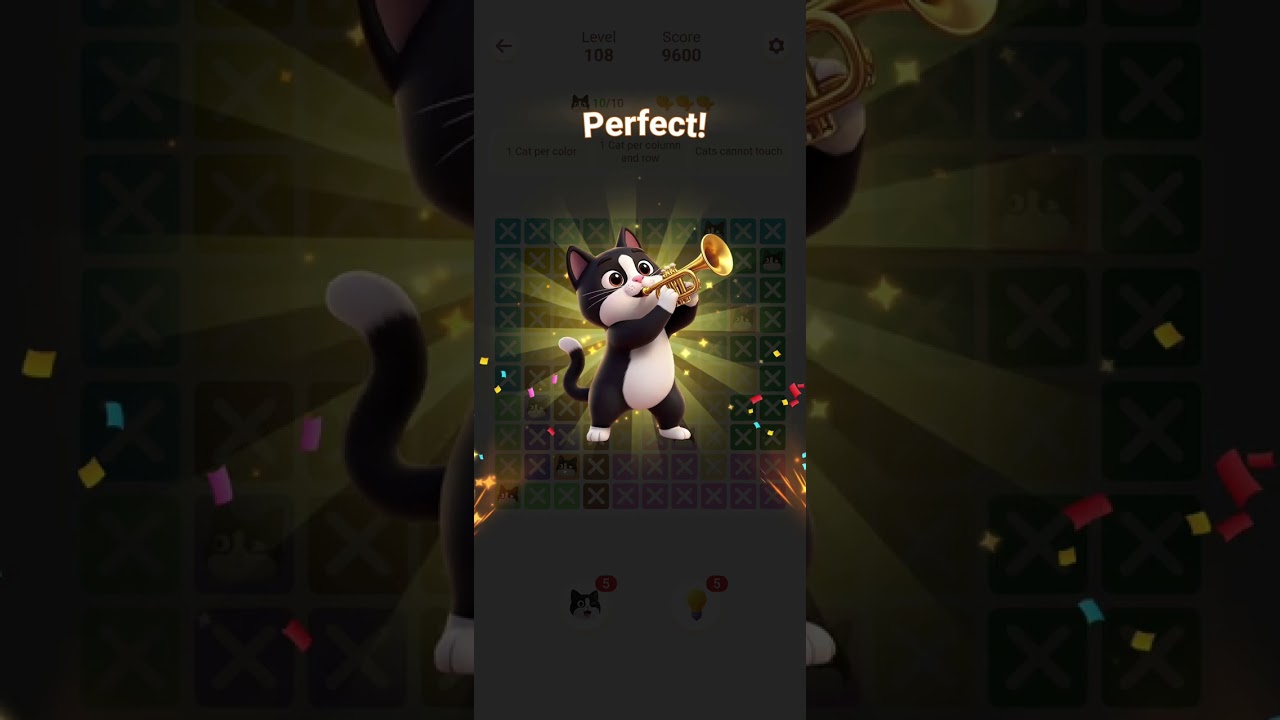
To conquer the mid-game hurdles of Meowdoku!, specifically levels 107, 108, and 109, players must transition from basic matching to advanced grid deduction. These levels mark a significant shift in difficulty, where the game introduces more locked tiles, complex overlapping cat patterns, and tighter constraints that penalize hasty decision-making. Success in these stages is not about speed; it is about systematically eliminating invalid candidates until only the logical solution remains.
Understanding the Core Logic of Meowdoku!
At its heart, Meowdoku! functions like a hybrid of Sudoku and Minesweeper. You are placing cats into a grid while adhering to row and column constraints—ensuring no two identical cats occupy the same row or column—while simultaneously interpreting "territory" hints that reveal how many cats are adjacent to a specific cell.
By the time you reach level 107, the game stops providing obvious clues. You must treat every row as a mathematical set. If a row has five cells and four are filled, the final cell is a "forced move." Mastering the identification of these forced moves is the primary skill required to progress through the 100s.
Analyzing Level 107: Using Anchor Points
Level 107 is the first major test of your ability to use "anchor points." An anchor point occurs when a row or column is populated enough that the remaining empty cells have limited possibilities.
The Anchor Point Strategy
- Identify High-Density Rows: Look for rows where 60–70% of the cells are already filled.
- Cross-Reference Intersections: Select an empty cell in a dense row. Check its vertical column. If that column already contains two or three specific cat types, those types are eliminated as candidates for your empty cell.
- The Process of Elimination: If a cell can only logically hold one specific type of cat based on the intersection of its row and column constraints, place it immediately.
In level 107, never guess. If you are unsure, move to a different section of the grid. Every correct placement creates a ripple effect, revealing new information for the remaining squares.
Managing Grid Density in Level 108
Level 108 introduces a tighter, more claustrophobic grid. The "outside-in" approach is the most effective strategy here. Because the corners of the grid are inherently the most restricted—they have the fewest possible neighbors—they often hold the key to unlocking the center.
Why Outside-In Works
When you start by solving the corners and the perimeter, you effectively "shrink" the board. By defining the outer edges, you increase the number of known variables for the central rows. This limits the number of possible cat configurations in the center, turning an overwhelming puzzle into a series of smaller, isolated logic problems. If you find yourself staring at a blank middle section, check your corners; you likely missed a placement that would have forced a move in the center.
Executing Logic Patterns for Level 109
Level 109 requires you to track multiple, overlapping cat patterns simultaneously. This is the most complex of the three, as it forces you to recognize "pairs." A pair occurs when two empty cells in a row or column can only be filled by two specific cat types.
Mastering Pairs and Trios
- Locked Pairs: If you identify that two specific cats must occupy two specific cells in a row (even if you don't know which is which yet), you have effectively cleared those cells of all other possibilities. This allows you to ignore those cells while focusing your logic elsewhere.
- The "Reset" Decision: In level 109, players often hit a "logic deadlock." If you place a cat and realize the rest of the board becomes impossible to complete, do not try to fix it. Meowdoku! is unforgiving; one error often cascades. It is almost always more efficient to reset the level once you identify the initial mistake rather than wasting time trying to backtrack through a flawed chain of logic.
Strategic Tips for Mid-Game Success
Regardless of the specific level, these three pillars of strategy will keep you from hitting a dead end:
- Prioritize Forced Candidates: Always scan the entire board for cells that have only one possible candidate before making a move that involves a 50/50 probability.
- The Column Intersection Check: Before placing a cat, look at the vertical column. Players often focus on the row they are currently working in while forgetting that they might be violating a column constraint.
- Recognize Recurring Shapes: Meowdoku! uses a finite set of logic patterns. As you play, you will begin to recognize certain "shapes" of cat distributions. If a configuration looks familiar, it is likely that the solution follows a similar logical progression to a previous level.
Avoiding Common Pitfalls
The most frequent mistake in Meowdoku! is "rushing the solve." Players often attempt to fill the grid based on intuition rather than deduction.
- Avoid Guessing: Guessing is a trap. If you guess correctly, you might feel a sense of relief, but you are not learning the logic. If you guess incorrectly, you will likely have to restart the entire level.
- Maintain a Scanning Rhythm: Don't tunnel-vision on one corner of the board. If you hit a wall, move your eyes to the opposite side of the grid. Often, the information you need to solve the "hard" part is hidden in the "easy" part you haven't finished yet.
- Utilize the Undo Function Wisely: Use the undo feature only when you are certain you made a logical error. If you are using it to "test" different placements, you are essentially guessing, which will prevent you from developing the deep pattern-recognition skills needed for levels 110 and beyond.
By consistently applying these methods—using anchors in 107, solving outside-in for 108, and tracking pairs in 109—you will navigate these complex levels with confidence. Remember that every Meowdoku! puzzle is designed with a singular, logical path. If the path appears blocked, simply re-examine your previous moves; the solution is always hidden in the math of the grid.

Free Meowdoku! Codes
Current active codes and how to redeem them.

Michael Smith
Michael covers live-service games, events, reward systems, and efficient daily routines, turning frequent updates into clear actions for players.
COMMUNITY
Player Comments
61 players commented on this guide.
Good guide for Meowdoku! players. The strategy part was useful.
Nice guide. I am checking the other Meowdoku! articles next.
The explanation is clear, especially for beginners.
Can you add more details about strategy in a future update?