
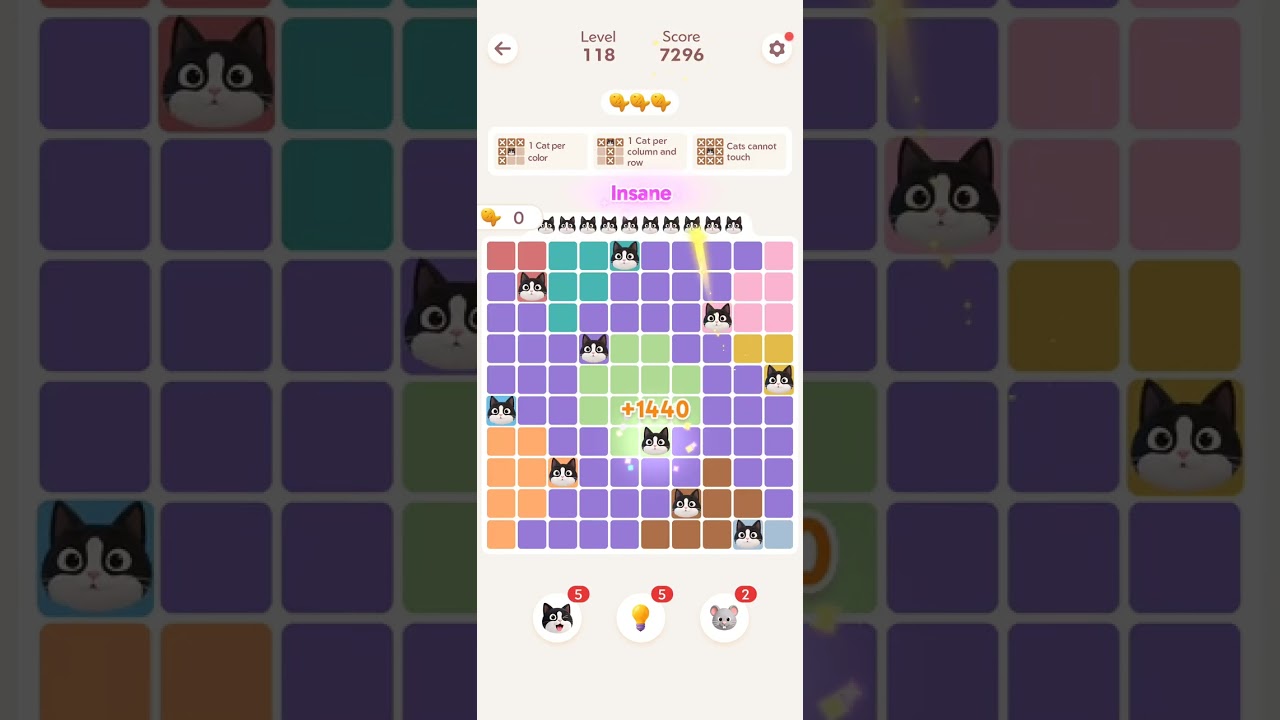
To solve Level 118 in Meowdoku!! with zero mistakes, target the most restricted color regions first and immediately mark all eight surrounding cells with an X whenever you place a cat. Completing the puzzle without errors requires balancing four core constraints simultaneously:
- Exactly one cat in every row.
- Exactly one cat in every column.
- Exactly one cat in every designated color region.
- Zero contact between cats horizontally, vertically, or diagonally.
Because a placed cat blocks all eight neighboring squares, placing defensive X marks is just as important as placing cats. Marking impossible tiles visually narrows the board and exposes forced placements without guesswork.
Step 1: Open on Compact Color Regions
Begin Level 118 by scanning the grid for the smallest, most compact color zones rather than trying to fill empty rows or columns. Sprawling shapes leave too many possibilities open, but regions limited to two or three squares severely constrain valid moves.
- Scan the perimeter and corners: Look for irregular color shapes containing the fewest total squares.
- Identify line-locked regions: If an entire color zone occupies only two squares within a single row or column, that line's cat must sit in one of those two cells. Immediately mark every cell outside that color zone in that row or column with an X.
- Check diagonal contact points: Where two separate color territories meet diagonally at their corners, note how a candidate in one territory would eliminate cells in the other.
Step 2: Apply the Eight-Cell Quarantine
The most common reason for accidental mistakes is overlooking the diagonal adjacency rule. Placing a cat claims nine total squares: the tile the cat sits on, plus the eight perimeter tiles framing it.
Whenever you confirm a cat's position, execute this quarantine sequence before analyzing the rest of the puzzle:
- Block orthogonal neighbors: Place an X in the cells directly above, below, left, and right of the cat.
- Block diagonal corners: Place an X in all four corner cells (top-left, top-right, bottom-left, bottom-right).
- Clear the full line: Project across the entire row and column, crossing out every remaining empty tile.
- Clear the color territory: Scan the cat's color region and place an X on every remaining square inside that shape.
Step 3: Use Line-to-Zone Squeezes
As defensive X marks cover the board, cross-referencing row requirements against unfilled color regions triggers forced placements.
When a row or column is reduced to one or two open squares, check the color regions tied to those squares. If an open tile belongs to a color territory that already has an active cat elsewhere on the board, that tile is invalid. Eliminating it leaves only one valid spot for that line's cat, triggering another eight-cell quarantine that unlocks neighboring columns.
| Deduction Technique | Primary Target | Timing | Tactical Purpose |
|---|---|---|---|
| Region-First Deduction | 2- to 3-cell color zones | Opening phase | Establishes anchor cats and clears border tiles |
| Perimeter Quarantine | 8 surrounding neighbor tiles | After every placement | Prevents diagonal and orthogonal collisions |
| Line-to-Zone Squeeze | Lines with 1–2 open cells | Mid-game | Triggers cascading deductions across lines |
| Endgame Validation | Final unassigned colors | Final moves | Prevents diagonal traps before the last inputs |
Step 4: Validate Before Final Placements
Rushing the final three or four placements frequently causes failure when a player places a cat diagonally adjacent to an existing one. Before committing your final cats, run through a systematic check:
- Confirm which color regions still lack a cat.
- Verify that each remaining empty candidate square aligns with an incomplete row and column.
- Check the diagonal corners of each candidate square to confirm no active cat borders it.
- Place the final cats into the confirmed squares and fill the remaining empty spaces with X marks to finish the stage.

Free Meowdoku! Codes
Current active codes and how to redeem them.

Michael Smith
Michael covers live-service games, events, reward systems, and efficient daily routines, turning frequent updates into clear actions for players.
COMMUNITY
Player Comments
68 players commented on this guide.
This helped me understand strategy much better.
The explanation is clear, especially for beginners.
Good guide for Meowdoku! players. The strategy part was useful.
I wish I had read this before upgrading the wrong thing.