
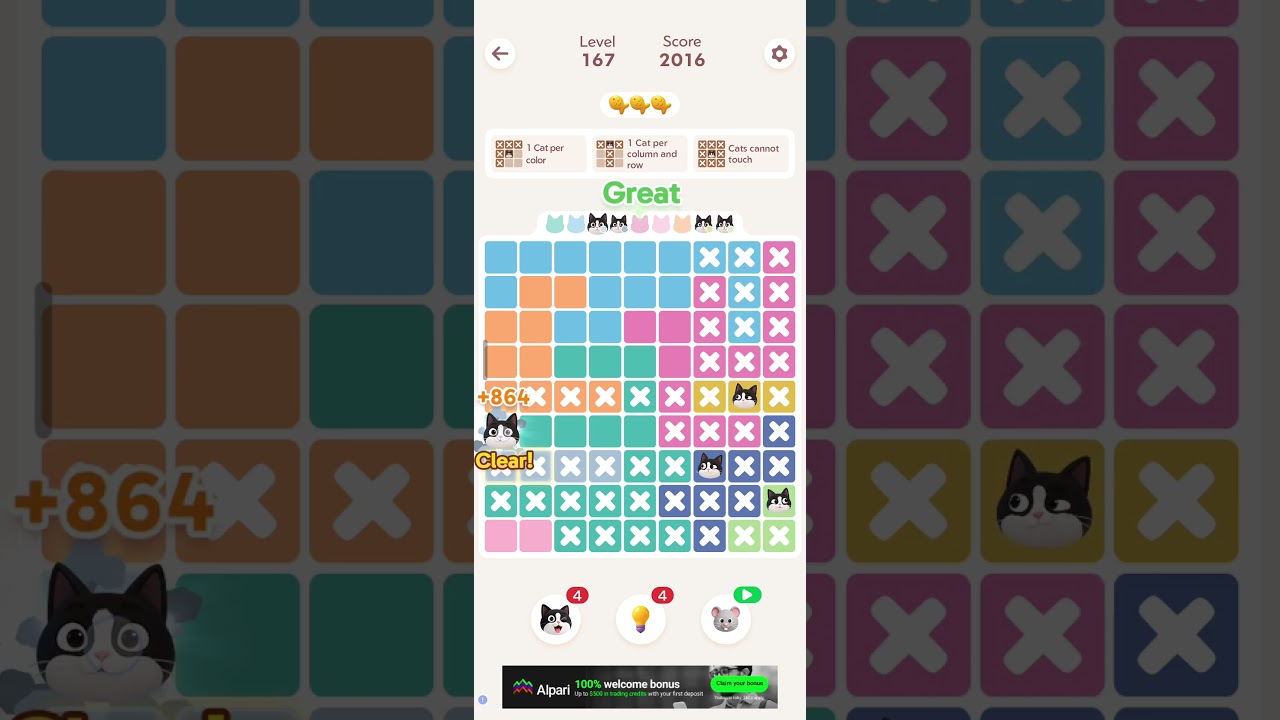
To clear Level 167 in Meowdoku!! without losing lives, locate color regions confined to a single line, mark all external cells in that line with an X, and let the resulting adjacency exclusions force your cat placements. Every row, column, and color shape must contain exactly one cat, and no two cats can touch—even diagonally. Guessing on this board quickly leads to rule violations, making logical elimination your primary path to victory.
Core Rules and Constraints in Level 167
Level 167 tests your ability to cross-reference line rules, territory shapes, and proximity boundaries at the same time. Placing a cat immediately eliminates valid positions across multiple systems:
| Constraint Type | Grid Rule | Deduction Applied |
|---|---|---|
| Row & Column Limits | Exactly one cat per line | Places X marks across the rest of the row and column. |
| Color Zone Limits | Exactly one cat per colored shape | Forces a cat placement when a region has only one open cell left. |
| Adjacency Buffer | No horizontal, vertical, or diagonal contact | Places X marks in all eight surrounding squares (a 3x3 block). |
| Line Confinement | A region's open cells occupy only one row or column | Clears the rest of that line outside the region with X marks. |
Step 1: Open with Line Confinement
Begin the puzzle by scanning the grid for narrow colored shapes that stretch across only one row or down only one column.
- Spot single-line color regions: Identify any polyomino shape whose available cells fit entirely inside one row or column.
- Eliminate outside line cells: Because that specific region must contain a cat, and that cat must sit in that line, no other cell in that row or column can hold a cat. Mark every cell outside the region in that line with an X.
- Check collapsed neighbors: Look at the adjacent color regions touched by those new X marks. This opening step regularly reduces neighboring multi-cell shapes to just two possible candidates, establishing pointing pairs that rule out squares elsewhere.
Step 2: Use Adjacency Buffers to Force Placements
Whenever you identify a forced cat location, use the eight-directional buffer rule to clear surrounding territory.
- Mark the full 3x3 footprint: Place an X on every adjacent square touching the confirmed cat horizontally, vertically, and diagonally.
- Scan for single-cell survivors: Check each neighboring color region caught in the exclusion zone. When an adjacency buffer removes all but one candidate square from a color shape, that remaining cell is guaranteed to hold a cat.
- Trigger the domino effect: Lock in the newly revealed cat, mark its row, column, and eight neighboring tiles with an X, and repeat the check across surrounding regions.
Step 3: Resolve Multi-Row Shapes
Sprawling polyominoes that span multiple rows and columns can create mid-game bottlenecks. Avoid guessing by running these shapes through a consistent reduction sequence:
- Cross-reference completed lines: If a row or column already contains a confirmed cat, mark every cell where that line intersects the open shape with an X.
- Filter out diagonal shadows: Check remaining cells in the shape against cats already locked in nearby regions. Place an X on any cell that shares a corner with a locked cat.
- Identify the forced cell: Once line and diagonal eliminations trim the shape down to one valid cell, place the cat.
- Clear axes immediately: Place X marks across the remaining open cells in that cat's row and column before assessing the next region.
Step 4: Run Endgame Column Verification
Before tapping your final placements, run a verification check to protect your remaining lives. Tunnel vision in the late game often causes players to fill color regions while overlooking vertical column limits.
Scan the grid vertically from the leftmost column to the rightmost column. Ensure each column contains either a locked cat or exactly one legal square that does not violate the diagonal buffer of an existing cat. Once every column and color shape aligns with zero overlap, place your final cats to complete Level 167.
Free Meowdoku! Codes
Current active codes and how to redeem them.

Michael Smith
Michael covers live-service games, events, reward systems, and efficient daily routines, turning frequent updates into clear actions for players.
COMMUNITY
Player Comments
76 players commented on this guide.
I tried this today and it worked better than my old setup.
The tips are practical and easy to follow.
I wish I had read this before upgrading the wrong thing.
This guide answered the exact question I had.