
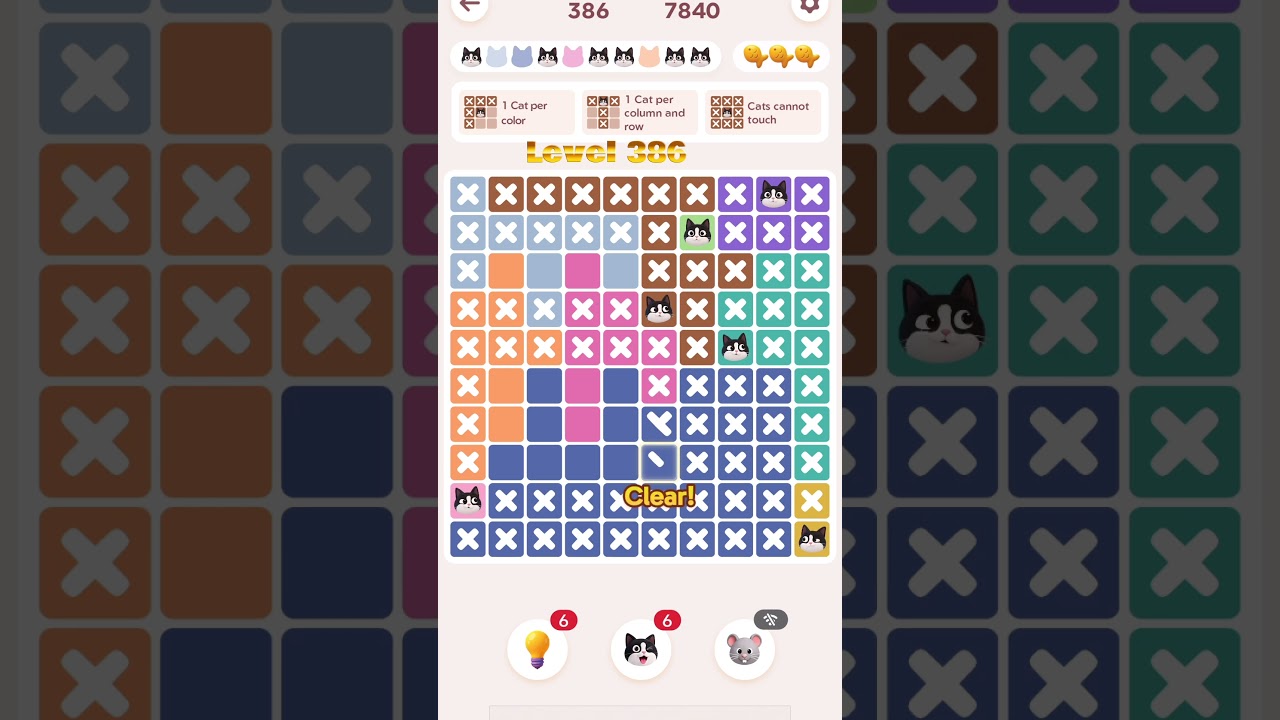
To solve Level 386 in Meowdoku!!, target the narrow color zones along the outer edges before touching the center of the board. Placing cats in restricted corner boundaries eliminates surrounding rows, columns, and diagonal neighbors, forcing single-cell placements across the remaining grid.
Core Rules and Grid Constraints
Level 386 uses an irregular polyomino board governed by three absolute conditions:
- One per line: Every horizontal row and vertical column must contain exactly one cat.
- One per territory: Every custom-colored zone must contain exactly one cat.
- Spatial buffer: Cats cannot touch horizontally, vertically, or diagonally. Placing a cat places an automatic exclusion barrier across all eight surrounding squares.
The puzzle’s central difficulty comes from interlocking, winding color regions spanning multiple lines. Do not analyze rows, columns, and color shapes in isolation. When an entire colored shape is confined to a single line, that line's single cat must appear inside that shape.
Priority Deduction Sequence
Follow this four-step deduction order to build reliable anchors across the board without guessing:
| Phase | Board Target | Direct Action | Deduction Principle |
|---|---|---|---|
| 1 | Corner regions | Check two-cell or L-shaped perimeter zones | Low candidate counts limit outer-edge freedom |
| 2 | Line-zone overlaps | Cross out outer squares in rows tied to one zone | Strips candidate cells across shared lines |
| 3 | Neighbor buffers | Mark an X in all eight squares around placed cats | Clears diagonal and adjacent row candidates |
| 4 | Single survivors | Place cats in any line or zone with one open square left | Converts negative space into positive placements |
Eliminating Candidates Through Region Confinement
Level 386 requires using negative space to clear open tiles before locking in cat positions:
- Horizontal confinement: If a colored zone only occupies spaces within a single row, the cat for that zone must be in that row. Mark an X in every other open square across that entire row, regardless of which specific tile holds the cat.
- Vertical confinement: If a colored territory's remaining legal positions fall exclusively within one vertical column, that column's cat is fulfilled by that territory. Mark an X on every cell in that column that belongs to a different colored shape.
- Cluster clearing: Apply this confinement rule to the mid-left and lower-right clusters. Removing invalid candidate squares in these areas clears false branching paths that prompt risky guesses.
Common Mid-Game Errors to Avoid
Mistakes in Level 386 typically cascade silently until the final two lines, where players run into dead-end rows with zero valid positions. Prevent structural errors by maintaining strict board discipline:
- Mark diagonal buffers immediately: Whenever you place a cat, cross out all four diagonal adjacent squares right away. Leaving a diagonal square open leaves an invalid candidate on the board, corrupting later line counts.
- Scan straight lines after every batch: Whenever you eliminate several squares with X marks, check every intersecting row and column. Any straight line reduced to one open square is an immediate forced cat placement.
- Leave 50/50 splits open: If a color region or line presents two equally viable empty spots, do not guess. Pivot to an intersecting column or corner shape instead. Secondary eliminations will naturally clear one of the two options.
Endgame Resolution Sequence
Once the perimeter zones and confined clusters are locked down, the center of Level 386 resolves quickly through direct elimination:
- Compare unfilled lines: Cross-reference remaining open rows against open columns.
- Trigger chain reactions: Place a cat in any column containing only one legal square. This placement immediately eliminates touching cells in adjacent rows.
- Verify final conditions: Confirm that every row contains one cat, every column contains one cat, every color zone contains one cat, and no two cats share a border or corner. Once every condition is met, the stage clears.
Free Meowdoku! Codes
Current active codes and how to redeem them.

Michael Smith
Michael covers live-service games, events, reward systems, and efficient daily routines, turning frequent updates into clear actions for players.
COMMUNITY
Player Comments
105 players commented on this guide.
This saved me time in the early game.
I tried this today and it worked better than my old setup.
The tips are practical and easy to follow.
The explanation is clear, especially for beginners.