
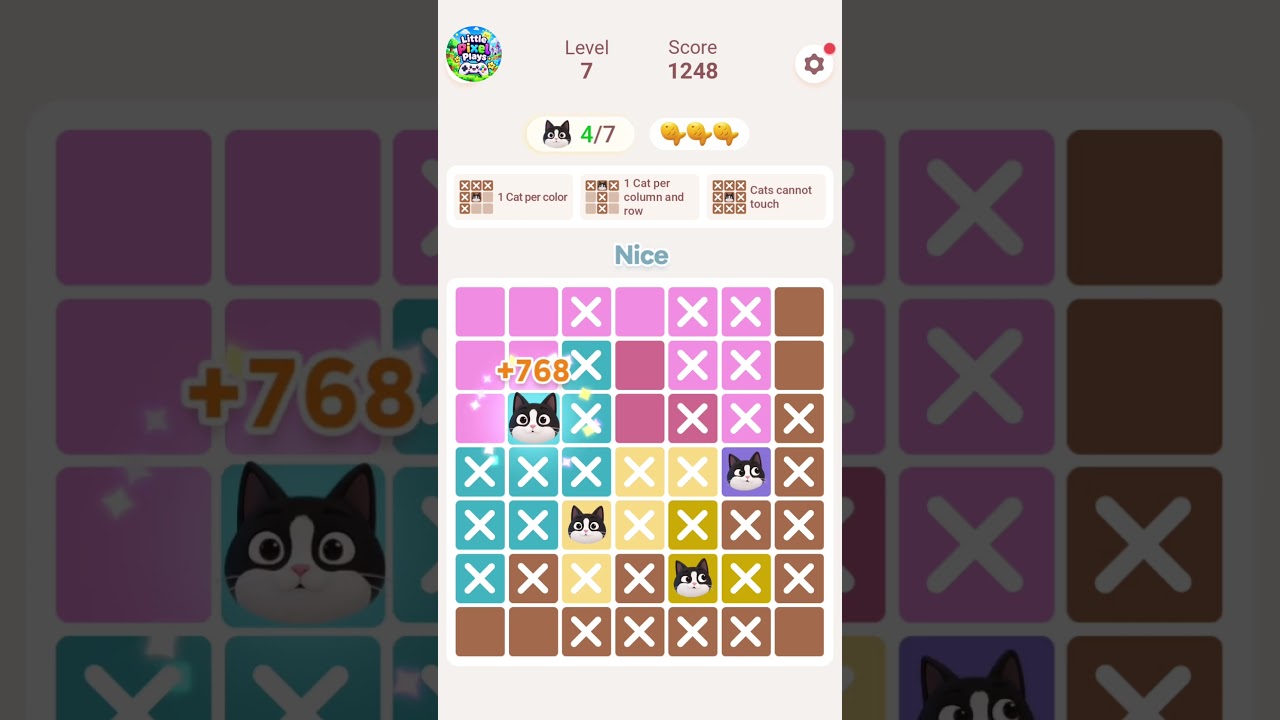
To solve Level 7 in Meowdoku!!, place exactly one cat in each row, column, and colored territory while ensuring no two cats touch horizontally, vertically, or diagonally. Begin by locating the most constrained territory along the grid perimeter, mark defensive crosses across its shared adjacent tiles, and use row-and-column elimination to lock in forced cat placements without guessing.
How the No-Touch Proximity Rule Shapes the Board
Every level of Meowdoku!! combines row and column constraints with territory-based spatial deductions. A placed cat projects an immediate exclusion zone across its entire row, its entire column, and all adjacent cells.
Diagonal proximity is an absolute restriction. An otherwise valid placement in an open row and column fails immediately if it touches a cat in a diagonally adjacent square.
| Cat Placement Location | Row and Column Impact | Adjacent Perimeter Impact | Board Disruption |
|---|---|---|---|
| Corner Cell | Full row and column lines | 3 adjacent squares (orthogonal and diagonal) | Lowest; leaves outer edges open |
| Edge Cell | Full row and column lines | 5 adjacent squares (orthogonal and diagonal) | Moderate; constrains neighboring borders |
| Interior Cell | Full row and column lines | 8 adjacent squares (orthogonal and diagonal) | Highest; blocks multiple adjacent zones |
Finding Your Opening Anchor in Constrained Territories
Do not start by evaluating large territories in the center of the board. Wide territories span several rows and columns, creating multiple possibilities that encourage premature guessing.
Instead, scan the outer edges of Level 7 for small, narrow territories:
- Two-cell or three-cell pockets: Territories squeezed into corners or edges limit possible cat positions to two or three options from the start.
- Shared perimeter threats: When a two-cell territory aligns vertically or horizontally, any cell outside the territory that touches both candidate squares simultaneously can never hold a cat. Place a cross mark on that shared neighbor immediately.
- Border contradictions: If placing a cat on a specific candidate cell would erase all legal placements in a neighboring territory, cross out that candidate cell right away.
Step-by-Step Elimination Sequence
Once you identify restricted regions, execute this elimination loop to uncover forced moves across Level 7:
- Identify line-locked territories: Locate any colored territory whose remaining legal cells sit entirely within a single row or column.
- Purge the line: Place cross marks on all other cells in that row or column that belong to different territories.
- Scan for single-cell openings: Check which territories lost candidate squares during the purge to identify any region reduced to one open square.
- Place the confirmed cat: Place a cat in any territory, row, or column that has only one legal cell remaining.
- Mark the eight-direction perimeter: Immediately place crosses in all eight orthogonal and diagonal cells surrounding the new cat, as well as along its entire row and column.
- Repeat the cycle: Use the newly cleared lines and boundaries to find the next forced placement.
Common Mistakes to Avoid on Level 7
- Overlooking diagonal contact: Always inspect all four diagonal corners before confirming a cat icon. Touching a cat diagonally invalidates the stage just as quickly as sharing a row.
- Leaving empty cells unmarked: Failing to place defensive crosses creates visual clutter and leads to illegal placements. Cross out impossible tiles as soon as they are deduced.
- Guessing in multi-cell territories: If progress stalls, step back and examine rows or columns that have only two open spaces. Testing how those two squares affect adjacent territory boundaries will reveal the single valid path to completion.

Free Meowdoku! Codes
Current active codes and how to redeem them.

Michael Smith
Michael covers live-service games, events, reward systems, and efficient daily routines, turning frequent updates into clear actions for players.
COMMUNITY
Player Comments
119 players commented on this guide.
This saved me time in the early game.
The tips are practical and easy to follow.
Good guide for Meowdoku! players. The strategy part was useful.
This helped me understand strategy much better.