
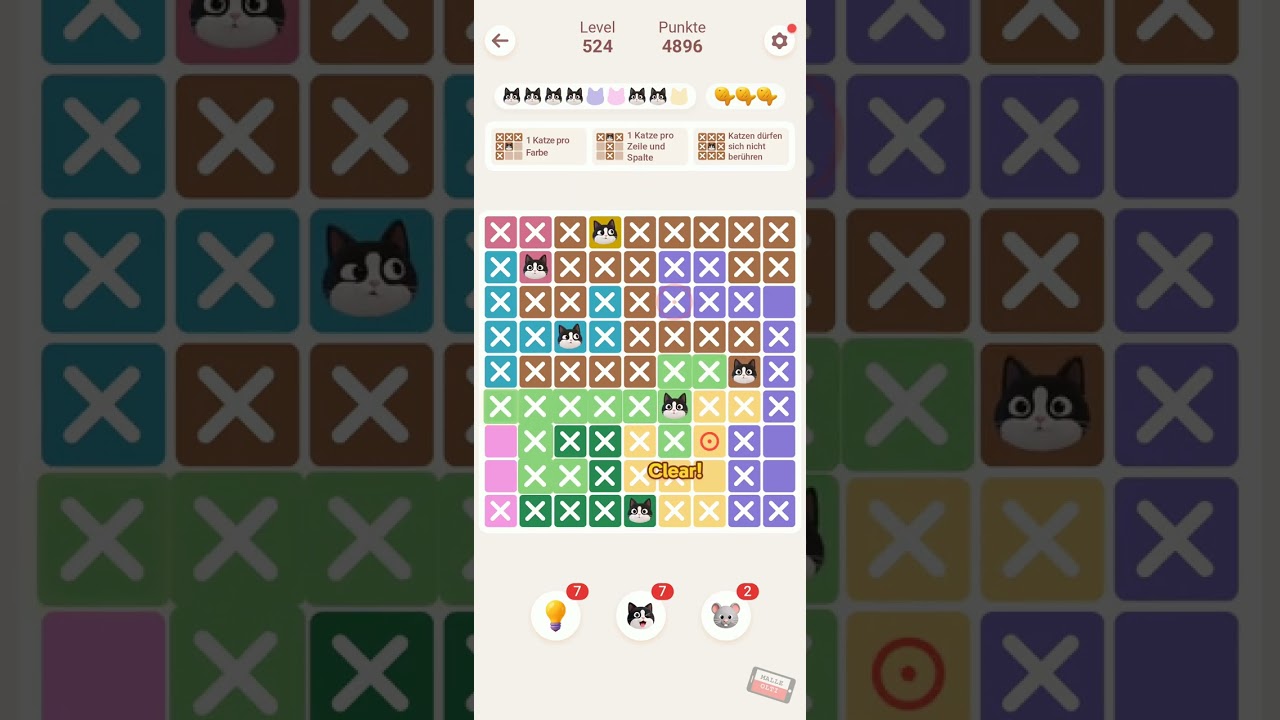
To clear levels 521 through 530 in Meowdoku!, open each puzzle by solving high-density lines containing six or more pre-filled values, cross-referencing intersecting columns to trigger forced moves, and tracking digits that already appear eight times across the board.
Because levels in this range feature crowded starting layouts, making an unverified entry can quickly break your grid. Following a systematic deduction process allows you to clear all ten stages without using hints or risking mistakes.
Prioritizing High-Density Rows and Forced Moves
Dense starting configurations restrict where numbers can go, making high-density lines the fastest starting point for any level in this block.
- Scan for lines with 6+ values: Identify any row or column that has three or fewer empty cells.
- Cross-reference intersecting lines: Look at the perpendicular columns or rows running through those empty spots to see which numbers are already present.
- Confirm forced moves: If an open cell's intersecting lines already contain all missing numbers except one, place the remaining required digit immediately.
- Cascade into open cells: Use the newly placed digits to re-evaluate adjacent lines, creating a chain reaction across the puzzle.
Avoid making speculative entries. Every placement in Meowdoku! must satisfy the core rule that no digit repeats within a single row, column, or 3x3 block.
Resolving Grid Bottlenecks with 3x3 Block Alignment
When simple row and column checks stop yielding immediate placements—such as in levels 525 or 528—use 3x3 sub-grid constraints to break the bottleneck:
- Identify required numbers per sub-grid: Check which numbers are missing inside a specific 3x3 block.
- Block candidate rows and columns: Look at existing numbers in the outer rows and columns intersecting the block. If a required number exists in an outer row, cross off that entire row within the 3x3 grid.
- Isolate single column or row alignments: When a number can only occupy one specific line inside a sub-grid, that number is effectively locked into that line, blocking it from being placed anywhere else along that outer row or column.
- Shift board quadrants: If a section remains locked, temporarily leave it and solve a less dense corner of the board. Clearing easier zones provides the information needed to solve tighter clusters.
Systematic Elimination and Final Verification
Maintain progress across all ten levels by sticking to a repeatable scanning loop:
- Execute a circular pass: Scan the board row by row from top to bottom, then repeat the process column by column from left to right.
- Track near-complete numbers: Count how many instances of each digit are visible on the board. When eight instances of a specific number are placed, search for the final remaining block to guarantee its ninth placement.
- Verify the final cells: Slow down when only three or four cells remain. Re-check both intersecting lines for each entry to prevent input errors from ruining a complete run.

Free Meowdoku! Codes
Current active codes and how to redeem them.

Michael Smith
Michael covers live-service games, events, reward systems, and efficient daily routines, turning frequent updates into clear actions for players.
COMMUNITY
Player Comments
82 players commented on this guide.
The tips are practical and easy to follow.
Nice guide. I am checking the other Meowdoku! articles next.
Good guide for Meowdoku! players. The strategy part was useful.
This guide answered the exact question I had.