
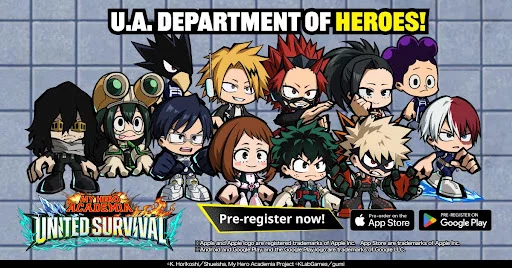
In MHA: UNITED SURVIVAL, succeeding as a free-to-play (F2P) player isn't about pulling every flashy banner unit; it is about strategic resource management and identifying characters whose skill kits punch well above their rarity weight class. Because the game emphasizes roguelite progression and squad-based combat, the best F2P heroes are those who provide consistent crowd control, reliable survivability, and wide-reaching AOE damage. By focusing on these core pillars, you can navigate even the most challenging boss encounters and story stages without hitting the dreaded "pay-to-win" wall.
Understanding the F2P Meta: Utility Over Raw Power
In MHA: UNITED SURVIVAL, a character's "tier" is often determined by their utility on the battlefield rather than their base attack stats. Many high-rarity units look impressive on paper, but if they lack the ability to manipulate enemy positioning or mitigate damage, they will quickly fall behind in mid-to-late game stages.
The most effective F2P characters are those with:
- High-Frequency Stuns/Knockbacks: Essential for interrupting enemy attack patterns.
- Self-Sustain: Heroes that can heal or provide damage reduction allow your team to survive long combat sequences without burning through revival items.
- Wide AOE Hitboxes: Necessary for clearing mob waves efficiently, which is the primary bottleneck for daily farming progression.
When evaluating your roster, ask yourself if a character contributes to the "team engine." If a unit only offers raw damage, they are replaceable. If they offer a unique debuff or an essential crowd-control window, they are a permanent fixture in your progression strategy.
Top-Tier F2P Picks for Mob Control
Mob clearing is where most players lose time and HP. When waves of enemies swarm the arena, single-target specialists often fail because they cannot manage the density of the battlefield. You should prioritize building heroes who can clear the screen or group enemies into a tight cluster.
- Crowd Control (CC) Specialists: Look for heroes whose quirks involve area-based stuns or displacement. These characters allow you to "reset" the battle if things get too chaotic.
- AOE Damage Dealers: These are your primary workhorses. Characters with circular or line-based AOE attacks are highly efficient for clearing story missions in record time.
- Strategic Positioning: Any unit capable of pulling enemies together creates a "kill zone," allowing you to follow up with secondary damage skills for maximum efficiency.
Mastering Boss Survival Strategies
Boss encounters in MHA: UNITED SURVIVAL shift the focus from speed to precision. Here, the game tests your ability to handle complex mechanics rather than just DPS output. To succeed as an F2P player, your squad must be able to withstand heavy hits while identifying vulnerability windows.
The "Dodge and Punish" Cycle
Many F2P-friendly units possess specific animation frames that grant invulnerability or high damage reduction. Learning the timing of these skills is crucial.
- Observe the Telegraph: Every boss has a visual or audio cue before a major attack.
- Save Your Burst: Do not dump all your skills at the start. Save your primary damage quirks for the moment the boss is stunned or vulnerable.
- Prioritize Sustain: If you find yourself consistently failing, swap one DPS for a character with a defensive quirk or a self-heal. A team that stays alive longer will always out-damage a team that dies halfway through the fight.
Optimizing Resource Allocation: The Foundation Squad
Resources like hero stones and upgrade materials are finite. Spreading these thin across your entire roster is a common mistake that leads to stagnation. Instead, focus on building a "Foundation Squad" of three heroes.
- The Anchor (Tank/Support): Your survival lead. This hero stays at the front, draws aggro, or provides the team with defensive buffs.
- The Engine (Utility/CC): This hero is responsible for keeping the battlefield under control, interrupting mobs, and setting up the Anchor and Striker.
- The Striker (Primary DPS): Your main damage source. This unit receives the bulk of your level-up and gear investment to ensure you hit necessary DPS thresholds.
By concentrating your resources on this core trio, you reach power spikes faster, allowing you to farm higher-tier materials that eventually help you build your secondary and tertiary characters.
Common Mistakes to Avoid
Even with a solid roster, certain habits can hamper your MHA: UNITED SURVIVAL progression:
- Ignoring Manual Control: While auto-combat is convenient for grinding, it is inefficient for boss fights. The AI rarely optimizes dodge timing or CC placement. Always pilot your squad manually for difficult content.
- Neglecting Synergy: Don't just pick the three strongest individual characters. Look for heroes whose quirks interact favorably—such as a character who creates a status effect (e.g., burn or freeze) followed by a character who deals bonus damage to enemies suffering from that effect.
- Overvaluing Rarity: An early-game "common" hero with an exceptional stun kit will often outperform a "rare" hero with a mediocre damage-only kit. Always test your units in the training room before committing resources.
The Path Forward: Long-Term Growth
As you progress, the game’s difficulty will inevitably scale. When you find your Foundation Squad hitting a wall, it is time to look at the secondary layer of progression: Gear and Collection Bonuses.
Even if your hero’s level is capped, the gear you equip can provide the necessary stat boost to push through the next chapter. Furthermore, check your collection logs for passive stat bonuses gained by acquiring and leveling up lower-tier characters—these small, incremental gains often make the difference in high-stakes encounters. By balancing your hero investment with consistent gear farming, you will maintain a competitive edge in MHA: UNITED SURVIVAL without ever needing to pull out your wallet.

Free MHA: UNITED SURVIVAL Codes
Current active codes and how to redeem them.

James Brown
James focuses on Android gaming on PC, emulator setup, controls, performance tuning, and practical troubleshooting for longer play sessions.
COMMUNITY
Player Comments
138 players commented on this guide.
The explanation is clear, especially for beginners.
This helped me understand heroes much better.
This guide answered the exact question I had.
I wish I had read this before upgrading the wrong thing.