
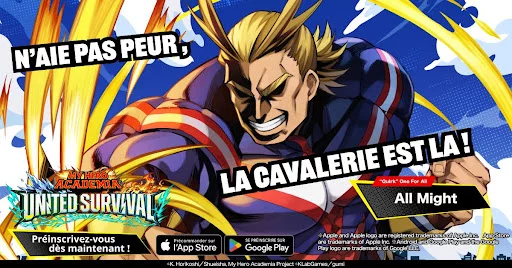
In MHA: UNITED SURVIVAL, victory is rarely determined by raw power alone. The most successful players win by constructing squads that function as a cohesive engine rather than a collection of high-rarity individuals. To dominate the game’s roguelite adventures and combat encounters, you must prioritize structural balance, strategic skill sequencing, and the exploitation of character tag interactions.
The Foundation of a Balanced Squad
New players often fall into the trap of deploying three high-damage "carry" units, only to find their team decimated by boss mechanics or overwhelmed by mob density. A stable team in MHA: UNITED SURVIVAL requires a clear distribution of labor across three essential pillars:
- The Anchor (Frontline/Tank): These units provide the durability needed to sustain long encounters. They serve as the primary target for enemy aggression and are often equipped with crowd-control (CC) abilities that interrupt enemy attacks, granting your fragile DPS units the breathing room they need.
- The Catalyst (Support/Utility): A top-tier support character does not just heal; they manipulate the battlefield. Look for units that provide damage buffs, armor shredding, or movement speed bonuses. A well-timed support ability can increase your overall team damage output by a larger margin than upgrading a single DPS unit’s gear.
- The Executioner (Burst/Sustained DPS): These are your primary damage dealers. You must categorize your damage units into "Burst" (units that deal high damage in short windows) and "Sustained" (units that maintain high DPS over long durations). Mixing these allows you to handle both high-health boss phases and high-volume mob waves.
Mastering Active Skill Rotations
Once your squad is assembled, the order in which you trigger abilities—your "rotation"—is the most significant factor in your damage ceiling. Many players waste potential by triggering cooldowns as they become available. Instead, think of your rotation as a combo string.
The Golden Rule of Rotations:
- Initiation: Use a support or CC character to lock down enemies or apply a "vulnerability" debuff.
- Setup: Deploy secondary DPS or utility skills to cluster enemies or align them for your primary damage dealer.
- Execution: Trigger your high-burst ultimate abilities while the enemy is debuffed or immobilized.
By coordinating these sequences, you ensure that 100% of your heavy-hitting abilities land during the window where the enemy is most vulnerable, preventing the common issue of "wasted DPS" where ultimates miss or hit shielded targets.
Leveraging Hero Synergy and Tag Interactions
MHA: UNITED SURVIVAL features a deep system of tag-based interactions. Before finalizing your team, navigate to the hero menu and inspect the "Synergy" or "Tag" tab for each character.
Some units provide passive stat boosts to specific archetypes (e.g., "Speed-type heroes gain 10% attack speed"). Others have active synergies where one hero’s skill triggers an additional effect if a teammate of a specific element is present.
Avoid the "On-Field" Conflict: A common mistake is stacking heroes who all require significant "field time" to animate their attacks. If your team consists of three heroes who all have long-duration ultimate animations, you will experience a clunky gameplay loop where you are constantly waiting for animations to finish. Aim for a mix of "instant-cast" utility heroes and one "channel-heavy" damage dealer to keep your gameplay fluid.
Energy Economy and Resource Management
Every skill in MHA: UNITED SURVIVAL comes with an energy cost. If your team is built entirely around high-cost ultimate abilities, you will encounter "dead zones"—periods of 5–10 seconds where you have no abilities available and are forced to rely on weak basic attacks.
To solve this, balance your squad's energy economy:
- Low-Cost Generators: Include at least one hero with low-cost, short-cooldown abilities that can be used frequently to keep the pressure on.
- Energy Recovery Buffs: If you are running a high-cost team, ensure at least one support unit has a passive or active skill that regenerates energy for the squad.
Adapting to Content-Specific Challenges
The best team for a wave-clearing survival mode is almost never the best team for a single-target boss raid. You must identify the "Victory Condition" of the stage before you hit the start button.
- For Boss Raids: Prioritize single-target armor penetration and self-sustain. You don't need AoE here; you need heroes who can survive long-form combat and maintain high DPS against a single high-HP target.
- For Wave-Based Survival: Focus on displacement and crowd control. If the enemies can't reach your team because they are constantly being knocked back or stunned, your survivability requirements decrease significantly.
Troubleshooting Your Squad
If you find yourself hitting a "power wall" where your team is simply dying or running out of time, do not immediately assume your gear is the problem. Follow this diagnostic checklist:
- Check for Overlap: Are two heroes doing the exact same job? If you have two healers but no CC, swap one healer for a utility hero.
- Evaluate Uptime: Is your main damage dealer actually hitting the enemy, or are they constantly being interrupted? If they are being interrupted, you need a stronger frontline or more CC.
- Inspect Buff Windows: Are your support buffs active when your DPS uses their ultimate? If not, you need to tighten your rotation timing.
By treating your team as a modular, evolving toolset rather than a static group of favorite characters, you will find that MHA: UNITED SURVIVAL becomes significantly easier to conquer. Experimentation is rewarded—don't be afraid to bench your highest-rarity hero if they don't fit the mechanical requirements of the current challenge. True mastery lies in the synergy between the units you choose and the way you deploy them on the battlefield.

Free MHA: UNITED SURVIVAL Codes
Current active codes and how to redeem them.

Emily Johnson
Emily writes practical mobile strategy guides with a focus on resource planning, base progression, and the early decisions that shape a long-term account.
COMMUNITY
Player Comments
63 players commented on this guide.
The explanation is clear, especially for beginners.
This guide answered the exact question I had.
Nice guide. I am checking the other MHA: UNITED SURVIVAL articles next.
I wish I had read this before upgrading the wrong thing.