
Selecting the right villains for your roster in MHA: UNITED SURVIVAL requires a clear understanding of their unique combat mechanics and specialized roles. While hero units often dominate early-game discussions, the available villain roster provides essential tactical variety for players looking to diversify their squad. By analyzing these characters, you can better prepare for specific encounters where standard hero kits might fall short, ensuring you have the right tools for both offensive and utility-focused strategies.
Evaluating Tomura Shigaraki’s Combat Utility
Tomura Shigaraki functions primarily as a high-threat offensive unit, characterized by his ability to exert significant pressure on the battlefield. His kit is designed for players who prioritize raw damage output and the ability to break through enemy formations. When integrating Shigaraki into your team, focus on his ability to disrupt standard combat flow, which makes him a reliable choice for clearing waves of enemies efficiently before reaching boss encounters.
The trade-off for utilizing Shigaraki is his reliance on specific positioning. Unlike more durable hero units that can sustain prolonged frontline combat, Shigaraki often requires a team structure that protects him while he executes his abilities. Ensure you pair him with units capable of crowd control or damage mitigation to maximize his uptime, as his high-damage output comes at the cost of lower defensive stats compared to tankier alternatives.
Analyzing Himiko Toga’s Tactical Flexibility
Himiko Toga offers a distinct playstyle centered around agility and precise strikes, making her an excellent candidate for players who prefer a hit-and-run approach. Her mechanics allow for rapid engagement and disengagement, which is particularly effective in high-difficulty missions where standing still results in taking unnecessary chip damage. Utilizing Toga effectively requires mastering her timing, as her strengths lie in capitalizing on brief openings in an enemy's defense.
Players should note that Toga’s effectiveness is highly dependent on the player’s ability to manage cooldowns. Because she thrives on bursts of speed and damage, mismanaging her ability usage can leave you vulnerable during downtime. Use her for high-priority targets where her specialized damage traits can quickly neutralize a threat, rather than relying on her for sustained frontline tanking against heavy-hitting bosses.
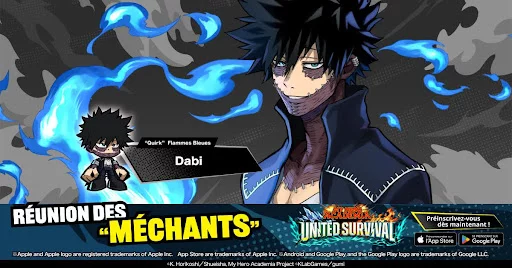
Understanding Dabi’s Area-of-Effect Capabilities
Dabi is a powerhouse when it comes to area-of-effect (AoE) damage, providing essential utility for stages that require clearing multiple enemies simultaneously. His kit allows for consistent damage application across a wide area, which is vital for maintaining control of the map. By positioning Dabi correctly, you can effectively manage enemy spawns and prevent your backline from being overwhelmed during intensive combat sequences.
The limitation of using Dabi involves his heat-based mechanics or specific elemental skill constraints. Players must watch their ability management carefully, as Dabi’s long-range utility is balanced by specific telegraphing that enemies can exploit. If you are struggling with stages that feature swarms of low-health mobs, Dabi’s ability to clear the board makes him a top-tier choice, provided you keep him shielded from direct, close-quarters combat.
Tactical Team Integration Strategies
Integrating villains into your main team requires balancing their distinct strengths against the standard hero meta. The most effective way to utilize these units is to identify the "gap" in your current squad—whether that is a lack of AoE damage, a need for faster engagement, or a requirement for specific status effects. By swapping in a villain who addresses a specific shortfall, you can often clear stages that previously seemed impossible with a standard hero-only lineup.
- Frontline Support: Pair heavy hitters like Shigaraki with defensive heroes to mitigate his lack of sustainability.
- Engagement Pacing: Use Toga as a secondary striker to clean up enemies weakened by your primary AoE characters.
- Stage-Specific Adaptations: Adjust your villain roster based on the enemy types; use Dabi for swarms and Shigaraki for single-target boss pressure.
By focusing on these synergies rather than individual unit power levels, you create a more resilient squad. Always consider the specific mission requirements, as the best villain choice is ultimately the one that complements the team’s overall objective rather than simply having the highest individual stats.

Free MHA: UNITED SURVIVAL Codes
Current active codes and how to redeem them.

Emily Johnson
Emily writes practical mobile strategy guides with a focus on resource planning, base progression, and the early decisions that shape a long-term account.
COMMUNITY
Player Comments
67 players commented on this guide.
I tried this today and it worked better than my old setup.
This guide answered the exact question I had.
This helped me understand heroes much better.
The tips are practical and easy to follow.